
Place
Mount Carmel
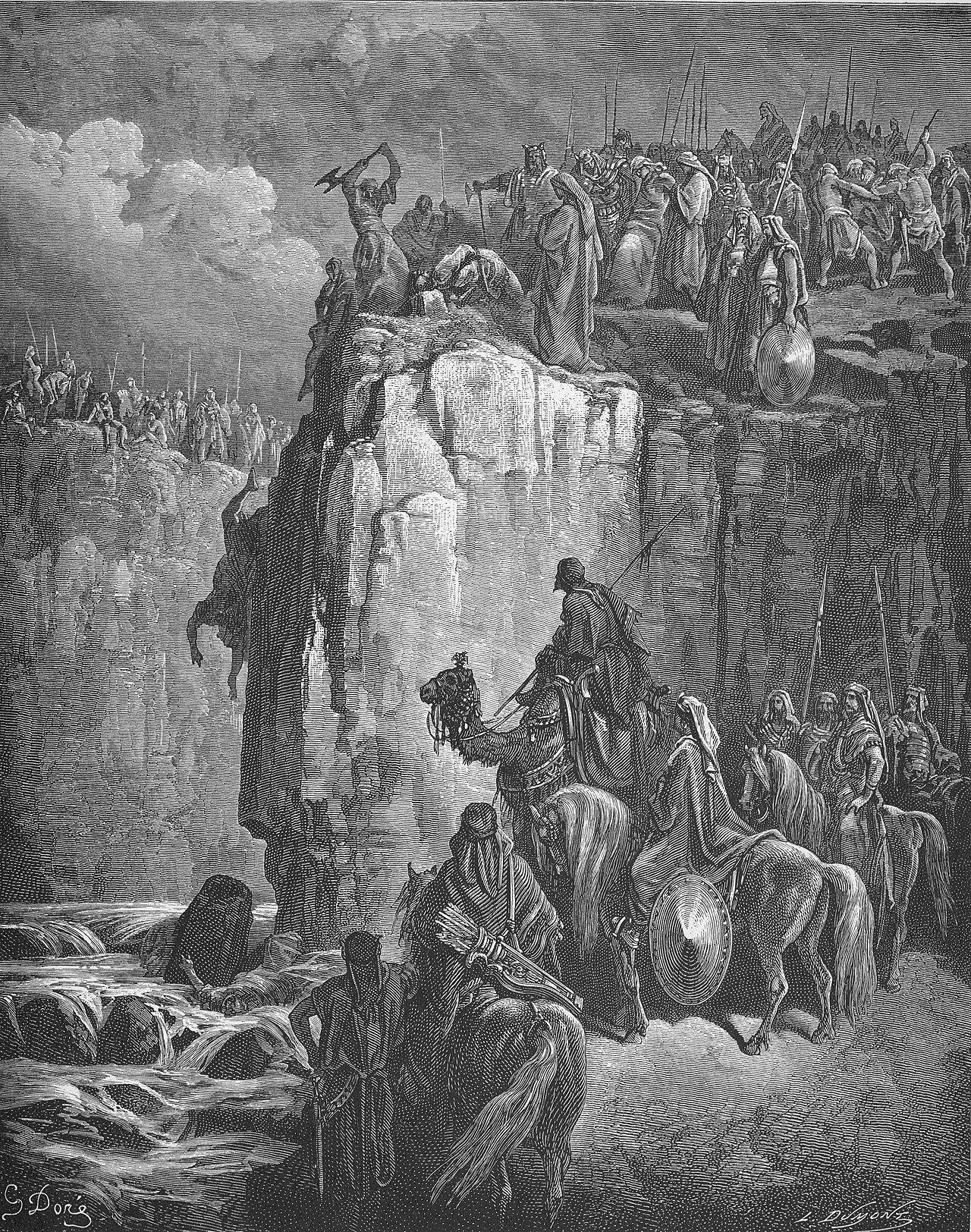
Gustave Doré, La Sainte Bible (Tours: Alfred Mame et fils, 1866). Public domain.
Summary
The long ridge above the sea where Elijah rebuilt the altar of the LORD, called down fire before the prophets of Baal, and prayed until a cloud the size of a man’s hand rose from the sea.
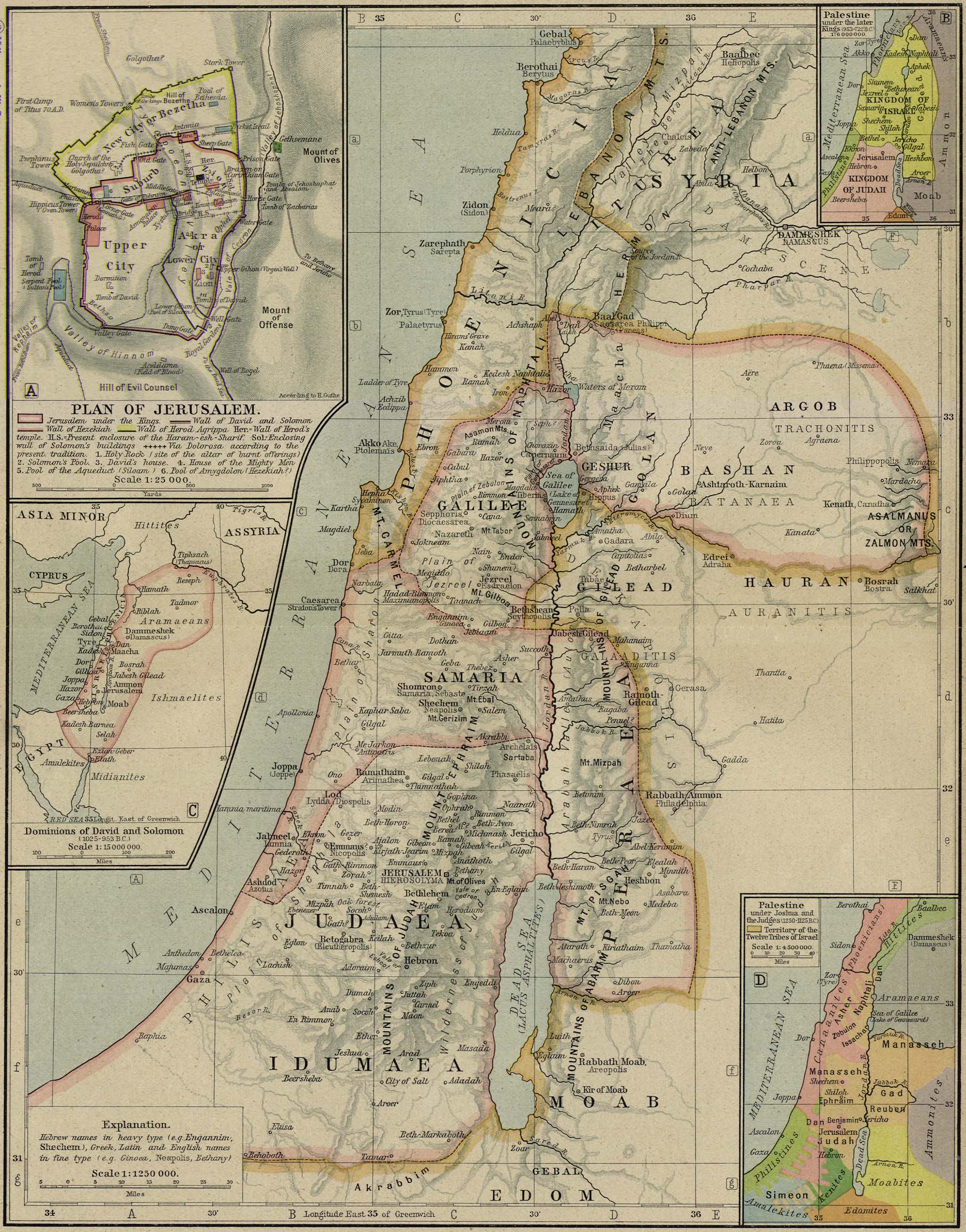
- Mount Carmel is a ridge about twenty four miles long, running from the Mediterranean coast down to the edge of the Jezreel valley. It formed the border between Israel and Phoenicia.
- Elijah faced the four hundred and fifty prophets of Baal here, and the fire of the LORD fell on a sacrifice that had been soaked with water three times.
- The contest was fought on ground both religions claimed. An altar of the LORD already stood on the mountain, and Elijah repaired it before he used it.
- The fire is not the end of the chapter. Elijah climbed higher, put his face between his knees, and sent his servant to look at the sea seven times before the rain came.
- Elisha was found on Carmel twice, and the woman from Shunem rode about seventeen miles to reach him there when her son died.
On this page
In Scripture
- Verses
- 5
- Books
- 3
Near Mount Carmel
- Nazareth24 km · 15 mi E
- Cana of Galilee27 km · 17 mi E
- Caesarea30 km · 18 mi SW
- Nain30 km · 19 mi E
- Shunem30 km · 19 mi SE
- Mount Tabor32 km · 20 mi E
Straight-line distances, computed from the gazetteer coordinates.
Where it is
the country around it
- Coordinates
- 32.7294° N, 35.0498° Efind it on the Atlas →
- Region
- Northern Israel
- Kind of place
- Mountain
3 places the record names with Mount Carmel, the farthest 52 km away
- 1Elijah runs ahead of Ahab to Jezreel1 Kings 18:46 · 33 kmAnd the hand of the LORD came upon Elijah, and he tucked his cloak into his belt and ran ahead of Ahab all the way to Jezreel.
- 2Elisha goes on to Mount Carmel2 Kings 2:25 · 52 kmAnd Elisha went on to Mount Carmel, and from there he returned to Samaria.
- 3The woman from Shunem rides to the man of God at Carmel2 Kings 4:25 · 30 kmSo she set out and went to the man of God at Mount Carmel. When the man of God saw her at a distance, he said to his servant Gehazi, “Look, there is the Shunammite woman.
- Located: the gazetteer fixes one site
- A dashed line ends at a place the gazetteer does not fix
Why Mount Carmel matters
What has been found
the evidence, and where it is disputed
Elijah and the prophets of Baal
1 Kings 18:17 to 18:46, in the order the chapter tells it
Read 1 Kings 18:17 to 18:46, in the order the chapter tells it
- Ahab calls him the troubler of Israel1 Kings 18:17When Ahab saw Elijah, he said to him, “Is that you, O troubler of Israel?”
- The question put to the nation1 Kings 18:21Then Elijah approached all the people and said, “How long will you waver between two opinions? If the LORD is God, follow Him. But if Baal is God, follow him.” But the people did not answer a word.
- The terms of the test1 Kings 18:24Then you may call on the name of your god, and I will call on the name of the LORD. The God who answers by fire, He is God.” And all the people answered, “What you say is good.”
- Morning until noon, and no answer1 Kings 18:26And they took the bull that was given them, prepared it, and called on the name of Baal from morning until noon, shouting, “O Baal, answer us!” But there was no sound, and no one answered as they leaped around the altar they had made.
- The altar that was already there1 Kings 18:30Then Elijah said to all the people, “Come near to me.” So all the people approached him, and he repaired the altar of the LORD that had been torn down.
- A prayer of two sentences1 Kings 18:36At the time of the evening sacrifice, Elijah the prophet approached the altar and said, “O LORD, God of Abraham, Isaac, and Israel, let it be known this day that You are God in Israel and that I am Your servant and have done all these things at Your command.
- The fire falls1 Kings 18:38Then the fire of the LORD fell and consumed the sacrifice, the wood, the stones, and the dust, and it licked up the water in the trench.
- The people on their faces1 Kings 18:39When all the people saw this, they fell facedown and said, “The LORD, He is God! The LORD, He is God!”
- The prophets of Baal at the Kishon1 Kings 18:40Then Elijah ordered them, “Seize the prophets of Baal! Do not let a single one escape.” So they seized them, and Elijah brought them down to the Kishon Valley and slaughtered them there.
- A cloud the size of a hand1 Kings 18:44On the seventh time the servant reported, “There is a cloud as small as a man’s hand rising from the sea.” And Elijah replied, “Go and tell Ahab, ‘Prepare your chariot and go down before the rain stops you.’”
Ahab summons the four hundred and fifty prophets of Baal and the four hundred prophets of Asherah in 18:19, but only the prophets of Baal take the challenge and only they are seized in 18:40. The chapter runs six verses past the fire. Elijah climbs to the summit, puts his face between his knees, and sends his servant to look toward the sea seven times before the cloud appears. The rain comes, and the hand of the LORD comes on Elijah so that he runs ahead of Ahab's chariot all the way to Jezreel.
Elijah on Carmel: the full studyWhat happened here, in order
in the order the canon tells it
- Jokneam in Carmel among the defeated kingsJoshua 12:22the king of Kedesh, one; the king of Jokneam in Carmel, one;
- Carmel on the western border of AsherJoshua 19:26Allammelech, Amad, and Mishal. On the west the border touched Carmel and Shihor-libnath,
- Ahab is told to summon Israel to Mount Carmel1 Kings 18:19Now summon all Israel to meet me on Mount Carmel, along with the four hundred and fifty prophets of Baal and the four hundred prophets of Asherah who eat at Jezebel’s table.”
- Elijah asks how long the nation will waver1 Kings 18:21Then Elijah approached all the people and said, “How long will you waver between two opinions? If the LORD is God, follow Him. But if Baal is God, follow him.” But the people did not answer a word.
- The altar of the LORD is repaired1 Kings 18:30Then Elijah said to all the people, “Come near to me.” So all the people approached him, and he repaired the altar of the LORD that had been torn down.
- The fire of the LORD falls1 Kings 18:38Then the fire of the LORD fell and consumed the sacrifice, the wood, the stones, and the dust, and it licked up the water in the trench.
- The people answer that the LORD is God1 Kings 18:39When all the people saw this, they fell facedown and said, “The LORD, He is God! The LORD, He is God!”
- The prophets of Baal are killed at the Kishon1 Kings 18:40Then Elijah ordered them, “Seize the prophets of Baal! Do not let a single one escape.” So they seized them, and Elijah brought them down to the Kishon Valley and slaughtered them there.
- A cloud rises from the sea1 Kings 18:44On the seventh time the servant reported, “There is a cloud as small as a man’s hand rising from the sea.” And Elijah replied, “Go and tell Ahab, ‘Prepare your chariot and go down before the rain stops you.’”
- Elijah runs ahead of Ahab to Jezreel1 Kings 18:46And the hand of the LORD came upon Elijah, and he tucked his cloak into his belt and ran ahead of Ahab all the way to Jezreel.
- Jezebel's threat sends Elijah running for his life1 Kings 19:3And Elijah was afraid and ran for his life. When he came to Beersheba in Judah, he left his servant there,
- Elisha goes on to Mount Carmel2 Kings 2:25And Elisha went on to Mount Carmel, and from there he returned to Samaria.
- The woman from Shunem rides to the man of God at Carmel2 Kings 4:25So she set out and went to the man of God at Mount Carmel. When the man of God saw her at a distance, he said to his servant Gehazi, “Look, there is the Shunammite woman.
- Carmel as a figure of beautySong of Solomon 7:5Your head crowns you like Mount Carmel, the hair of your head like purple threads; the king is captured in your tresses.
- The splendor of Carmel given to the desertIsaiah 35:2It will bloom profusely and rejoice with joy and singing. The glory of Lebanon will be given to it, the splendor of Carmel and Sharon. They will see the glory of the LORD, the splendor of our God.
- The summit of Carmel is no hiding placeAmos 9:3Though they hide themselves atop Carmel, there I will track them and seize them; and though they hide from Me at the bottom of the sea, there I will command the serpent to bite them.
- Elijah was a man just like usJames 5:17Elijah was a man just like us. He prayed earnestly that it would not rain, and it did not rain on the land for three and a half years.
- He prayed again, and the heavens gave rainJames 5:18Again he prayed, and the heavens gave rain, and the earth yielded its crops.
Where it points
The voices
each quoted from the work named
IT WAS A DAY to be remembered, when the multitudes of Israel were assembled at the foot of Carmel and when the solitary prophet of the Lord came forth to defy the four hundred and fifty priests of the false god. We might look upon that scene with the eye of historical curiosity, and we should find it rich with interest. Instead of doing so, however, we shall look upon it with the eye of attentive consideration, and see whether we can not improve by its teachings.
FROM the narrative we may learn that things can never be so bad but what God can bring deliverance in His own time. The country had been parched in Palestine for three years. Travelers in the East will tell you how brown and burned that country looks at all times, but how it must have appeared when the clouds cleaved together and all the pastures were turned to dust, I can scarcely conceive. It must have been a terrible and piteous sight when the cattle had perished and the people were ready to die through famine and hunger.
Though ten of the tribes had revolted to Baal, he would look upon them as belonging to God still, by virtue of the ancient covenant with their fathers: and, though those ten were unhappily divided from the other two in civil interest, yet in the worship of the God of Israel they had communion with each other, and they twelve were one.
4 more teachers on these versesAdam Clarke · John Wesley · Jamieson, Fausset & Brown · Albert Barnes
He repaired the altar of the Lord - There had been an altar of Jehovah in that place, called, even among the heathens, the altar of Carmel, probably built in the time of the judges, or, as the rabbins imagine, by Saul. Tacitus and Suetonius mention an altar on Mount Carmel, which Vespasian went to consult; there was no temple nor statue, but simply an altar that was respectable for its antiquity. “Est Judaeam inter Syriamque Carmelus; ita vocant montem Deumque: nec simulachrum Deo, aut templum situm tradidere majores: aram tantum, et reverentiam.” - Tacit. Hist. lib. ii., c.
Elijah does not say, The God that answers by water, tho' that was the thing the country needed, but that answers by fire, let him be God; because the atonement was to be made, before the judgment could be removed. The God therefore that has power to pardon sin, and to signify that by consuming the sin-offering, must needs be the God that can relieve us against the calamity.
Behold, there ariseth a little cloud out of the sea, like a man's hand--The clearness of the sky renders the smallest speck distinctly visible; and this is in Palestine the uniform precursor of rain. It rises higher and higher, and becomes larger and larger with astonishing celerity, till the whole heaven is black, and the cloud bursts in a deluge of rain.
Carmel - Where Elisha held gatherings for religious purposes 2Ki 4:23-25 during one period of his life, if he did not actually reside there.
Mount Carmel in Scripture
5 verses name it, in 3 books
Open a book to read its mentions here. Text: Berean Standard Bible.
Old TestamentNew Testamentsegment width = share of mentions
Old Testament3 books · 5 mentions
1 Kings2 mentions
2 Kings2 mentions
The account
Read the account as one telling
Mount Carmel is a limestone ridge, not a peak. It runs northwest to southeast for about thirty nine kilometres, near twenty four miles, from the promontory above the bay at Haifa down to the hills at the head of the Jezreel and Dothan valleys. Its highest point is about 546 metres, near 1,790 feet. The northwestern end drops into the Mediterranean, which makes it a headland as well as a mountain. The Kishon runs along its northeastern foot and out to the sea. The name means garden land in the standard lexicons, and the ridge earns it. It is wooded, well watered by the standards of the region, and full of caves.
Carmel enters Scripture as a boundary. Joshua 12:22 lists the king of Jokneam in Carmel among the defeated kings, and Joshua 19:26 sets Carmel on the western edge of the inheritance of Asher. That places the ridge at the northwestern corner of the land and on the seam between Israel and Phoenicia. A town of the same name stands far to the south in the hill country of Judah, near Maon, and most of the Carmel verses in 1 and 2 Samuel belong to that town rather than to the mountain.
By the time of Ahab the seam mattered. Ahab married Jezebel, a daughter of Sidon on the Phoenician side of the ridge, and the worship of Baal was carried into Israel with royal backing. Jezebel killed the prophets of the LORD, and Obadiah, the man in charge of Ahab's palace, hid a hundred of them in the caves of the country and fed them. Elijah announced a drought, and by 1 Kings 18 the land was in its third year without rain.
The contest happened on this ridge. Ahab summoned all Israel and the prophets of Baal to Carmel, and Elijah put one question to the people: how long will you waver between two opinions? Nobody answered. He set the terms, gave the other side the first turn and the whole morning, and then the whole afternoon. He repaired an altar of the LORD that was already on the mountain and had been torn down, built it with twelve stones for the twelve tribes, soaked the offering and the wood with water three times, and prayed two sentences. The fire fell and took the sacrifice, the wood, the stones and the dust, and licked up the water in the trench. The people fell on their faces. The prophets of Baal were brought down to the Kishon and killed there.
The chapter does not stop at the fire. Elijah told Ahab to eat and drink because there was the sound of a heavy rain, then climbed to the summit, bent to the ground and put his face between his knees. He sent his servant to look toward the sea seven times. On the seventh the servant saw a cloud the size of a man's hand. The sky went black, the rain came, and the hand of the LORD came on Elijah so that he ran ahead of Ahab's chariot to Jezreel. Within a day Jezebel sent word that she would kill him, and the prophet who had faced four hundred and fifty men alone ran for his life and walked forty days to Horeb.
Elisha came to Carmel after Elijah was taken up. Second Kings 2:25 has him going on to Mount Carmel and returning from there to Samaria, and 2 Kings 4:25 has the woman from Shunem riding to find him on the mountain when her son died. Albert Barnes reads the two verses together and concludes that Elisha held gatherings on Carmel and may have lived there for a season. Gill, following Heinrich Bunting, gives the distance from Shunem as sixteen miles and Barnes gives sixteen or seventeen.
After the kings, Carmel became a figure of speech. The poets used it for beauty and abundance, as in Song of Solomon 7:5 and Isaiah 35:2, and the prophets used a withered Carmel to say that judgment had reached everything, as in Amos 1:2 and Nahum 1:4. Amos 9:3 uses the ridge for the opposite reason. Its caves and the sea at its foot were the two best hiding places in the north, and neither one works when God is the one searching.
- AD 100
Roman writers knew the mountain as holy ground. Tacitus, writing near AD 100 about the year 69, says that between Judea and Syria stands Carmel, that this is the name of both the mountain and the god, that the ancestors handed down no image and no temple, and that there was an altar and reverence. He reports that Vespasian sacrificed there and that the priest Basilides read the offerings for him. Suetonius reports the same consultation. Iamblichus, writing around AD 300, says Pythagoras withdrew to Carmel, which he calls the most holy of all mountains. Josephus retells the contest in Antiquities 8.13.5.
Common questions
Is the Carmel of Nabal and Abigail the same place as Mount Carmel?
No. Nabal's Carmel was a town in the hill country of Judah, near Maon and south of Hebron (Joshua 15:55; 1 Samuel 25:2). Mount Carmel is the ridge on the Mediterranean coast, at the other end of the country.
Saul's monument in 1 Samuel 15:12 belongs to the southern Carmel on the standard reading, which Jamieson, Fausset and Brown and Albert Barnes both give. Two places carry one name, and the name means garden land.
Why did Elijah pick fire as the test?
Baal was the storm god, the one who was supposed to send lightning and rain, and the land was three years into a drought his prophets had not broken. Asking him for fire asked him to work in his own element, which Adam Clarke notes gave the other side every advantage.
John Wesley adds a second reason from the sacrifices themselves. Fire consuming an offering is the sign that sin has been dealt with, and the drought could not lift until it was.
Where exactly on the mountain did this happen?
Readers differ; the positions are named
The text does not name a spot. Tradition places it at el-Muhraqa, the burning place, at the southeastern end of the ridge, and the site fits the story on three counts. It overlooks the Kishon valley where 18:40 puts the killing, there is water nearby, and the sea is hidden from the site itself but visible from a rise a few minutes above it, which is the movement of 18:43.
Arthur Penrhyn Stanley recorded that observation in the nineteenth century and Jamieson, Fausset and Brown pass it on. No altar has been excavated there and the written tradition is medieval, so the fit is an argument and not a proof.
Was the fire lightning?
The text says the fire of the LORD fell and consumed the sacrifice, the wood, the stones, and the dust, and licked up the water in the trench (18:38). Albert Barnes says plainly that this cannot have been a flash of lightning, on the ground that the stones and the dust went with it.
Adam Clarke adds a second point. The fire came down rather than bursting out from under the altar, which is what ruled out the trick that pagan altars were known for. This site teaches it as what the text calls it, the fire of the LORD.
Was Elijah really the only prophet left?
He says so in 18:22, and the same chapter has already told the reader that Obadiah hid a hundred prophets in caves, fifty to a cave, and fed them through the famine (18:4 and 18:13). Both statements stand in the text and the chapter does not reconcile them for us.
Elijah was the only prophet of the LORD standing in public on that day. He says the same thing again at Horeb, where God answers him with seven thousand who have not bowed to Baal (1 Kings 19:18).
Why were the prophets of Baal killed?
Because the law of Israel required the death of anyone who led the nation to serve other gods, and the case had just been proved in front of the whole people. Matthew Henry points to Deuteronomy 13, and Albert Barnes writes that a prophet under the theocracy could execute the law when the king failed to.
John Wesley notes why the Kishon was chosen. The blood ran to the sea rather than into the land. This page reports the killing on the evidence and neither softens it nor dwells on it.
Does God still answer prayer like this?
James says the answer plainly, and he uses this exact episode to say it. Elijah was a man just like us, he writes. He prayed earnestly that it would not rain, and it did not rain on the land for three and a half years. Again he prayed, and the heavens gave rain (James 5:17 to 5:18).
The point of the passage is that the prophet was not a different kind of creature. He prayed, he kept praying, and he sent the servant back seven times before there was anything at all to see (1 Kings 18:43). The God who answered him answers now.
What is the cloud the size of a man's hand?
It is the first sign of the rain, seen from the summit after six empty looks (18:44). Adam Clarke says he watched the same thing at sea before a storm, a small cloud that grew until it covered the sky and burst.
Matthew Henry draws the lesson the phrase is famous for: "Great blessings often arise from small beginnings, and showers of plenty from a cloud of a span long." Preachers in the early church read the cloud rising out of the sea as a figure of Christ, and this page gives that as a reading of its own period.
Does 1 Enoch or any Second Temple book say anything about Mount Carmel?
No. The Watchers of 1 Enoch descend on Mount Hermon and swear their oath there, and Carmel is not named anywhere in the Enochic literature or in Jubilees.
The one Second Temple period text that touches this ground is the Lives of the Prophets, a first century Jewish collection of traditions about the prophets, which preserves what was told about Elijah. On Carmel the Bible carries the whole weight, and that is worth knowing rather than guessing at.
Notable art
3 verified pieces depicting Mount Carmel
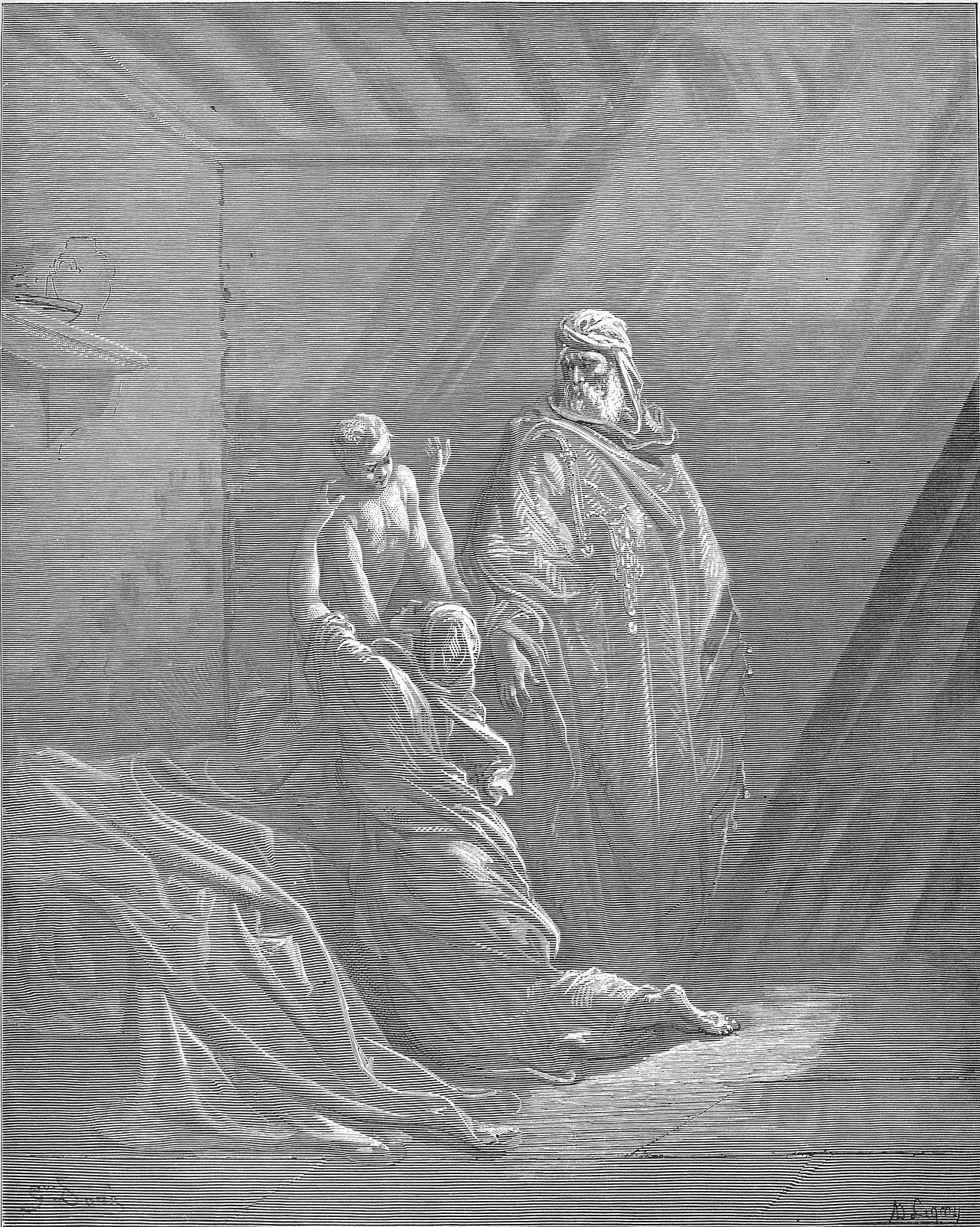
Sources cited
- OpenBible.info Bible Geocoding: Mount Carmelread 2026-08-20The coordinates on this page. Used under CC-BY with attribution to OpenBible.info.
- Berean Standard BibleAll Scripture text on this page, translation_id 3 in the site's verse store. Public domain since 2023.
- Charles H. Spurgeon, The New Park Street Pulpit, Sermon No. 134, “Elijah’s Appeal to the Undecided” (1857), and The Metropolitan Tabernacle Pulpit, Sermon No. 3376, “God’s Answer to Persistent Prayer” (1913)The two voices blocks on this page, on 1 Kings 18:21 and on the three years of drought at 18:41. Public domain, lightly modernized CCEL text.
- Matthew Henry, Commentary on the Whole Bible (1710)The twelve stones at 18:31, the high place at 18:30, the people convinced at 18:39, and Deuteronomy 13 on the Kishon. Public domain.
- Adam Clarke, Commentary on the Bible (1832)The altar of Carmel with the Tacitus citation at 18:30, the hopping between two boughs at 18:21, the terms of the test at 18:24, and the little cloud at 18:44. Public domain.
- Albert Barnes, Notes, Explanatory and Practical, on the Old and New Testaments (1832 to 1869)The silent people at 18:21, the irony at 18:27, the self-cutting parallels at 18:28, the distance to Jezreel at 18:46, Elisha at Carmel on 2 Kings 2:25, and the two hiding places on Amos 9:3. Public domain.
- John Wesley, Explanatory Notes upon the Old Testament (1765)Fire rather than water at 18:24, the top of Carmel at 18:42, the Kishon at 18:40, and Carmel in Song of Solomon 7:5. Public domain.
- Robert Jamieson, A. R. Fausset and David Brown, Commentary Critical and Explanatory on the Whole Bible (1871)The little cloud at 18:44, the distance to Jezreel at 18:45, Stanley's observation at 18:43, and the southern Carmel at 1 Samuel 15:12. Public domain.
- John Gill, Exposition of the Old Testament (1748 to 1763)The distances, which Gill takes from Heinrich Bünting, Itinerarium Sacrae Scripturae, and the parallels for the self-cutting. Public domain.
- Arthur Penrhyn Stanley, Sinai and Palestine (1856)The eminence above the traditional site from which the sea is visible, quoted here through Jamieson, Fausset and Brown on 1 Kings 18:43.
- Ambrose of Milan, On the Duties of the Clergy 3.18.106 to 107 (c. 391)The fourth century reading of the drenched sacrifice. The pool row carries the year 397; this page follows the usual dating of the work to around 391. Public domain.
- Caesarius of Arles, Sermon 124.5, transmitted in the collection under Augustine's nameThe cloud read as a figure of Christ. The attribution is open and both names are given on the page. Public domain.
- Tacitus, Histories 2.78The god and altar of Carmel with no image and no temple, and Vespasian's consultation in AD 69. Quoted in Latin by Adam Clarke on 1 Kings 18:30. Public domain.
- Suetonius, Vespasian 5The second, independent report of the same oracle, written in the AD 120s. Public domain.
- Iamblichus, On the Pythagorean Life 3 (c. AD 300)Pythagoras on Carmel, “the most holy of all mountains.” Public domain.
- Flavius Josephus, Antiquities of the Jews 8.13.5The first century retelling of 1 Kings 18. Public domain.
- Lives of the ProphetsA first century Jewish collection of traditions about the prophets, including Elijah. Named, dated and placed as a witness to tradition and not as Scripture.
- Shalmaneser III, the annals and the Black Obelisk, British MuseumThe tribute of Jehu in 841 BC at Ba'li-ra'si, “a cape jutting out into the sea before the land of Tyre.” Both identifications of that cape are given on the page.
- Associates for Biblical Research, “Israelite Kings in Assyrian Inscriptions”A confessional body, named as such rather than presented as neutral ground, on the Assyrian references to Israelite kings.
- Dorothy A. E. Garrod and Dorothea M. A. Bate, The Stone Age of Mount Carmel (Oxford: Clarendon Press, 1937)The Nahal Me'arot cave excavations of 1929 to 1934. The chronology in that work belongs to the excavators and is reported as theirs.
- UNESCO World Heritage Centre, Sites of Human Evolution at Mount CarmelThe Nahal Me'arot caves, inscribed in 2012.
- Deir el-Muhraqa, the Carmelite monastery at the traditional site of the sacrificeBuilt in 1883 on an earlier foundation, with an altar of twelve stones built in memory of 1 Kings 18:31.
- The Rule of Saint Albert, given by Albert of Vercelli, Latin Patriarch of Jerusalem (c. 1206 to 1214)The rule given to the hermits living on Mount Carmel, and the origin of the Carmelite order.
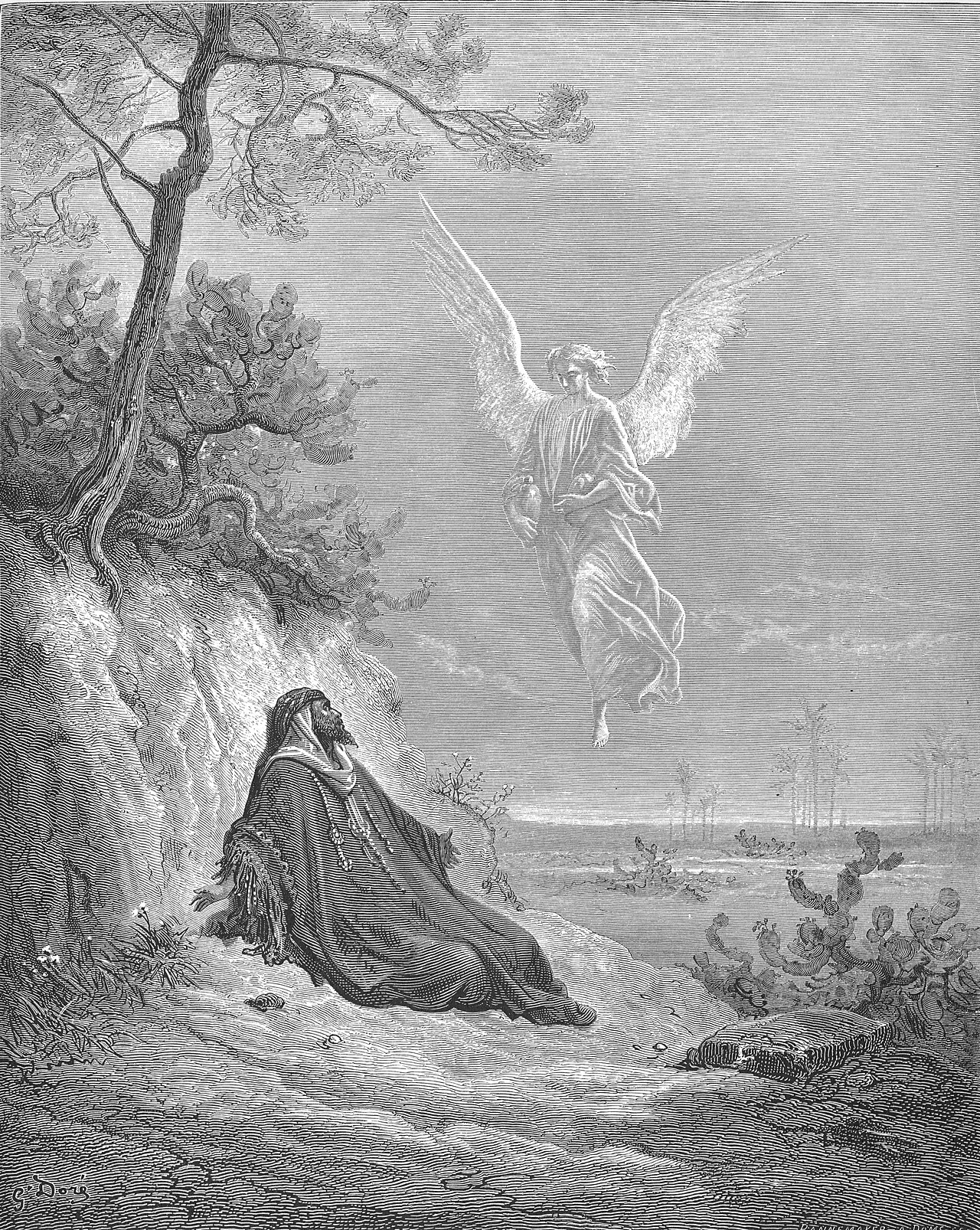
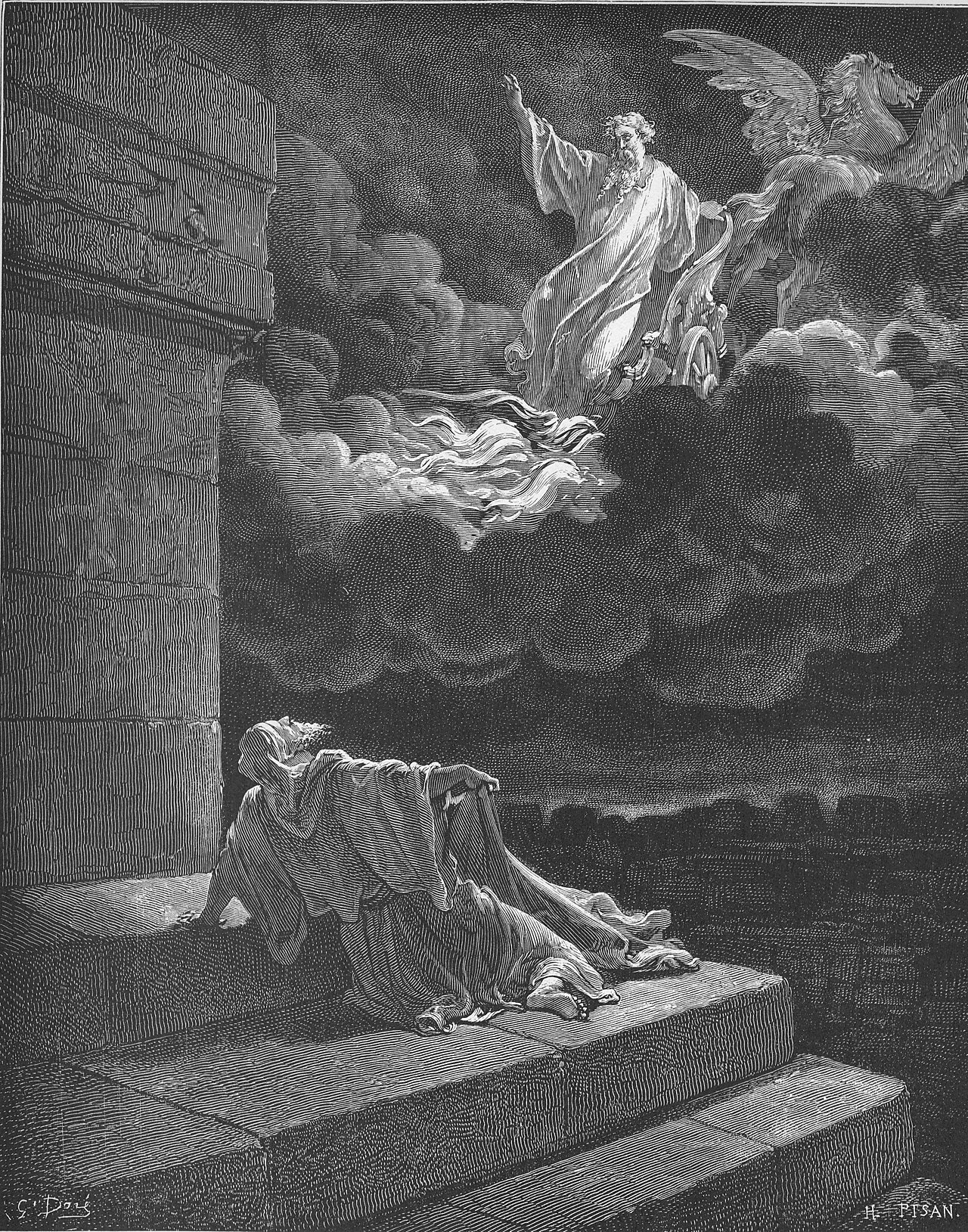
- Gustave Doré, La Sainte Bible (Tours: Alfred Mame et fils, 1866)The four engravings on this page. Public domain.
- James Strong, Strong's Exhaustive ConcordanceThe lexicon floor behind the name of the mountain: h3760 Karmel, h3759 karmel, h3754 kerem, h410 el, and h6452 pasach, the verb of 18:21 and 18:26.
Keep studying
On this page
Books that name it3
Doorway2
Keep this page