
Capernaum
Summary
Capernaum is the fishing town on the north shore of the Sea of Galilee that Jesus made his base. Matthew ends up calling it his own town.
- Jesus moved here from Nazareth, about 32 km downhill, and settled.
- The Sabbath in the synagogue, the paralytic through the roof, the centurion’s servant and the bread of life discourse all happen in this town.
- A Roman officer paid for the town’s synagogue. Jesus said he had found no faith like that man’s in Israel.
- The town that saw the most works was warned the hardest. Jesus set it beside Sodom.
- White limestone walls stand on older black basalt. Whether that basalt is the synagogue Jesus taught in is argued, and both readings are named here.
On this page
In Scripture
- Verses
- 16
- Books
- 4
Near Capernaum
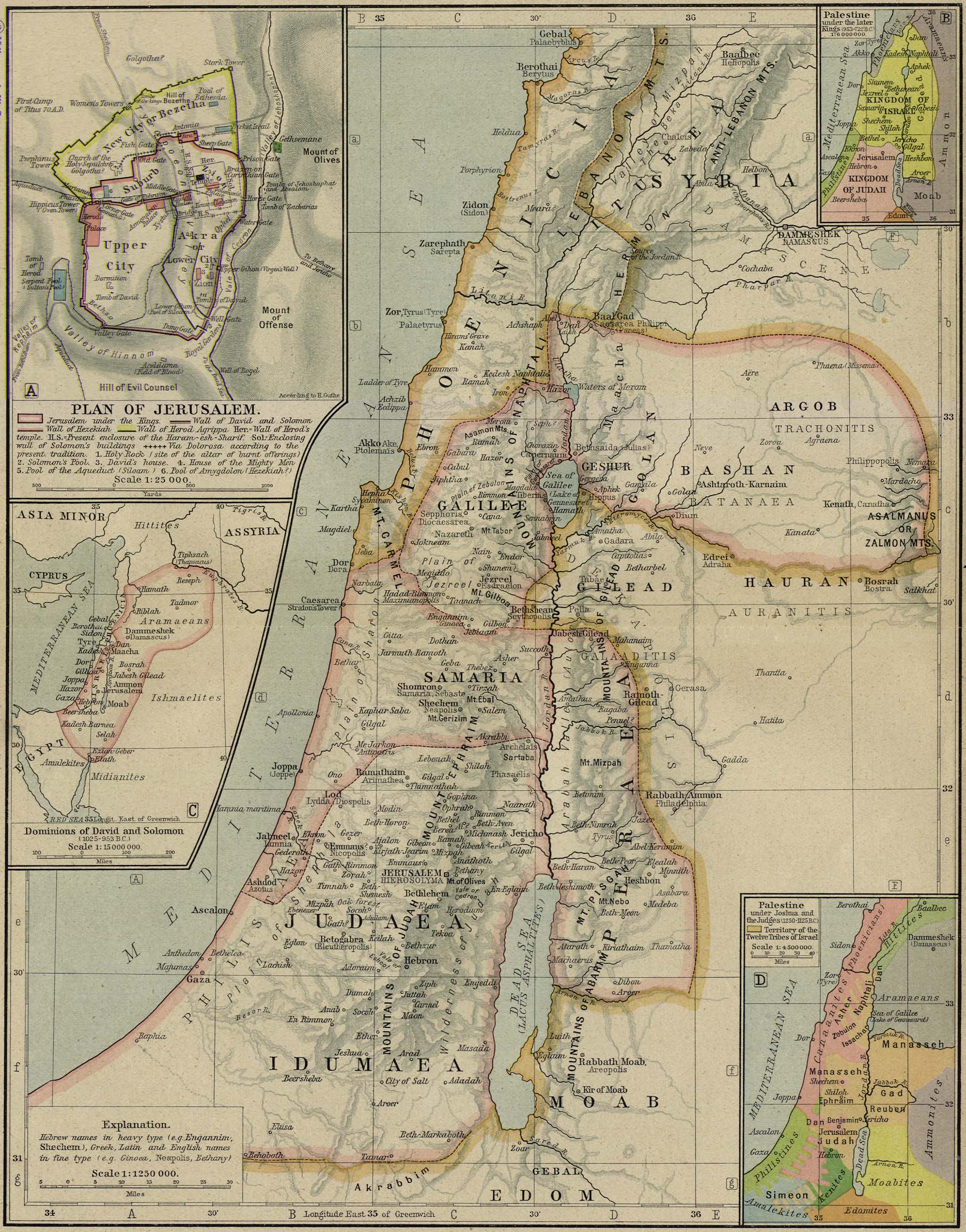
- Sea of Galilee7.1 km · 4.4 mi S
- Cana of Galilee27 km · 17 mi SW
- Mount Tabor28 km · 17 mi SW
- Nazareth32 km · 20 mi SW
- Nain35 km · 22 mi SW
- Shunem38 km · 24 mi SW
Straight-line distances, computed from the gazetteer coordinates.
Where it is
the country around it
- Coordinates
- 32.8806° N, 35.5752° Efind it on the Atlas →
- Region
- Galilee
- Kind of place
- Town
Every movement the Gospels record here is short, except the 32 km down from Nazareth
- 1Jesus leaves Nazareth and settles hereMatthew 4:13 · 32 kmLeaving Nazareth, He went and lived in Capernaum, which is by the sea in the region of Zebulun and Naphtali,
- 2The disciples sent on ahead by boatMark 6:45 · 6 kmImmediately Jesus made His disciples get into the boat and go on ahead of Him to Bethsaida, while He dismissed the crowd.
- 3The crossing to the country of the GerasenesMark 5:1 · 9 kmOn the other side of the sea, they arrived in the region of the Gerasenes.
- Located: the gazetteer fixes one site
- A dashed line ends at a place the gazetteer does not fix
Not located: The Temple. The gazetteer records no location for it, so it is not marked.
What has been found
the evidence, and where it is disputed
The white building, and whose synagogue it is
The basalt beneath, and whether it is the synagogue of Mark 1:21
The house under the octagonal church
The boat from the lake bed
The paralytic through the roof
Mark 2:1 to 2:12, in the order it happens
Read Mark 2:1 to 2:12, in the order it happens
- Home again, and word gets outMark 2:1A few days later Jesus went back to Capernaum. And when the people heard that He was home,
- No room, not even outside the doorMark 2:2they gathered in such large numbers that there was no more room, not even outside the door, as Jesus spoke the word to them.
- Four men carrying oneMark 2:3Then a paralytic was brought to Him, carried by four men.
- They dig through the roofMark 2:4Since they were unable to get to Jesus through the crowd, they uncovered the roof above Him, made an opening, and lowered the paralytic on his mat.
- The first word is about sinMark 2:5When Jesus saw their faith, He said to the paralytic, “Son, your sins are forgiven.”
- The scribes reason it out in silenceMark 2:7“Why does this man speak like this? He is blaspheming! Who can forgive sins but God alone?”
- Which is easier to sayMark 2:9“Which is easier: to say to a paralytic, ‘Your sins are forgiven,’ or to say, ‘Get up, pick up your mat, and walk’?
- So that you may knowMark 2:10But so that you may know that the Son of Man has authority on earth to forgive sins...” He said to the paralytic,
- Get up and go homeMark 2:11“I tell you, get up, pick up your mat, and go home.”
- Out through the crowd on his own feetMark 2:12And immediately the man got up, picked up his mat, and walked out in front of them all. As a result, they were all astounded and glorified God, saying, “We have never seen anything like this!”
The roof was flat and low. A Galilean village house of that period had a roof of wooden beams packed with brush and mud, reached by stairs on the outside, so four men could carry a mat up it and dig through. Mark 2:4 has them uncover the roof and make an opening; Luke 5:19 has them lower the man “through the tiles.” The two describe the same opening in different materials, and the page leaves the difference standing.
His Authority: the full study of the claim to forgiveWhat happened here, in order
in the order the canon tells it
1He comes down and teaches on the Sabbath
- He went down to Capernaum and taught on the SabbathLuke 4:31Then He went down to Capernaum, a town in Galilee, and on the Sabbath He began to teach the people.
- An unclean spirit names him before any disciple doesMark 1:24“What do You want with us, Jesus of Nazareth? Have You come to destroy us? I know who You are—the Holy One of God!”
- Peter’s mother-in-law raised from a feverMark 1:31So He went to her, took her by the hand, and helped her up. The fever left her, and she began to serve them.
- The whole town at the door after sunsetMark 1:33and the whole town gathered at the door.
2The house so full they come through the roof
- Matthew calls Capernaum his own townMatthew 9:1Jesus got into a boat, crossed over, and came to His own town.
- Forgiveness spoken before healingMark 2:5When Jesus saw their faith, He said to the paralytic, “Son, your sins are forgiven.”
- Matthew called away from the tax boothMatthew 9:9As Jesus went on from there, He saw a man named Matthew sitting at the tax booth. “Follow Me,” He told him, and Matthew got up and followed Him.
3A Roman officer, and a tax question
- The officer who built their synagogueLuke 7:5for he loves our nation and has built our synagogue.”
- Faith he had not found in IsraelLuke 7:9When Jesus heard this, He marveled at the centurion. Turning to the crowd following Him, He said, “I tell you, not even in Israel have I found such great faith.”
- The temple-tax collectors come to PeterMatthew 17:24After they had arrived in Capernaum, the collectors of the two-drachma tax came to Peter and asked, “Does your Teacher pay the two drachmas?”
4The teaching that emptied the crowd
- The bread of life discourse, placed in this synagogueJohn 6:59Jesus said this while teaching in the synagogue in Capernaum.
- Many disciples turn backJohn 6:66From that time on many of His disciples turned back and no longer walked with Him.
- The woe on Capernaum, set beside SodomMatthew 11:23And you, Capernaum, will you be lifted up to heaven? No, you will be brought down to Hades! For if the miracles that were performed in you had been performed in Sodom, it would have remained to this day.
Where it points
The voices
each quoted from the work named
On the move itself as the point: Isaiah’s prophecy lands when Jesus settles in this territory.
By Messiah's taking up His abode in those very regions of Galilee, and shedding His glorious light upon them, this prediction, He says, of the Evangelical prophet was now fulfilled; and if it was not thus fulfilled, we may confidently affirm it was not fulfilled in any age of the Jewish ceremony, and has received no fulfilment at all.
On what the synagogue crowd noticed first, which was authority rather than the argument.
You will find the same narrative in Luke, at the fourth chapter, from the 31st to the 37th verse. It will be handy for you to be able to refer to the second passage, from which I shall quote one or two matters. These two Evangelists commence the narrative by telling us of the singular authority and power which there was about the Savior's teaching— authority so that no man dared question His doctrine—power, so that every man felt the force of the Truths of God which He delivered.
On what the woe measures: the town was raised high by privilege, and the warning is set against it.
And thou, Capernaum - See the notes at Mat 4:13. Which art exalted to heaven - This is an expression used to denote great privileges. He meant that they were especially favored with instruction. The city was prosperous. It was signally favored by its wealth. Most of all, it was signally favored by the presence, the preaching, and the miracles of the Lord Jesus Christ. Here he spent a large portion of his time in the early part of his ministry, and in Capernaum and its neighborhood he performed his chief miracles.
4 more teachers on these versesJ.C. Ryle · Matthew Henry
These verses begin the long list of miracles which Mark's Gospel contains. They tell us how our Lord cast out devils in Capernaum, and healed Peter's wife's mother of a fever. We learn, in the first place, from these verses, the uselessness of a mere intellectual knowledge of religion . Twice we are specially told that the unclean spirits know our Lord. In one place it says, "they knew Him." to another, the devil cries out, "I know you who you are, the Holy One of God."
These verses form a sorrowful conclusion to the famous discourse of Christ which occupies the greater part of the sixth chapter. They supply a melancholy proof of the hardness and corruption of man's heart. Even when the Son of God was the preacher, many seem to have heard in vain. Let us mark in this passage what an old sin apostasy is. We read that when our Lord had explained what He meant by "eating and drinking his flesh and blood,"—"After this, many of his disciples quit following him and did not accompany him any longer."
Thy sins are forgiven thee. Sin is the procuring cause of all our pains and sicknesses. The word of Christ was to take his thoughts off from the disease, which was the effect, and to lead them to the sin, the cause, that he might be more concerned about that, to get that pardoned.
Note, Building places of meeting for religious worship is a very good work, is an instance of love to God and his people; and those who do good works of that kind are worthy of double honour. Jesus Christ was very ready to show kindness to the centurion.
Capernaum in Scripture
16 verses name it, in 4 books
Open a book to read its mentions here. Text: Berean Standard Bible.
Old TestamentNew Testamentsegment width = share of mentions
New Testament4 books · 16 mentions
Matthew4 mentions
- Matthew 4:13Leaving Nazareth, He went and lived in Capernaum, which is by the sea in the region of Zebulun and Naphtali,
- Matthew 8:5When Jesus had entered Capernaum, a centurion came and pleaded with Him,
- Matthew 11:23And you, Capernaum, will you be lifted up to heaven? No, you will be brought down to Hades! For if the miracles that were performed in you had been performed in Sodom, it would have remained to this day.
- Matthew 17:24After they had arrived in Capernaum, the collectors of the two-drachma tax came to Peter and asked, “Does your Teacher pay the two drachmas?”
Mark3 mentions
- Mark 1:21Then Jesus and His companions went to Capernaum, and right away Jesus entered the synagogue on the Sabbath and began to teach.
- Mark 2:1A few days later Jesus went back to Capernaum. And when the people heard that He was home,
- Mark 9:33Then they came to Capernaum. While Jesus was in the house, He asked them, “What were you discussing on the way?”
Luke4 mentions
- Luke 4:23Jesus said to them, “Surely you will quote this proverb to Me: ‘Physician, heal yourself! Do here in Your hometown what we have heard that You did in Capernaum.’”
- Luke 4:31Then He went down to Capernaum, a town in Galilee, and on the Sabbath He began to teach the people.
- Luke 7:1When Jesus had concluded His discourse in the hearing of the people, He went to Capernaum.
- Luke 10:15And you, Capernaum, will you be lifted up to heaven? No, you will be brought down to Hades!
John5 mentions
- John 2:12After this, He went down to Capernaum with His mother and brothers and His disciples, and they stayed there a few days.
- John 4:46So once again He came to Cana in Galilee, where He had turned the water into wine. And there was a royal official whose son lay sick at Capernaum.
- John 6:17got into a boat, and started across the sea to Capernaum. It was already dark, and Jesus had not yet gone out to them.
- John 6:24So when the crowd saw that neither Jesus nor His disciples were there, they got into the boats and went to Capernaum to look for Him.
- John 6:59Jesus said this while teaching in the synagogue in Capernaum.
The account
Read the account as one telling
The name behind the site is Kfar Nahum, the village of Nahum. It stood on the north shore of the lake that Scripture calls by several names: the Sea of Chinnereth in the Old Testament, the Lake of Gennesaret in Luke, and the Sea of Galilee or the Sea of Tiberias in the Gospels. All four name the same water.
- first century
first centuryIn the first century this was a village of black basalt houses, roofed with beams, brush and packed mud, reached by stairs on the outside. It had a fishing fleet, a synagogue and a customs post on the road along the lake. The tax booth where Matthew sat belongs to that road, and so do the collectors of the two-drachma temple tax who came to Peter. A Roman officer was stationed here, which Luke 7 takes for granted.
Jesus came down from Nazareth and made the town his base. John has him going down to Capernaum with his mother, his brothers and his disciples early on, staying a few days. Matthew records the move as settled and reads it as the fulfilment of Isaiah 9:1 to 9:2, the great light dawning on Zebulun and Naphtali.
What follows is a dense run of recorded work. The synagogue teaching and the man with the unclean spirit. Peter's mother-in-law raised from a fever, and the whole town at the door after sunset. The paralytic lowered through the roof. The call of Matthew at the tax booth. The centurion's servant healed at a distance. The temple tax paid out of a fish's mouth.
The bread of life discourse ends the Galilean run. John places it in the synagogue at Capernaum and records what it cost: many of the disciples called it a difficult teaching, turned back, and no longer walked with him.
Then the woe. Matthew and Luke both record Jesus naming Chorazin, Bethsaida and Capernaum, the towns where most of his works were done, because they did not repent. The saying is about response, not about buildings.
The town outlived the Gospels by a long way. In the Byzantine period a white limestone synagogue was raised on the site of an older basalt building, and an octagonal church was built over one room of a courtyard house about thirty metres to the south. Pilgrims came to both.
- eleventh century
eleventh century ADThe site was abandoned around the eleventh century AD and lay as a ruin until the nineteenth-century surveyors came looking for it.
Common questions
Why did Jesus leave Nazareth and settle in Capernaum?
Matthew records the move and reads it as the fulfilment of Isaiah 9:1 to 9:2, the great light dawning on Zebulun and Naphtali. Luke supplies the immediate cause: the people of Nazareth had tried to throw him off a cliff. Capernaum sat on the lake and on the road, with a synagogue, a customs post and a fishing fleet, and Matthew ends up calling it his own town.
Is the synagogue you can visit at Capernaum the one Jesus taught in?
Readers differ; the positions are named
No, on every dating that has been offered. Kohl and Watzinger dated the white limestone building in 1905 to the late second or early third century AD. Corbo and Loffreda dated it from 1968 onward to the late fourth or fifth century, on coins and pottery sealed in its foundations, and that is now the majority view. Underneath it lies a black basalt wall and pavement. The Franciscan excavators identify that basalt as the first-century synagogue, the one Luke 7:5 says the centurion built. Others hold that basalt masonry under a later public building shows an earlier public building and nothing more specific. What is not in question is that Capernaum had a synagogue then, because Mark 1:21, Luke 7:5 and John 6:59 all say so.
Is the house under the octagonal church really Peter's?
Readers differ; the positions are named
One room in a first-century courtyard house about thirty metres from the synagogue was plastered in the later first century, which is unusual for a village house, and its finds shift from cooking pots to storage jars and lamps. Christians scratched graffiti on that plaster. A square hall was built around the room in the fourth century, and an octagonal church over it in the fifth. The fourth-century pilgrim Egeria reports that the house of the prince of the apostles at Capernaum had been made into a church, though that passage reaches us through Peter the Deacon's twelfth-century compilation rather than her own surviving text.
No inscription names Peter, and no excavated object ties the house to him. The identification rests on the early singling out of that one room and on a continuous tradition of veneration, and it is offered here as tradition with its earliest witnesses named.
Why did Jesus pronounce a woe on Capernaum after doing so much good there?
Matthew gives the reason directly: these were the towns where most of his works were done, and they did not repent. The measure is opportunity rather than wickedness, which is why Capernaum is set against Sodom, and Chorazin and Bethsaida against Tyre and Sidon. Luke records the same saying in shorter form.
Are the healings at Capernaum something the church still prays for?
The Gospels report them as things Jesus did, in front of a whole town, and they name the people healed: a man with an unclean spirit, Peter's mother-in-law, a paralysed man carried by four friends, a centurion's servant, a synagogue leader's daughter. Acts then records the apostles healing in his name, and James tells the church to call the elders and pray over the sick with anointing oil. This site's tradition is that the gifts of the Spirit did not close with the apostles, and that the church still prays this way and still asks for the same mercy.
Is the raising of Jairus's daughter set at Capernaum?
Mark does not name the town. He writes that Jesus crossed back by boat, that a crowd met him beside the sea, and that a synagogue leader named Jairus came to him there. Matthew 9:1 puts that whole run of events in his own town, which is Capernaum. So the location comes from the sequence in Matthew rather than from any place name in Mark 5, and this page leaves the town unnamed where the chapter leaves it unnamed.
Sources cited
- OpenBible.info Bible Geocoding: Capernaumread 2026-08-20The coordinates on this page. Used under CC-BY with attribution to OpenBible.info.
- Heinrich Kohl and Carl Watzinger, Antike Synagogen in Galilaea (Leipzig, 1916)The 1905 excavation of the white limestone synagogue and the early dating, cited for the position it argues.
- Virgilio C. Corbo, La casa di S. Pietro a Cafarnao (Jerusalem: Franciscan Printing Press, 1969)The Franciscan excavation of the insula and the room under the octagonal church.
- Vassilios Tzaferis, Excavations at Capernaum, Volume I (1989)The separate excavation of the eastern, Greek Orthodox part of the site. The imprint was not re-checked against the printed volume.
- Egeria, Itinerarium, late fourth centuryThe pilgrim's report of the house at Capernaum, which survives through Peter the Deacon's twelfth-century compilation.
- Shelley Wachsmann, The Sea of Galilee Boat (New York: Plenum Press, 1995)The excavator's account of the first-century boat found near Kibbutz Ginosar in 1986.
- Charles H. Spurgeon, The Metropolitan Tabernacle Pulpit, Sermon No. 1765Public domain, CCEL edition, lightly modernized text.
- J.C. Ryle, Expository Thoughts on the Gospels: Mark (1857) and John (1869)Public domain, Grace Gems edition, lightly modernized text.
- Jamieson, Fausset & Brown, Commentary Critical and Explanatory on the Whole Bible (1871)Public domain.
- Matthew Henry, Commentary on the Whole Bible (1710)Public domain.
- Albert Barnes, Notes, Explanatory and Practical, on the Old and New Testaments (1832 to 1869)Public domain.
- Jodi Magness, “The Question of the Synagogue: The Problem of Typology” (2001)The later dating of the white synagogue.
Keep studying
On this page
Studies12
Doorway2
Keep this page