love
LN 25.43“This stands first, not as distinct from, but as including all the rest.”
— Cambridge Bible (PD)
Opposite in the flesh: enmities ἔχθρα G2189 · strong pairing
Galatians 5:22–23 names a singular fruit (karpos, not fruits) with nine visible facets. Gifts are distributed; fruit is unified. Every believer bears the whole fruit. The grammar is the theology.
But the fruit of the Spirit is…
One fruit — καρπός (karpos), singular— with nine facets. Not nine fruits; not the flesh's ἔργα (erga), plural, many. The grammar is the argument.
Radial cluster — Gal 5:22–23 (ASV facet names); center John 15:5. The picture argues the singular karpos.
Each facet opens a Greek word door into the workbench, and carries its opposite from Paul's own works-of-the-flesh list (Gal 5:19–21). The facet-to-vice pairing is a design overlay drawn from Paul's own vocabulary in the same passage (warranted by 5:17's flesh-vs-Spirit antithesis) — Paul clusters the vices, he does not pair them one-to-one.
Galatians 5:22 reads in Greek: ho de karpos tou pneumatos estin agapē, chara, eirēnē — "but the fruit of the Spirit is love, joy, peace…" Karpos is singular. The list of nine attributes that follows is not a list of nine separate fruits but a single fruit visible from nine angles. This stands in deliberate contrast to charismata (the spiritual gifts of 1 Cor 12), which are explicitly plural and distributed: "to one is given by the Spirit the word of wisdom; to another the word of knowledge." Gifts are distributed; fruit is unified. Every believer bears the whole fruit. No believer has all the gifts. The grammar is the theology.
The nine facets fall naturally into three triads. Inward (toward God): love, joy, peace — fruit oriented vertically. Relational (toward others): longsuffering, gentleness, goodness — fruit oriented horizontally. Outward (self-governance): faithfulness, meekness, temperance — fruit oriented in the disposition that governs the believer's own response. Each facet has OT parallels and Christological exemplification (e.g. agapē parallels Hebrew chesed; prautēs — meekness — finds its exemplar in "the man Moses was very meek, above all the men which were upon the face of the earth" (Num 12:3) and in Christ's own "I am meek and lowly in heart" (Matt 11:29)).
The fruit-of-the-Spirit list (Gal 5:22–23) is positioned by Paul against the works of the flesh (Gal 5:19–21): "adultery, fornication, uncleanness, lasciviousness, idolatry, witchcraft, hatred, variance, emulations, wrath, strife, seditions, heresies, envyings, murders, drunkenness, revellings, and such like." The contrast is grammatical as well as moral — flesh produces works (plural, multiplied, fragmented); Spirit produces fruit (singular, unified, organic). The list-of-vices is a list-of-things; the fruit is a kind-of-life.
"I am the true vine, and my Father is the husbandman… he that abideth in me, and I in him, the same bringeth forth much fruit: for without me ye can do nothing" (John 15:1, 5). The fruit-of-the-Spirit is organic, not mechanical. It is borne, not manufactured. The Spirit is the sap; the believer abides; the fruit appears. Founder editorial slot reserved on the [[singularity-of-fruit-vs-plurality-of-gifts]] drilldown — Pastor Marc frames the singularity argument and its pastoral consequences.
The nine facets are not arbitrary virtues Paul thought sounded good. Each one appears in Scripture, somewhere, as a description of God himself or of Christ. The fruit of the Spirit is — by the Spirit''s own production in a yielded life — the character of God reproduced in the believer.
This is why Paul calls it fruit of the Spirit and not fruit of effort. The character is God''s; the production is the Spirit''s; the believer is the orchard.
→ Go deeper: the singular karpos and the vine mechanism
Galatians 5:23 ends the fruit list with a five-word coda: "against such there is no law." The Mosaic law was given to restrain sin (Gal 3:19, Rom 7:7–13). It tells the heart: do not covet, do not steal, do not bear false witness. Where the Spirit has produced love, joy, peace, longsuffering, gentleness, goodness, faith, meekness, temperance — the law has nothing to restrain. The fruit is what the law was trying to produce and could not.
Romans 8:3–4 makes this explicit: "What the law could not do, in that it was weak through the flesh, God sending his own Son... condemned sin in the flesh: that the righteousness of the law might be fulfilled in us, who walk not after the flesh, but after the Spirit." The fruit is the law''s goal, achieved by a different mechanism. The mechanism is not command and obedience — it is transformation by indwelling.
This is why the works-of-the-flesh / fruit-of-the-Spirit contrast in Galatians 5 is structurally placed between Paul''s long argument that justification is not by works of the law (Gal 1–4) and his application that the believer walks in the Spirit (Gal 5:25, 6:1–10). Paul is not switching back to law-keeping; he is showing what it looks like when the law has been written on the heart.
→ Go deeper: Works of the flesh — the contrast Paul lists first
Paul writes καρπός (fruit) as a singular noun governing a nine-item list — against the plural ἔργα (works) of the flesh in 5:19. The contrast is in the Greek itself, not an overlay: one organic fruit versus many manufactured works. Both nouns are floor-verifiable doors.
“The works of the flesh are many, the fruit of the Spirit is one, yet manifold.”
“The collective… singular καρπός has sprung… from the idea of internal unity and moral homogeneity.”
“The singular number of the noun is employed in preference to the plural… in consequence probably of the feeling which the apostle had that the combination of graces described is in its entirety the proper outcome in each individual of the Spirit's agency.”
“Fruit, metaphorical, frequent in N.T.… Almost always of a good result.”
Guardrail (cite-only). The “one fruit” reading is the mainstream exegesis, not a proof — Meyer already labels the singular a collective. D. A. Carson, Exegetical Fallacies (1996), warns against loading grammar with more than usage bears; present the unity as the reading the grammar supports, not one it forces.
Sources: Gal 5 Greek text (PD floor); verse_words live corpus (karpos / erga counts); Cambridge Bible / Meyer / Ellicott / Vincent (PD, verbatim); Carson 1996 (cite-only ≤50 words).
By the Louw-Nida semantic-domain lens (MACULA Greek @ln, CC BY 4.0), the nine words fall into three domains — and the grouping is itself teaching: an emotions cluster, a moral-quality cluster, and faithfulness in the domain of trust. Each facet below carries a live word door, its domain sub-code, a public-domain gloss, and its opposite from the flesh.
Caveat · pairing is interpretive. Paul does notpair the nine fruit one-to-one with the vices — he clusters the vices by kind (Gal 5:19–21). Each “opposite” below is a design overlay drawn from Paul's own vocabulary in the same passage, warranted by 5:17's flesh-vs-Spirit antithesis, not a claim Paul paired them. And the sub-codes are standard Louw-Nida values, build-verified against the per-token @lnjoin (domain names 25 / 88 / 31 are high-confidence).
Guardrail (cite-only): agapē and phileō share Domain 25 — do not over-read synonym alternation (Carson's parade case). The domain groups the words; it does not flatten their senses.
“This stands first, not as distinct from, but as including all the rest.”
— Cambridge Bible (PD)
“Not a selfish emotion, but a sun whose rays warm and gladden all within the sphere of its influence.”
— Cambridge Bible (PD)
“In the conscience, pervading the soul, calming the passions, manifested in the disposition and conduct.”
— Cambridge Bible (PD)
“Patience sustained under injuries and provocation.”
— Cambridge Bible (PD)
“Rather, kindliness. A term frequently applied to God.”
— Cambridge Bible (PD)
“Beneficence.”
— Cambridge Bible (PD)
“Meekness is the outcome of true humility, the bearing towards others which results from a lowly estimate of ourselves.”
— Expositor's Greek Testament (PD)
“The word means self-control, holding in hand the passions and desires.”
— Vincent, Word Studies (PD)
“The ASV renders pistis here “faithfulness” — fidelity, reliability toward God and neighbour, not saving faith.”
— ASV rendering; dossier occurrence note
Sources: atlas lens 06 semantic-domains; MACULA Greek @ln (CC BY 4.0); Louw & Nida (1989, domain codes via MACULA; original prose LOCKED, UBS); facet glosses Cambridge Bible / Expositor's GT / Vincent (PD); antonyms from Gal 5:19–21 (PD floor).
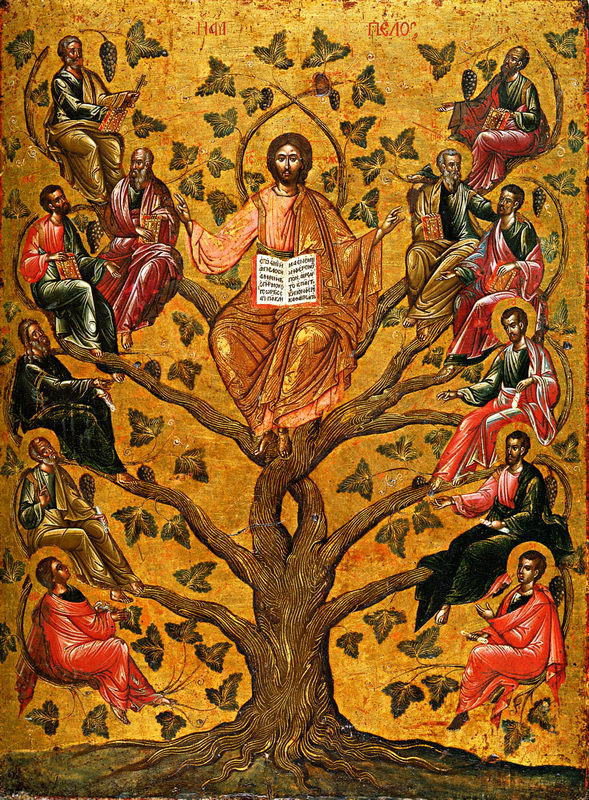
The center of the cluster is John 15's true vine. The fruit of Galatians 5 grows on the branch that abides — it is borne, not made. Abide (μένω) and fruit (καρπός) are the same words the whole page turns on.
“Abide in me, and I in you. As the branch cannot bear fruit of itself, except it abide in the vine; so neither can ye, except ye abide in me. I am the vine, ye are the branches…”
John 15:4–5ASV 1901 (PD floor)
Sources: atlas lenses 33 tree-vine, 04 same-word; ASV floor; Talbert 1994 / Streett 2014 (cite-only, John 15 vine background).

The fruit list is nine in every text. The works-of-the-flesh list is not: it reads 15 in the critical text and the ASV, and 17 in the Textus Receptus and the KJV, which add adultery and murders. Text-type affects the vice list, not the fruit. Here is the ASV 15.
| # | Work of the flesh (ASV) | Greek | Cluster |
|---|---|---|---|
| 1 | fornication | porneia G4202 | sexual |
| 2 | uncleanness | akatharsia G167 | sexual |
| 3 | lasciviousness | aselgeia G766 | sexual |
| 4 | idolatry | eidōlolatria G1495 | religious |
| 5 | sorcery | pharmakeia G5331 | religious |
| 6 | enmities | echthra G2189 | social |
| 7 | strife | eris G2054 | social |
| 8 | jealousy | zēlos G2205 | social |
| 9 | wraths | thymos G2372 | social |
| 10 | factions | eritheia G2052 | social |
| 11 | divisions | dichostasia G1370 | social |
| 12 | parties / heresies | hairesis G139 | social |
| 13 | envyings | phthonos G5355 | social |
| 14 | drunkenness | methē G3178 | intemperance |
| 15 | revellings | kōmos G2970 | intemperance |
TR / KJV adds two (→ 17): adultery (moicheia G3430), murders (phonos G5408). Paul closes the vice list with an open “and such like”— the flesh's output is a checklist that does not pretend to be exhaustive. The fruit is closed at nine, because the unity does not admit additions.
Sources: Gal 5:19–21 (PD floor); text-type note — critical/ASV 15 vs TR/KJV 17 (adds μοιχεία G3430, φόνοι G5408). This corrects the page's earlier “fifteen” label set over a KJV 17-item quotation.
Two honest debates. Each drawer holds the claim and its critique at full strength, tradition tagged and cited; the page adjudicates neither.
Is the fruit borne by abiding, or won by striving? A genuine inter-tradition difference — presented as data; the text holds both poles.
Andrew Murray, Abide in Christ (1888, PD), and Hannah Whitall Smith, The Christian's Secret of a Happy Life (1875, PD): the branch bears fruit by union, not exertion. Claim: the fruit is borne; effort to manufacture it is the flesh's counterfeit.
J. C. Ryle, Holiness (1879, PD), explicitly critiques Higher-Life passivity — sanctification is a battle with real striving.
“Be killing sin or it will be killing you.”
— John Owen, Of the Mortification of Sin (1656, PD)
Critique of the growth-only view: it can slide into quietism and neglect the commanded warfare — Gal 5:24 (“crucified the flesh”), Rom 8:13 (“mortify the deeds of the body”).
John Wesley, A Plain Account of Christian Perfection (1777, PD): sanctification as growth in and toward perfect love, both instantaneous and gradual. Claim: the fruit — especially love (5:14) — is the goal of the sanctified life. MannaFest posture: Wesleyan-Pentecostal.
The text holds both poles. Gal 5:22 — the fruit grows on the abiding branch (John 15) — AND Gal 5:24–25 — believers “crucified the flesh” and must “walk by the Spirit” (active). The tension is the passage's own, not a scholars' quarrel for the page to resolve.
Sources: Murray / Smith / Ryle / Owen / Wesley (all PD); Owen quoted verbatim, the others attributed summaries; Gal 5 text (PD floor).
The claim. The radial page shows each facet against an opposite from the works-of-the-flesh list — a clean facet-vs-vice antithesis, warranted by Gal 5:17 (“the flesh lusteth against the Spirit … contrary the one to the other”).
The critique. Paul does notpair them one-to-one. He clusters the vices by kind — sexual, religious, social/relational, intemperance — and the relational cluster (eight vices) dominates. The per-facet “opposite” is a design overlay drawn from Paul's own vocabulary in the same passage, not a Pauline pairing. Where no natural antonym exists — goodness (ἀγαθωσύνη) has none clean in the list — the page says so rather than forcing one.
Sources: Gal 5:19–23 (PD floor); dossier caveat (lens 06 / intra-passage contrast). The pairing is honest data where a natural antonym exists, flagged where it does not.
πραΰτης prautēs G4240 (meekness, Gal 5:23) → πραΰς praus G4239 (“blessed are the meek,” Matt 5:5) — noun / adjective of one stem. A cognate link, not an etymological meaning-claim (Carson / Barr guardrail; Vincent cross-references Matt 5:5).
Source: lens 05 same-root; Vincent (PD).