
Event
Giving of the Law at Sinai
The covenant and law-giving at Mount Sinai following the Exodus; Israel receives the Ten Commandments and the broader Torah.
Also called Sinai Theophany · Matan Torah
Start here
The day a nation heard God speak
Seven weeks out of Egypt, Israel stood at a burning mountain and heard the voice of God. No other nation makes this claim — not one prophet's private vision, but a whole people, awake and terrified, listening together.
The Ten Words are not advice. They are the terms of a covenant between a King and the people He had already rescued. Grace came first; the law came to a people who were already free.
Sinai set a pattern that Pentecost filled: fire, a sound from heaven, a covenant — the second one written on hearts instead of stone.
The record itself
Where it is written
‘You have seen for yourselves what I did to Egypt, and how I carried you on eagles’ wings and brought you to Myself. Now if you will indeed obey My voice and keep My covenant, you will be My treasured possession out of all the nations—for the whole earth is Mine. And unto Me you shall be a kingdom of priests and a holy nation.’ These are the words that you are to speak to the Israelites.”The covenant offer, and the eagles' wings it rests on.
And God spoke all these words: “I am the LORD your God, who brought you out of the land of Egypt, out of the house of slavery. You shall have no other gods before Me.The first of the Ten Words, spoken by God Himself.
“But this is the covenant I will make with the house of Israel after those days, declares the LORD. I will put My law in their minds and inscribe it on their hearts. And I will be their God, and they will be My people.The promise of the same law in a different place: the heart.
Suddenly a sound like a mighty rushing wind came from heaven and filled the whole house where they were sitting. They saw tongues like flames of fire that separated and came to rest on each of them. And they were all filled with the Holy Spirit and began to speak in other tongues as the Spirit enabled them.Fire and sound again, on the anniversary of the giving of the law.
The account in brief
What happened
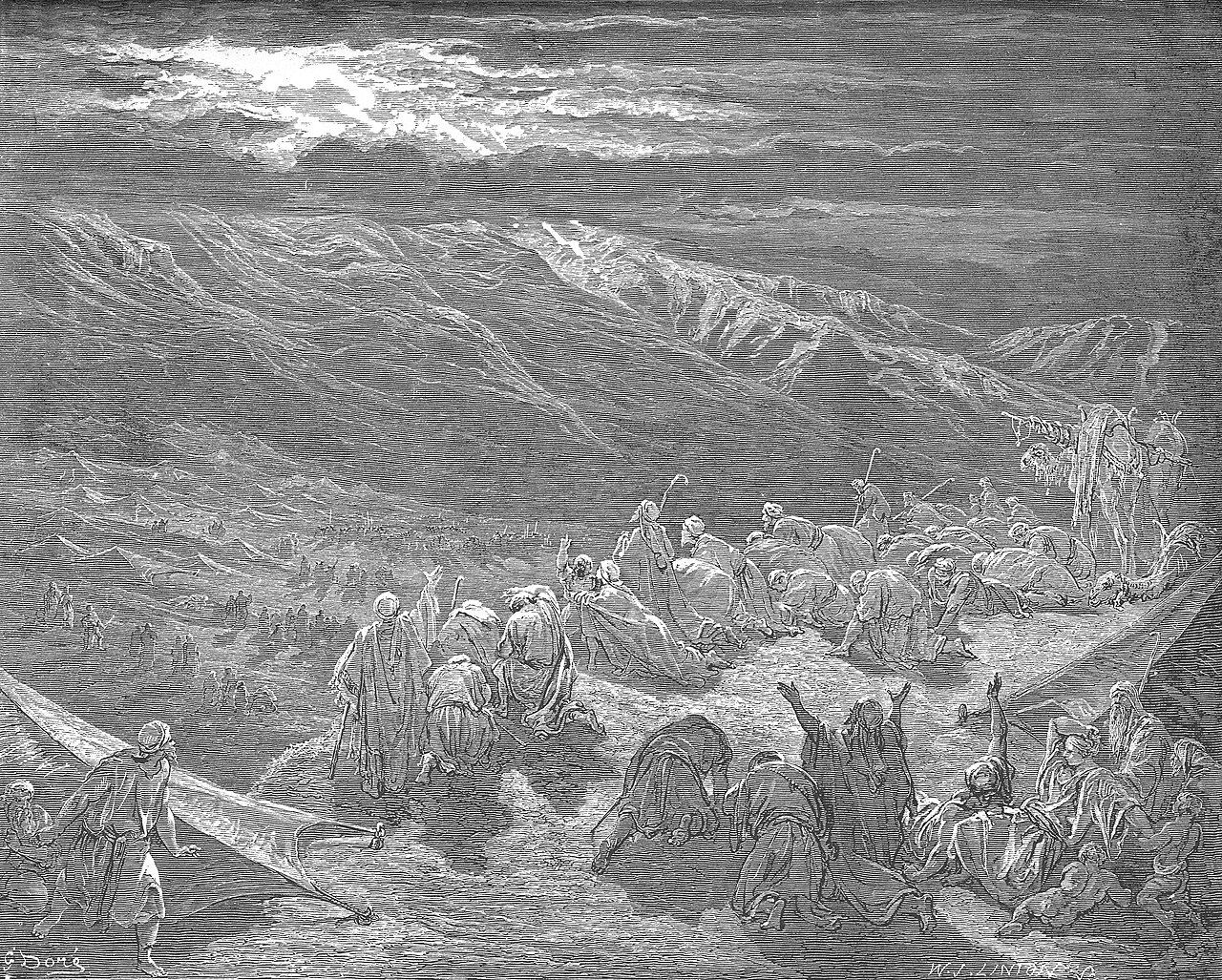
According to Exodus 19–24, the people of Israel arrived at Mount Sinai in the third month after leaving Egypt. There, in a dramatic theophany (thunder, lightning, smoke, trumpet blast), God entered into covenant with Israel and gave the Ten Commandments (Exodus 20) and a broader body of case-law (Exodus 21–23).
Moses ascended the mountain repeatedly over a forty-day period to receive further instruction (Exodus 24:18); this is the narrative setting for the Book of the Covenant and the tabernacle instructions. In Jewish tradition this event is celebrated as Shavuot (the "giving of the Torah"). In Christian interpretation (notably Hebrews 8–10 and 2 Corinthians 3), the Sinai covenant is contrasted with the "new covenant" mediated through Christ.
The physical location of the giving of the Law depends on the debated identification of Mount Sinai itself (see the Mount Sinai node).
◈Which mountain was it?contested
The traditional site is Jebel Musa in the southern Sinai peninsula, marked by monastic tradition since the fourth century.
A second view puts the mountain in Arabia — Paul writes that Sinai is a mountain in Arabia, and the case for Jebel al-Lawz has been argued from that verse and from the eastward route.
The location changes nothing about what was said there. The text names the covenant, not a set of coordinates.