The Covenants
Six covenants in succession, cumulative rather than replacing. Adamic, Noahic, Abrahamic, Mosaic, Davidic, New. Each narrowing the line of promise while widening the scope of fulfillment.
I will cut a covenant with you.
Five oaths across history — each cut with its own sign, none cancelling the last — all leaning toward one Person at one cup. The gold arcs are unconditional grants; the scarlet arc is the conditional treaty of Sinai.
Framework
Karath berith — covenant-cutting in ANE practice and in Scripture
The Hebrew idiom is karath berith — literally, "to cut a covenant." The grammar is physical: parties walk between bisected animals, invoking on themselves the fate of the pieces if they break the oath (Gen 15:9–18; Jer 34:18–20). Gen 15 as structural key: Abraham bisects the animals; "a smoking furnace and a burning lamp" (representing God) passes between them — Abraham does not. The one-sided passage is theologically load-bearing: God obligates himself alone. This is the grammatical basis for calling the Abrahamic unconditional. ANE covenant-cutting is widely attested in second-millennium BC Hittite and Mesopotamian treaty practice; cite Keil & Delitzsch on Genesis (PD) for the comparative-cultural background.
The six covenants surveyed
Adamic (Gen 1:26–30; 2:15–17; 3:14–19) — God with humanity through Adam. Sign: seed of the woman. Classification contested. Noahic (Gen 8:20–9:17) — God with all flesh. Sign: rainbow. Unconditional (preservation). Abrahamic (Gen 12:1–3; 15; 17; 22:15–18) — God with Abraham and his seed. Sign: circumcision. Unconditional (Gen 15 one-sided passage). Mosaic (Ex 19–24; Deut 28–30) — God with national Israel. Sign: Sabbath. Conditional — Jer 31:32 explicitly notes this conditionality. Davidic (2 Sam 7:8–17; Ps 89; Ps 132) — God with David's line. Sign: throne. Unconditional (Ps 89:30–37). New (Jer 31:31–34; Ezek 36:26–27; Luke 22:20; Heb 8) — God with Israel & Judah (expanded to Gentiles per Rom 11). Sign: bread and cup. Unconditional from God's side; inaugurated at the Last Supper; ratified at the cross.
Conditional vs. unconditional classification
Four unconditional (Noahic, Abrahamic, Davidic, New) + one conditional (Mosaic) + one contested (Adamic, classified differently by tradition). The classification is theologically load-bearing. The unconditional covenants ground divine promise in divine oath-keeping; the conditional Mosaic tests human oath-keeping and finds it lacking, setting up the need for the New Covenant. Reformed framework reads the unconditional covenants as the covenant of grace in successive administrations; the Mosaic as the covenant of works republished to show inability (Westminster Confession ch. 7; Owen). Dispensational framework keeps each covenant distinct, preserves Israel-Church distinction, reads the Abrahamic land-promise as literal-territorial and awaiting future fulfillment (Scofield Reference Bible 1909).
The covenant of redemption (pre-temporal, Reformed-specific)
Reformed tradition posits a pre-temporal pactum salutis among the persons of the Trinity: the Father gives a people to the Son, the Son undertakes redemption, the Spirit applies it (John Owen, The Death of Death in the Death of Christ; Herman Witsius, The Economy of the Covenants, both PD). Dispensational and non-Reformed evangelical traditions typically do not affirm the covenant of redemption as a distinct category. Surfaced per §7.9 — Reformed framework, not pan-Christian consensus.
The New Covenant as fulfillment
Jer 31:31–34 — explicit promise of a new covenant with Israel and Judah, distinguished by being inward (law on the heart) not merely outward (stone tablets). Ezek 36:26–27 — paired prophecy of heart-of-flesh replacing heart-of-stone with Spirit-giving. Luke 22:20 — Jesus' inauguration: "This cup is the new testament in my blood." Heb 8:6–13 — direct exposition, quoting Jer 31 in full. Heb 10:15–18 — completion-of-sacrifice argument: "their sins and iniquities will I remember no more." The typological trajectory is cumulative, not replacive: Adamic → Noahic → Abrahamic → Mosaic → Davidic → New. Founder editorial slot reserved on the [[new]] drilldown.
The Covenant Progression — All Lines Converge at Christ
The covenants do not run in parallel. They converge. Each new covenant does not abolish the prior one (the Mosaic does not annul the Abrahamic — Gal 3:17); each adds a register the prior could not carry; all of them flow toward a single point. That point is Christ.
- The Abrahamic seed is Christ — Galatians 3:16: "He saith not, And to seeds, as of many; but as of one, And to thy seed, which is Christ."
- The Mosaic law points to Christ — Galatians 3:24: "the law was our schoolmaster to bring us unto Christ."
- The Davidic throne is Christ''s — Luke 1:32: "the Lord God shall give unto him the throne of his father David."
- The New covenant is in Christ''s blood — Luke 22:20: "This cup is the new testament in my blood, which is shed for you."
The covenants are not competing systems — they are the chapters of a single divine program advancing through time. Hebrews is the inspired commentary on the whole structure: a better covenant (8:6), with better promises (8:6), through a better mediator (8:6, 9:15), by a better sacrifice (9:23). Every "better" in Hebrews is a covenant-category claim: the new fulfills what the prior could only foreshadow.
→ Go deeper: The New Covenant in Christ''s blood
Karath Berith — To "Cut" a Covenant
The Hebrew idiom for making a covenant is karath berith (כָּרַת בְּרִית) — literally to cut a covenant. The verb is the same one used for chopping wood, severing a head, slaughtering an animal. A covenant in the Hebrew Bible is cut, not signed.
The cutting is literal. Animals are slaughtered, divided in halves, and laid opposite each other. The covenant parties walk the path between the pieces, invoking on themselves the death curse of the animals: if I break this covenant, may I be made like these.
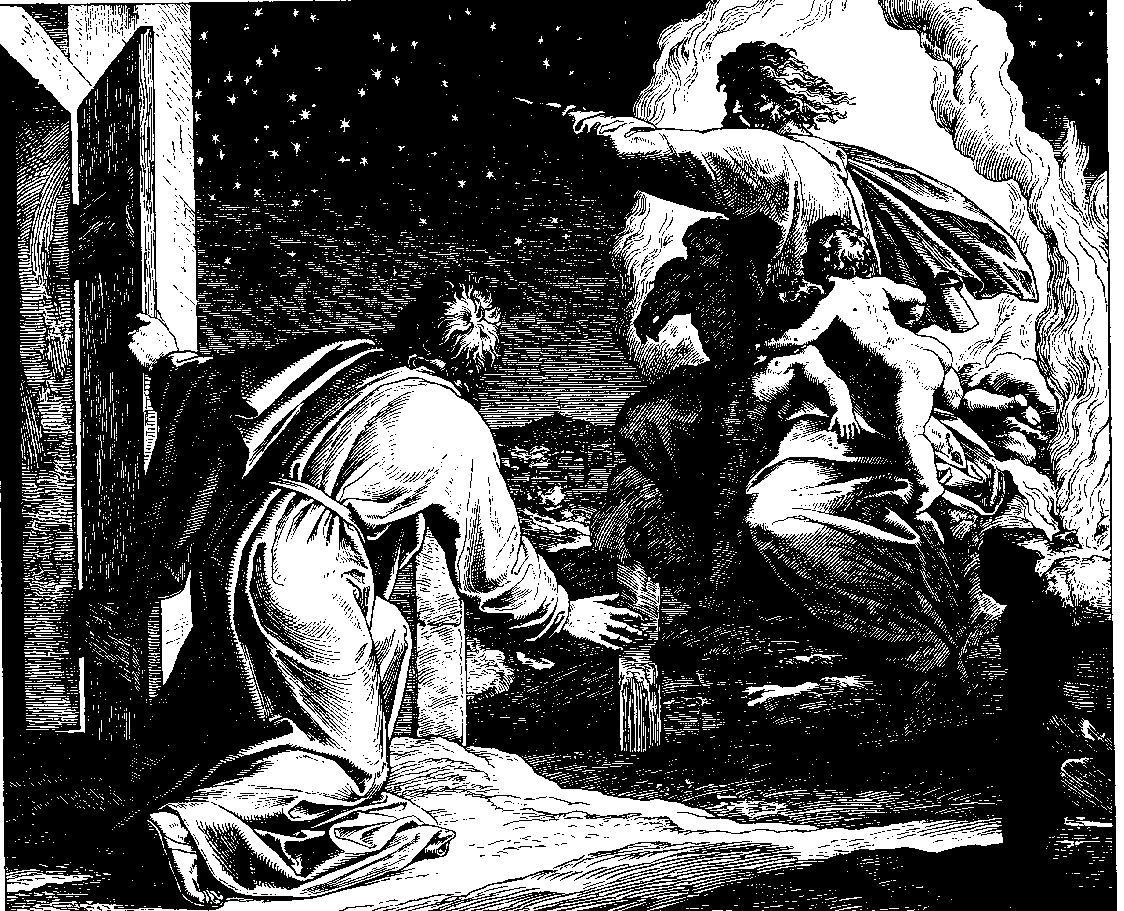
Genesis 15 is the paradigmatic scene. Abram cuts the heifer, the goat, the ram (and divides each in two), the dove and the pigeon (kept whole — birds were not divided in the standard ANE rite). At sunset, Abram falls into a deep sleep. A smoking furnace and a burning lamp — manifestations of the divine presence, paralleled by the pillar of cloud and fire at Sinai — pass between the pieces while Abram sleeps. Only God walks the path. Abram does not. The covenant''s death-curse is invoked only on God; the covenant is unilateral; God alone can break it, and God alone bears the death-curse if it is broken.
This grammar is the theological foundation of the cross. Hebrews 9:15–17 names the requirement explicitly: a covenant (Greek diathēkē, "testament") requires the death of the testator. The death-curse Abram should have walked under, God walked under at Calvary.
→ Go deeper: The Abrahamic covenant — the cutting ceremony exegeted
Depth 2 · the method
Five covenants, one row each
The arc diagram is the shape; this table is the anatomy. Read down the Condition and Type columns and unconditional-vs-conditional stops being a claim and becomes visible structure — the one distinction that governs the whole page.
| Covenant | Parties | Promise | Sign | Condition | Type (Weinfeld) | Mediator | Scripture | Fulfillment (framework note) |
|---|---|---|---|---|---|---|---|---|
| Noahic | God ↔ Noah & all flesh / every living creature | Never again to destroy all flesh by a flood; seasons will not cease | The bow in the cloud (rainbow) | Unconditional / universal / unilateral | Promissory (universal maintenance) | Noah | Gen 9:8–17 | Standing; both frameworks agree — cosmic preservation until the new creation |
| Abrahamic | God ↔ Abraham & his seed | Land, seed (nation), blessing to all families of the earth | Circumcision | Unconditional grant (God passes through alone, Gen 15:17) | Royal grant | Abraham | Gen 12:1–3; 15; 17 | CONTESTED: dispensational = literal future land to national Israel (Rom 11:29 irrevocable); covenantal = land is a type escalating to Christ / 'heir of the world' (Rom 4:13) / heavenly country (Heb 11:10,16) |
| Mosaic (Sinai) | God ↔ Israel | Israel a treasured possession, a kingdom of priests, a holy nation (Exod 19:5–6) | The Sabbath | CONDITIONAL — 'if ye will obey my voice' (Exod 19:5); blessings & curses (Deut 27–28) | Suzerain–vassal treaty (six-part Hittite form) | Moses | Exod 19–24; 31:12–17; Deut | Fulfilled and superseded in Christ (Heb 8–10; 2 Cor 3:6–18); framework nuance on the law's continuing role |
| Davidic | God ↔ David & his house | An enduring house, throne, and kingdom forever; a son (2 Sam 7:12–16) | The throne (an established throne forever — emblem, not a ritual sign) | Unconditional grant; chastened but not revoked (2 Sam 7:14–15; Ps 89:30–37) | Royal grant | David / Nathan | 2 Sam 7:8–16; Ps 89; Ps 132 | Christ enthroned (Acts 2:30–36; Luke 1:32–33); framework nuance on a future millennial throne |
| New | God ↔ house of Israel & Judah (Jer 31:31); the church by NT application | Law written within, forgiveness of sins, 'I will be their God, they my people' | The cup ('this cup is the new covenant in my blood', Luke 22:20) | Unconditional grace, monergistic ('I will' — Jer 31:33–34) | Promissory | Christ (Heb 9:15; 12:24) | Jer 31:31–34; Ezek 36:26–27; Luke 22:20; Heb 8:8–12 | Inaugurated at the cup/cross; consummation and membership-scope (Israel vs church) contested |
Optional sixth row (dossier): a Priestly (Phinehas) covenant — Num 25:12–13, 'a covenant of an everlasting priesthood' — belongs in the six-covenant set but not in the five-arc diagram; it is offered as a study-rail note, not an arc.
Why the table reads as it does — Weinfeld's grant vs. treaty
An obligatory vassal treaty is conditional — the lord imposes duties on the vassal (the pattern of Sinai/Mosaic). A promissory royal grant rewards an already-loyal servant with an unconditional, perpetual gift of land or dynasty (the pattern of Abrahamic & Davidic). This single distinction is why Genesis 15 and 2 Samuel 7 read as grace while Exodus 19–24 reads as obligation.
Moshe Weinfeld, “The Covenant of Grant in the OT and in the ANE” (JAOS 90, 1970) — cite-only.

Genesis 15 — the covenant of the piecesDepth 3 · the exemplar
The idiom is karath berith (Gen 15 ff.) — literally to cut a covenant. Watch the rite in five steps; the key that unlocks it is in-canon, three chapters short of the exile.
- 01Gen 15:9
God tells Abram to bring a heifer, a she-goat, a ram (each three years old), a turtledove, and a young pigeon.
Abram divides the animals in two and lays each half opposite its other (the birds are not divided).
At sundown a deep sleep and a great darkness fall upon Abram.
'A smoking furnace, and a burning lamp' — the theophany — passes between the pieces. God alone walks the aisle; Abram is asleep.
'In that same day the LORD made a covenant with Abram, saying, Unto thy seed have I given this land.'
The key — the Bible's own explanation of the rite
Jeremiah 34:18— Judah's leaders "cut the calf in twain, and passed between the parts thereof." The divided animals are a self-curse: may I become like these carcasses if I break my word. Because in Genesis 15 God passes between the pieces alone (Abram is asleep), the self-curse is His own — the grant is unilateral and unconditional (Heb 6:13–18, "he sware by himself").
ANE corroboration: the same self-maledictory cutting rite appears in the Sefire inscriptions and the Abba-El / Alalakh "I cut the neck of a lamb" formula — Hillers 1969 (cite-only).

◈Does 'cut a covenant' (karath berith) always encode a self-maledictory oath?contested · root-fallacy caution
The claim (Hillers 1969 — standard, for the ritual)
The Gen 15 / Jer 34 divided-animal rite is a self-curse: 'may I be dismembered if I break faith.' Because God passes between the pieces alone (Gen 15:17), the self-curse is His own — the grant is unilateral (Heb 6:13–18).
The critique (full strength)
Extending 'karath = cut = therefore every covenant is a self-curse' to the WORD is a root fallacy (Carson, Exegetical Fallacies) — most OT covenant-cuttings carry no divided-animal rite at all.
Ruling
Surface the self-curse where the RITUAL is present (Gen 15; Jer 34), not as a blanket etymology.
Sources: Gen 15:17; Jer 34:18; Heb 6:13–18. Hillers 1969; Carson, Exegetical Fallacies (cite-only).
The six-part treaty form under the Mosaic covenantDepth 3 · the substrate
Deuteronomy runs the full six-part second-millennium Hittite suzerainty-treaty sequence — the legal form every Ancient Near Eastern reader already knew. The biblical covenant did not invent a shape; it filled a known one.
| # | Treaty part | Function | Deuteronomy |
|---|---|---|---|
| 1 | Preamble | identifies the great king and his titles | Deut 1:1–5 |
| 2 | Historical prologue | the suzerain's past benefactions — obligation grounded in gratitude | Deut 1:6–4:49 |
| 3 | Stipulations | the terms the vassal must keep | Deut 5–26 |
| 4 | Deposit & periodic public reading | the treaty stored in the sanctuary and read aloud | Deut 27; 31:9–13 |
| 5 | List of witnesses | the gods (in Israel: heaven and earth) | Deut 30:19; 32:1 |
| 6 | Blessings & curses | sanctions for fidelity and breach | Deut 27–28 |
Attribution: Korošec 1931 → Mendenhall 1954 → Kline 1963 (all cite-only); Weinfeld 1970 for the grant-vs-treaty distinction.
Hammurabi 196 — the casuistic law-form underneath
The Covenant Code's talion (Exod 21:24, "eye for eye, tooth for tooth") sits beside Hammurabi §196–197 — a shared Ancient Near Eastern casuistic form. The contrast is the point: Hammurabi's penalties are class-stratified; the Torah's talion is not.
Code of Hammurabi §196, L. W. King trans., 1915 (public domain) — cited fact, not a claim.

◈Do the ANE treaty parallels date the Deuteronomy material early?contested · date disputed
The claim (Kitchen 2003; Kline 1963)
The full six-part form WITH a historical prologue is distinctively second-millennium Hittite; first-millennium Neo-Assyrian treaties drop the prologue and front-load curses. Deuteronomy has the prologue → a late-second-millennium (Mosaic-era) date.
The critique (full strength)
Many critical scholars date Deuteronomy's form to the 7th century, citing close parallels to the Neo-Assyrian Vassal Treaties of Esarhaddon (VTE, 672 BC); Ernest Nicholson (1986) reads covenant as a late theological development.
Ruling
Present both dates; do not adjudicate.
Sources: Deut 1–28. Kitchen 2003; Kline 1963 vs Nicholson 1986 (all cite-only).
Where the fulfillment forks — three readings, side by sideDepth 3 · the frameworks
Which passages enact a covenant, who the parties are, and what the sign is are floor data all three systems share. The interpretive fork comes only at the fulfillment step. Each framing is stated at full strength and attributed; none is adjudicated here — there are no confidence badges.
Covenant theology
One covenant of grace (framed by a pretemporal covenant of redemption and a prelapsarian covenant of works), administered through the historical covenants and fulfilled in Christ; land and throne are types escalating to the new creation and the church.
The land reading: Abraham 'heir of the world' (Rom 4:13); 'a city… a heavenly country' (Heb 11:10,16).
“Man by his fall having made himself incapable of life by that covenant, the Lord was pleased to make a second, commonly called the covenant of grace: wherein He freely offereth unto sinners life and salvation by Jesus Christ.”Westminster Confession of Faith 7.3 (1646, public domain)public domain
Sources: Horton 2006; Robertson 1980; Vos 1948; Westminster Confession ch. 7 (1646, PD).
Dispensationalism
Marc's flagSuccessive administrations; a consistent literal hermeneutic; a preserved distinction between national Israel and the church; OT land and kingdom promises to Israel await future literal fulfillment.
The land reading: Gen 15:18 is an unconditional grant (Weinfeld); Rom 11:29 'the gifts and calling of God are without repentance' → the land promise is future and literal.
Sources: Ryrie 2007; Vlach 2008; Blaising & Bock 1993 (all cite-only).
Progressive covenantalism
The biblical covenants climax in Christ without either the covenant-of-grace overlay or the rigid Israel/church dichotomy — surfaced as a labeled third framing so the page is not a false binary.
The land reading: The land/kingdom promises are fulfilled and escalated in Christ and the new creation, without a distinct national-Israel program.
Sources: Gentry & Wellum, Kingdom through Covenant, 2018 (cite-only).
The two flashpoints — claim and critique, both at full strength
◈Romans 11:27 — 'this is my covenant unto them': future national Israel, or the elect remnant?contested · framework flashpoint
The claim (dispensational — Marc's flag)
Paul cites Isa 59:20–21 / 27:9: 'this is my covenant unto them, when I shall take away their sins' (Rom 11:26–27). Read literally, this pledges a future national turning of ethnic Israel — 'all Israel shall be saved' after the fullness of the Gentiles — because 'the gifts and calling of God are without repentance' (Rom 11:29).
The critique (full strength)
'All Israel' is the elect remnant — the one olive tree into which believing Jew and Gentile are grafted (Rom 11:17–24); 'they are not all Israel, which are of Israel' (Rom 9:6). The covenant is realized now in the remnant, not deferred to a separate national program.
Ruling
Both readings cited; neither adjudicated. Steelman both.
Sources: Rom 11:26–29; Rom 9:6; Isa 59:20–21. Vlach 2008; Ryrie 2007 vs Wellum 2022; Gentry & Wellum 2018 (all cite-only).
◈The Abrahamic land grant — fulfilled literally, or as a type?contested · framework flashpoint
The claim (dispensational — Marc's flag)
Gen 15:18 is an unconditional royal grant (Weinfeld); Rom 11:29 says the gifts and calling are irrevocable. The land promise is therefore a future, literal territorial inheritance for national Israel.
The critique (full strength)
The land is a TYPE that escalates to the whole renewed cosmos: Paul makes Abraham 'heir of the world' (Rom 4:13); Hebrews 11:10,16 says Abraham sought 'a city… a heavenly country.'
Ruling
Framework toggle on Gen 15:18; both cited, neither adjudicated.
Sources: Gen 15:18; Rom 4:13; Heb 11:10,16. Vlach 2008; Ryrie 2007 vs Wellum 2022; Gentry & Wellum 2018 (all cite-only).
◈Is there a prelapsarian 'covenant of works' with Adam as federal head?contested · interpretive framework, not a floor datum
The claim (covenant theology)
Westminster Confession 7.2 (1646, PD) reads Gen 2:16–17 as a works-covenant; Hosea 6:7 ('they like Adam have transgressed the covenant') is cited as proof.
The critique (full strength)
The word berith does not appear in Gen 2–3; dispensationalists and many Baptists deny the construct as read-in; the Hosea 6:7 rendering is disputed ('like Adam' vs 'at Adam' [a place name] vs 'like men').
Ruling
Present as an interpretive framework, not a floor datum. (This is why the arc set locks at five covenants — Noah → New — not an Adamic arc.)
Sources: WCF 7.2 (PD); Gen 2:16–17; Hosea 6:7; dispensational responses (cite-only).
The threads that run throughDepth 3 · the web
Beyond the six enactment anchors, the covenant line is stitched across the canon by explicit quotation and shared vocabulary. Each opens the verse it starts from.
Gen 15:6Rom 4:3 / Gal 3:6 / Jas 2:23
'Abram believed the LORD, and it was counted to him for righteousness' — quoted three times in the NT as the charter of justification by faith.
quote-explicit (PD-conv; xcheck-UBS)
Gen 17:11Rom 4:11
Circumcision read as 'a seal of the righteousness of the faith' Abraham already had — the sign subordinated to faith.
quote-explicit; Horton 2006 (cite-only)
Gen 17:10Col 2:11
Physical circumcision prefigures the heart-circumcision 'of Christ' — the sign fulfilled inwardly.
text (Col 2:11–12); explicit-nt
2 Sam 7:14Heb 1:5
'I will be to him a Father, and he shall be to me a Son' applied to the Son (also Ps 2:7) — messianic on both readings.
quote-explicit
2 Sam 7:12Acts 2:30
Peter reads the Davidic throne-promise as fulfilled in the resurrected, enthroned Christ (Acts 2:29–36).
text; explicit-nt
Jer 31:31Heb 8:8
Hebrews quotes the entire Jeremiah 31 oracle (Heb 8:8–12) — the longest single OT quotation in the NT.
quote-explicit (PD-conv; xcheck-UBS)
Jer 31:33Heb 10:16
'I will put my laws into their hearts' requoted in Hebrews 10 as proof the new covenant perfects worshippers.
quote-explicit (PD-conv; xcheck-UBS)
Ezek 36:26Jer 31:33
'A new heart… my spirit within you' parallels the internalized-law promise — the two great new-covenant oracles interpret each other.
bt-consensus
Exod 24:8Heb 9:20
Hebrews quotes 'the blood of the covenant' verbatim as the shadow of Christ's covenant-inaugurating blood (Heb 9:18–20).
quote-explicit; explicit-nt
Exod 19:61 Pet 2:9
The Sinai vocation 'a kingdom of priests, an holy nation' applied directly to the church — a royal priesthood.
text; explicit-nt
Gen 9:13Rev 4:3
The bow set after the flood reappears as the rainbow encircling the throne — the mercy-sign at the throne of grace. Figural/traditional; labeled as tradition (Edwards, PD), not fulfilment.
Edwards, Images of Divine Things (PD); contested figural association
Gal 4:24Gal 4:24
Paul's own two-covenants allegory: Hagar/Sinai/bondage vs Sarah/Jerusalem-above/freedom — an explicit covenant-contrast text.
text (allegoreo)
2 Cor 3:62 Cor 3:6
'Ministers of a new testament [covenant]; not of the letter, but of the spirit' — anchors the Mosaic-vs-new contrast.
text
The covenant wordsDepth 3 · the workbench
The idiom the whole page rides on is karath berith. Each door opens the workbench — the full lexicon entry and every tagged occurrence, live from the floor. A shared root proves vocabulary, not theology (the Carson caution) — karath's "cut" is surfaced as a self-curse only where the divided-animal rite is present.
The covenant word itself — door to every enactment across the OT (Noahic sign Gen 9:13, circumcision Gen 17, Sinai Exod 24, Jer 31). ~287 OT occurrences (confirm live).
The NT covenant word; the LXX choice that carries berith into the new covenant (Luke 22:20; Heb 8–10; Gal 3–4). The 'covenant/testament' ambiguity is itself a study point (Heb 9:16–17).
The verb behind 'make a covenant' — karath berith, literally 'cut a covenant.' Anchors the Gen 15 ceremony. Caution: do not over-read as 'every covenant is a self-curse' (root fallacy).
The seed-thread word Paul leverages in Gal 3:16 ('not seeds, but seed… which is Christ'); carries one promise Gen 3:15 → Gen 22:18 → 2 Sam 7:12 → Ps 89:4.
The covenant-loyalty word — the disposition God keeps toward covenant partners ('the sure mercies of David,' Isa 55:3).
The witnessesDepth 3 · the voices
The signs, in the canon's own words (KJV, public domain), each linking to the verse. Attribution and tradition are always visible; nothing is flattened.
“I do set my bow in the cloud, and it shall be for a token of a covenant between me and the earth.”
Scripture· KJVpublic domain
“behold a smoking furnace, and a burning lamp that passed between those pieces.”
Scripture· KJVpublic domain
“And ye shall circumcise the flesh of your foreskin; and it shall be a token of the covenant betwixt me and you.”
Scripture· KJVpublic domain
“Behold the blood of the covenant, which the LORD hath made with you concerning all these words.”
Scripture· KJVpublic domain
“Verily my sabbaths ye shall keep: for it is a sign between me and you throughout your generations.”
Scripture· KJVpublic domain
“And thine house and thy kingdom shall be established for ever before thee: thy throne shall be established for ever.”
Scripture· KJVpublic domain
“Behold, the days come, saith the LORD, that I will make a new covenant with the house of Israel, and with the house of Judah.”
Scripture· KJVpublic domain
“when they cut the calf in twain, and passed between the parts thereof.”
Scripture· KJVpublic domain
“This cup is the new testament in my blood, which is shed for you.”
Scripture· KJVpublic domain
Modern authors — cited only (≤50 words, never ingested)
- Moshe Weinfeld, The Covenant of Grant in the OT and in the ANE (JAOS 90, 1970) — The grant-vs-treaty distinction: an obligatory vassal treaty is conditional; a promissory royal grant rewards a loyal servant unconditionally.
- George E. Mendenhall, Covenant Forms in Israelite Tradition (BA 17.3, 1954) — First mapped the Hittite suzerainty-treaty form onto the Sinai covenant.
- Meredith G. Kline, Treaty of the Great King (Eerdmans, 1963) — Reads Deuteronomy as a single covenant document in the second-millennium treaty form.
- Delbert R. Hillers, Covenant: The History of a Biblical Idea (Johns Hopkins, 1969) — The standard study of the self-maledictory cutting rite behind Gen 15 and Jer 34.
- Michael Horton / O. Palmer Robertson, God of Promise (2006) / The Christ of the Covenants (1980) — The covenant-theology synthesis: one covenant of grace across the historical covenants.
- Charles Ryrie / Michael Vlach, Dispensationalism (2007) / Dispensationalism (2008) — The dispensational case for a preserved Israel-church distinction and a future literal land.
- Peter Gentry & Stephen Wellum, Kingdom through Covenant (Crossway, 2018) — The progressive-covenantal third way — the covenants climax in Christ without either overlay.
OnwardWhere the covenants cross
The blood of the covenant → the Scarlet Thread
Exodus 24:8 "blood of the covenant" → the cup (Luke 22:20); Hebrews 9:19–20 binds blood, water, scarlet wool, and hyssop into one ratification rite.
The Davidic seed → the Genealogies of Christ
The seed-grant (zeraʿ) built from Abraham to David lands on the enthroned Son — "son of David" (Matt 1; Acts 2:30–36).
Sources
Sources.Scripture: KJV/ASV/WEB (resident floor, PD). Westminster Confession of Faith ch. 7 (1646, PD). Code of Hammurabi, L. W. King trans. (1915, PD). STEPBible TAHOT/TAGNT (CC BY 4.0). OpenBible.info cross-references (CC BY). Artwork (Wikimedia Commons, license-verified at render): Joseph Anton Koch, Landscape with Noah (c. 1803, PD); Gerard Hoet et al., Figures de la Bible (1728, PD); Julius Schnorr von Carolsfeld, Die Bibel in Bildern (1860, PD); Treaty of Kadesh tablet photo (CC BY 3.0, Iocanus — attribution rendered under the image). Cite-only (modern, copyrighted, ≤50 words, never ingested): Mendenhall 1954; Weinfeld 1970; Kline 1963; Hillers 1969; Kitchen 2003; Nicholson 1986; Horton 2006; Robertson 1980; Ryrie 2007; Vlach 2008; Gentry & Wellum 2018; Parker & Lucas 2022. Everything on this page is AI-proposed → Marc-approved → published; nothing auto-publishes.