
Event
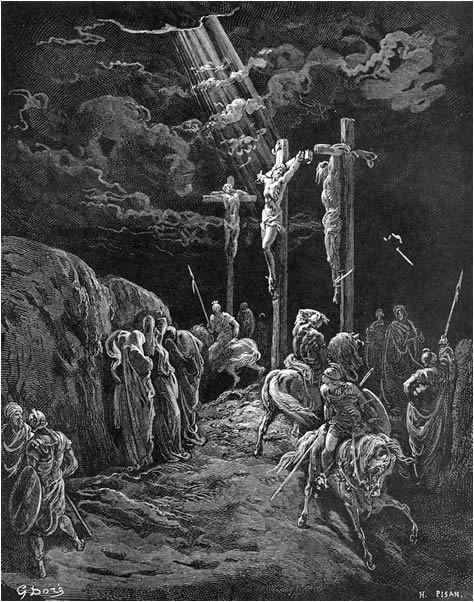
Crucifixion of Christ
The public execution of Jesus of Nazareth by Roman crucifixion in Jerusalem under Pontius Pilate — the central event of the Christian faith.
Also called The Passion · Good Friday
Start here
Why the cross stands at the center
The cross was not a tragedy the church later made the best of. It was the plan. Jesus said He came to give His life as a ransom for many, and He said it long before anyone laid a hand on Him.
Every sacrifice from Genesis forward pointed here: an innocent life given, the guilty set free. At Calvary the Lamb was God's own Son, and the debt was not reduced — it was paid.
Isaiah described the scene about seven hundred years early: pierced, crushed, silent before His accusers, numbered with sinners, buried with the rich. Read Isaiah 53 beside John 19 and the two read like one report.
The record itself
Where it is written
Surely He took on our infirmities and carried our sorrows; yet we considered Him stricken by God, struck down and afflicted. But He was pierced for our transgressions, He was crushed for our iniquities; the punishment that brought us peace was upon Him, and by His stripes we are healed. We all like sheep have gone astray, each one has turned to his own way; and the LORD has laid upon Him the iniquity of us all.Written centuries before the nails: the wounds and the reason for them.
From the sixth hour until the ninth hour darkness came over all the land. About the ninth hour Jesus cried out in a loud voice, “Eli, Eli, lema sabachthani?” which means, “My God, My God, why have You forsaken Me?”Darkness over the land, and the cry that opens Psalm 22.
After this, knowing that everything had now been accomplished, and to fulfill the Scripture, Jesus said, “I am thirsty.” A jar of sour wine was sitting there. So they soaked a sponge in the wine, put it on a stalk of hyssop, and lifted it to His mouth. When Jesus had received the sour wine, He said, “It is finished.” And bowing His head, He yielded up His spirit.“It is finished” — one word in Greek, the word written across a paid bill.
For what I received I passed on to you as of first importance: that Christ died for our sins according to the Scriptures, that He was buried, that He was raised on the third day according to the Scriptures,The earliest creed the church carried: died, buried, raised, according to the Scriptures.
The account in brief
What happened
The crucifixion of Jesus is recorded in all four canonical Gospels (Matthew 27; Mark 15; Luke 23; John 19). It is attributed to a combination of Jewish religious leadership accusations and the Roman administrative decision of the prefect Pontius Pilate (governor of Judea c. 26–36 CE).
The crucifixion took place at Golgotha ("place of a skull"), a location just outside the city walls of Jerusalem at the time; the traditional site since at least the 4th century has been within what is now the Church of the Holy Sepulchre. The date is debated within a narrow window — most scholars place it on either Friday, April 7, 30 CE, or Friday, April 3, 33 CE. Non-Christian ancient references to the crucifixion include Tacitus (Annals 15.
44) and Josephus (Antiquities 18.3 — in the debated Testimonium Flavianum). The event is described as a voluntary substitutionary sacrifice in the New Testament (e.g., Mark 10:45; Romans 5:6–8; 1 Peter 2:24) and is foundational to Christian theology. In Christian tradition, it is remembered on Good Friday.
◈The year: AD 30 or AD 33?contested
The Gospels fix the day — a Friday, Passover, under Pontius Pilate — but not the year. Two Fridays in Pilate's governorship fall on the right Passover date: 7 April AD 30 and 3 April AD 33.
AD 33 fits Luke's note that John began preaching in the fifteenth year of Tiberius and squares with Daniel's sixty-nine weeks counted from Artaxerxes' decree. AD 30 fits a shorter public ministry.
Nothing in the faith rests on which Friday it was. The event, the witnesses, and the empty tomb are the claim.