The Seven Signs of John
John never calls them mighty works — he calls them signs, deeds that point past themselves to who the doer is.
These are written, that ye might believe.
Framework
Sign, not spectacle
The Synoptic Gospels reach for dynamis — a "mighty work," a display of power. John almost never does. His word for the miracles is sēmeion (sēmeion, G4592), a sign: a deed that points beyond itself to who the doer is. Thayer's Lexicon glosses it as "a sign, mark, token… by which God authenticates the men sent by him" (Thayer, s.v. σημεῖον, PD). The shift in vocabulary is the shift in argument. A mighty work asks for astonishment; a sign asks for a verdict.
That is why John frames the works as evidence rather than wonder. Each one is admissible testimony toward a single claim — "that ye might believe that Jesus is the Christ, the Son of God" (John 20:31). Westcott read the signs precisely this way: revelations of Christ's glory, not demonstrations of raw power (Westcott, The Gospel According to St. John, 1882, PD — named, not quoted).
The floor bears the weight. Across John, the verb the whole Gospel is for — pisteúō, "to believe" (G4100) — appears 98 times, 41% of its 237 New Testament occurrences (per the John distinctive-words floor). The signs are the exhibits; belief is the requested finding. Read the works as a case, and the strangeness of John's word choice becomes its point.
Every sign opens a door in the text
The signs are not scattered marvels — in John each one opens directly into teaching that interprets it, and the greatest of them lock onto an "I am" saying. Feeding the five thousand (John 6:14) gives way to "I am the bread of life" (6:35), the loaves answering the wilderness manna (cf. Exod 16:15). The man born blind receives sight (John 9:7) beside "I am the light of the world" (8:12; 9:5). Lazarus comes forth from the tomb (John 11:44) under the word "I am the resurrection, and the life" (11:25).
Even the barest sign speaks this way. On the sea Jesus says only "It is I; be not afraid" (John 6:20) — but the Greek is egō eimi, the emphatic "I AM" that is John's grammatical signature (the pronoun egō runs 309 times in John, 37% of its New Testament total, per the floor). The sign and the claim are welded together: the deed shows, the word names.
So a sign in John is never finished when the miracle ends. It is the threshold of a discourse, and the discourse is where the sign says out loud what the deed said in act. To read the signs well is to keep reading past the wonder into the words it was given to introduce.
Cana to Cana, Galilee to a tomb
The Book of Signs has a shape you can trace on a map. It opens "in Cana of Galilee" (John 2:11) and returns there for the second numbered sign — "This is again the second miracle that Jesus did, when he was come out of Judaea into Galilee" (John 4:54). Those two Cana signs are the only ones John numbers, and they frame the movement from a village wedding outward.
From that frame the signs escalate in stakes, not just in scale. The series runs from glory quietly manifested at a feast to a dead man called out of his grave by name — from water made wine to life pulled back through death. The atlas division (sourced to Brown, Anchor Bible 1966; Dodd, Interpretation of the Fourth Gospel 1953; Köstenberger, John BECNT 2004 — all cite-only) sets the Book of Signs at 1:19–12:50, framed by the structural pair 2:11 ↔ 11:44.
That geography matters because it keeps the signs from reading as a list. They are a road: each stop farther from the wedding table, each claim heavier than the last, until the final sign stands at the mouth of a tomb — where the Gospel's own summit, "I am the resurrection, and the life," is spoken before the stone is moved. The Gospel of John hub lays out the full arc; the reader picks it up at John 2.
Featured study
A gospel built as an argued case
John never calls the miracles “mighty works.” His word is sēmeion — a sign, a deed that points beyond itself to who the doer is. After the Prologue, the first half of the Gospel (chapters 1–12) is often called the Book of Signs: seven public works, building from glory manifested at a village wedding to a dead man called out of his tomb by name.
The count is a scholarly reconstruction — John never numbers past two — and this page says so honestly below. What is not a reconstruction is the purpose: the Gospel closes by telling you exactly why these particular works were written down.
The arc
Seven signs, one unbroken line
Series per atlas lens 16 (structural markers), tier: curated — a scholarly count, not a stated number. Every node is a door into the reader.
The stated purpose
Why these seven were written down
And many other signs truly did Jesus in the presence of his disciples, which are not written in this book: But these are written, that ye might believe that Jesus is the Christ, the Son of God; and that believing ye might have life through his name.The Gospel's own selection principle — and the floor agrees: believe (pisteúō) occurs 98 times in John, 41% of its whole New Testament count.
The signs in art
The first sign and the last
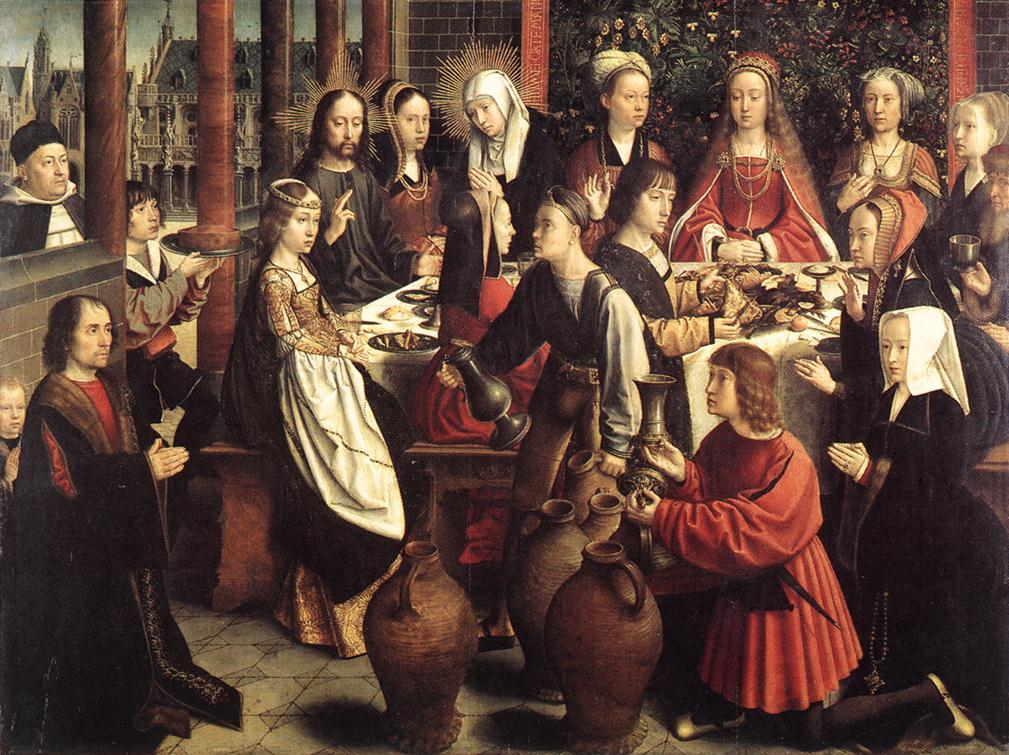
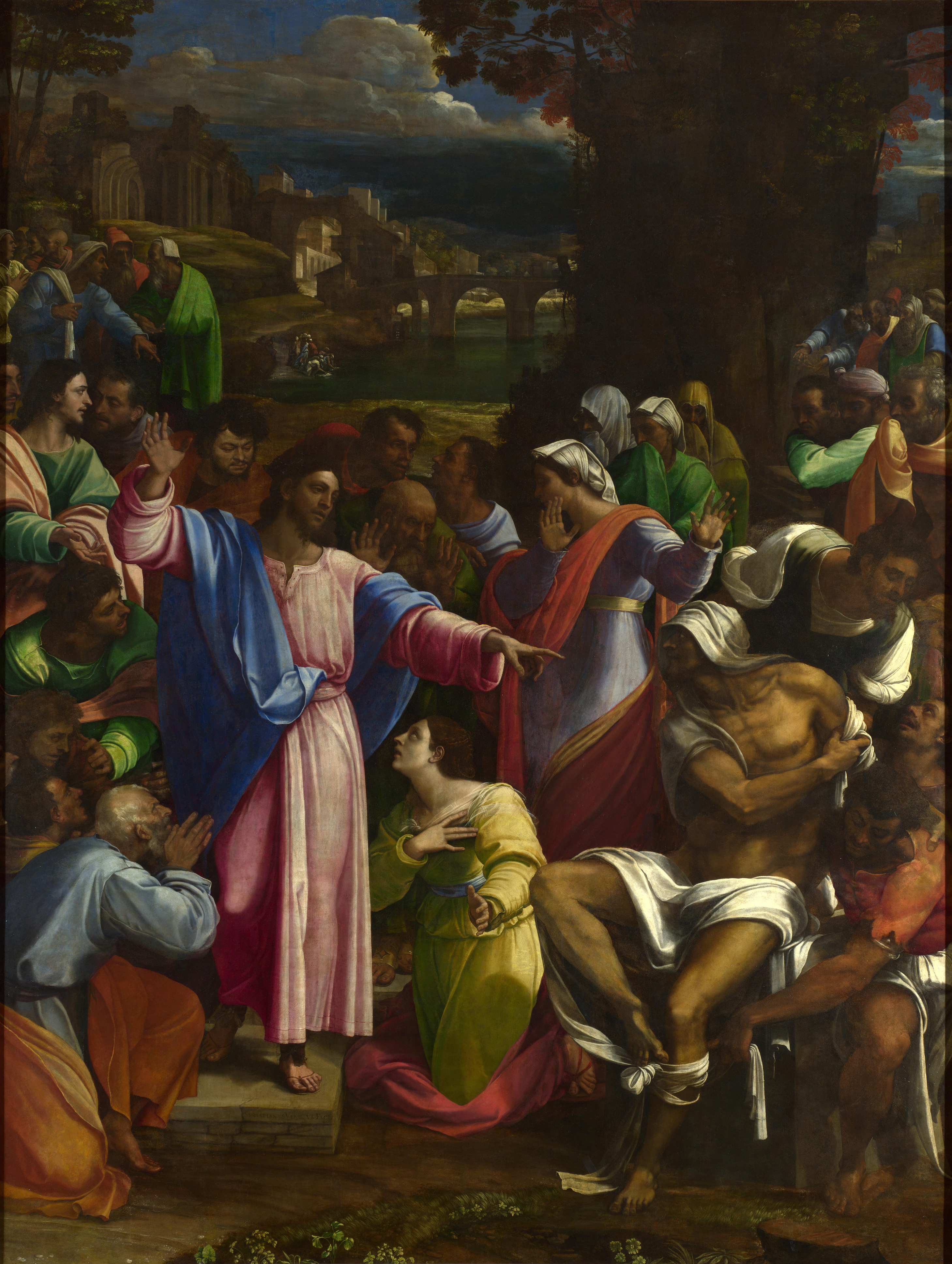
Claim and receipt
Each sign makes a claim
| Sign | The text (KJV) | The claim it carries |
|---|---|---|
| 1 · Water to wineJohn 2:11 | This beginning of miracles did Jesus in Cana of Galilee, and manifested forth his glory; and his disciples believed on him. | Glory manifested — the Book of Signs opens on the word the whole arc builds toward. |
| 2 · The nobleman's sonJohn 4:50 | Jesus saith unto him, Go thy way; thy son liveth. And the man believed the word that Jesus had spoken unto him. | The bare word heals at a distance — believing the word precedes seeing the result. |
| 3 · The man at BethesdaJohn 5:8–9 | Rise, take up thy bed, and walk. And immediately the man was made whole, and took up his bed, and walked. | Sabbath authority — the sign opens into “My Father worketh hitherto, and I work” (5:17). |
| 4 · Feeding the five thousandJohn 6:14 | Then those men, when they had seen the miracle that Jesus did, said, This is of a truth that prophet that should come into the world. | Paired I AM: “I am the bread of life” (6:35) — the loaves answer the manna (Exod 16:15). |
| 5 · Walking on the seaJohn 6:20 | But he saith unto them, It is I; be not afraid. | The barest claim of all — the Greek of “It is I” is egō eimi, John's signature emphatic I AM. |
| 6 · The man born blindJohn 9:7 | Go, wash in the pool of Siloam… He went his way therefore, and washed, and came seeing. | Paired I AM: “I am the light of the world” (8:12; 9:5) — sight given where sight never was. |
| 7 · Lazarus raisedJohn 11:43–44 | He cried with a loud voice, Lazarus, come forth. And he that was dead came forth. | Paired I AM: “I am the resurrection, and the life” (11:25) — life over death, the arc's summit. |
Contested
◈Is “seven signs” John's number, or ours?contested · curated series — the count is scholarly
The standard seven, ending at Lazarus
The common scholarly series runs 2:11 → 4:54 → 5:9 → 6:14 → 6:21 → 9:7 → 11:44, with Lazarus as the climactic seventh — the arc from glory to life-over-death that frames the Book of Signs.
Raymond E. Brown· The Gospel According to John (Anchor Bible, 1966) — cite-only; so also Köstenberger, John (BECNT, 2004)
The seventh sign is genuinely open
John numbers only two signs (2:11 “beginning”; 4:54 “the second”) and never says “seven.” The walking on the sea is never called a sēmeionin the text, so some count the resurrection itself as the seventh (cf. 2:18–19, “Destroy this temple, and in three days I will raise it up”). The atlas flags the whole series as tier: curated — a reconstruction, presented as one.
The signs-source hypothesis, and its answer
Bultmann posited a pre-Johannine “signs source” behind the numbered signs. The counter: the numbering stops after two, the Gospel’s style is famously seamless, and the numerals read naturally as the evangelist’s own Cana-to-Cana frame (“when he was come out of Judaea into Galilee,” 4:54). Both positions shown; neither adjudicated here.
Rudolf Bultmann· Das Evangelium des Johannes (1941) — cite-only; counter per Carson, John (1991) and Köstenberger (2004), cite-only
Why these links
The Gospel’s own honesty about signs
“That ye might believe” (John 20:31)
Then said Jesus unto him, Except ye see signs and wonders, ye will not believe. (John 4:48)
John's own caution inside the signs themselves — sign-seeking is not yet faith.
But though he had done so many miracles before them, yet they believed not on him: that the saying of Esaias the prophet might be fulfilled… (John 12:37–38)
The Book of Signs closes on unbelief despite the signs, read as Isaiah 53:1 fulfilled — evidence invites a verdict; it does not compel one.
Start where the signs start
Enter the reader at John 2 →Go deeper