The Sermon on the Mount
The longest teaching of Jesus in any Gospel — a floorplan you can walk, opening on blessing and ending on a house built to stand.
He taught them as one having authority.
Framework
The first of five books
Matthew hangs his Gospel on five great blocks of teaching, and the Sermon on the Mount (chapters 5–7) is the first of them. Each block is sealed by the same formula — "and it came to pass, when Jesus had finished these sayings" — which recurs at 7:28, 11:1, 13:53, 19:1, and 26:1. Benjamin W. Bacon named the pattern ("The 'Five Books' of Matthew Against the Jews," The Expositor, 1918; Studies in Matthew, 1930), and the closing formula is universally recognized as a real structural marker.
Bacon went further and read the five blocks as a deliberate Pentateuch — a new Torah answering the old five books of Moses. That stronger claim is largely rejected today. Jack Dean Kingsbury (Matthew: Structure, Christology, Kingdom, 1975) and W. D. Davies with Dale Allison (ICC Matthew, 1988) object that the five-book scheme awkwardly relegates the birth and passion narratives to mere "framework." The site carries both: the formula is solid; the full Pentateuch parallel is a proposal, not a settled reading. What is not in dispute is scale — this is one continuous sermon, not a scrapbook of sayings, and Matthew has placed it first for a reason: the King's kingdom is announced by its ethic before it is announced by its cross.
A mountain, and a resonance
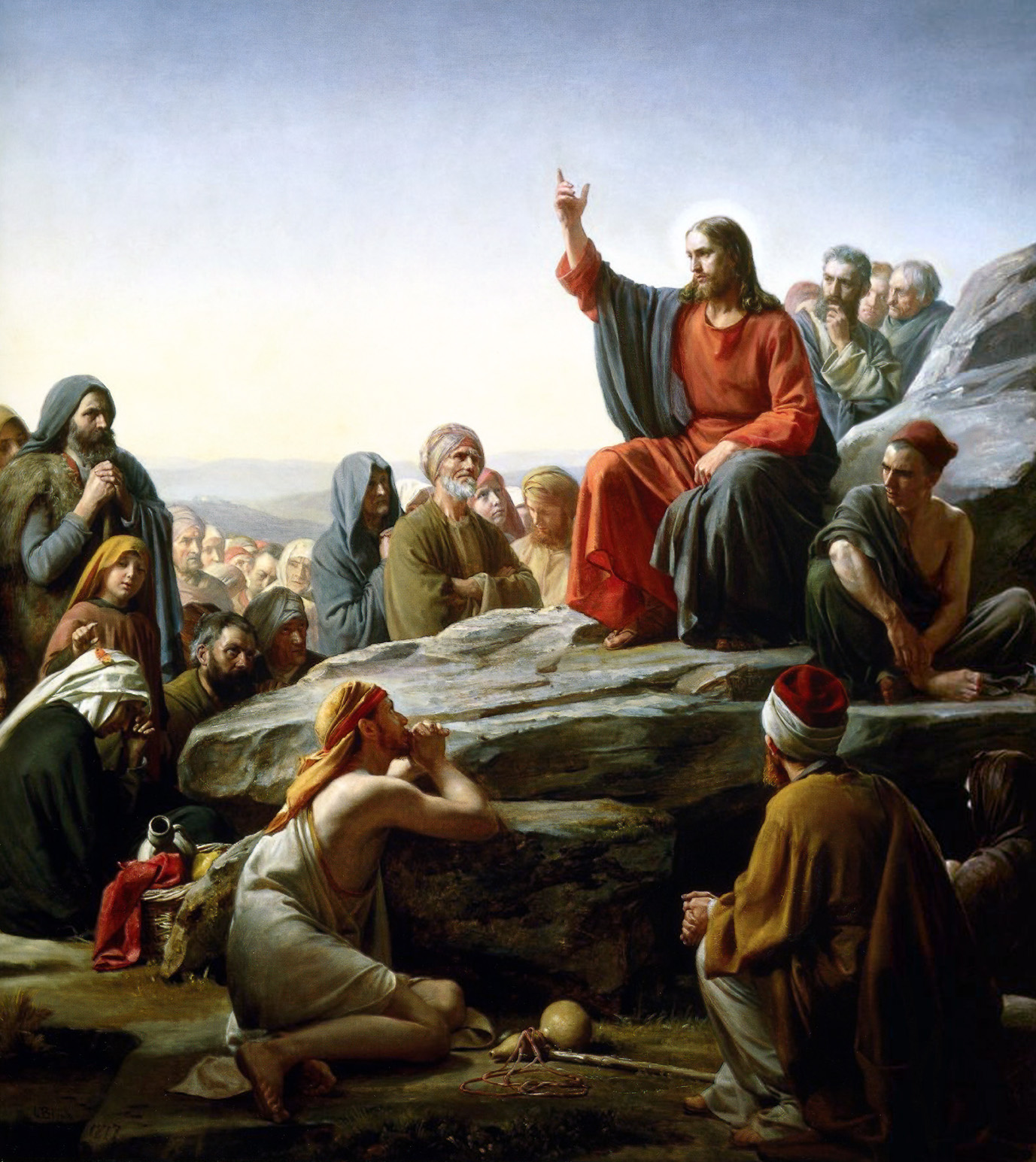
"And seeing the multitudes, he went up into a mountain" (Matt 5:1, KJV). The setting is not incidental. A teacher ascends a mountain, sits, and delivers the terms of a covenant people's life — and the oldest reader of the Old Testament feels the pull toward Sinai, where Moses "went up unto God" and the LORD "came down upon mount Sinai, on the top of the mount" (Exod 19:20).
The atlas carries this as a proposed literary resonance — verse:mat.5.1 set beside verse:exo.19.20 — with the critique attached in the same breath. Bacon's Moses typology overreaches if pressed into a strict parallel, and most scholars decline the full equation. But the fainter echo survives the objection: one greater than Moses teaches from a mountain, and where Moses relayed commandments received, this teacher speaks in his own name — "But I say unto you" — six times over. The crowd hears the difference and renders the verdict Matthew has been driving toward: "he taught them as one having authority, and not as the scribes" (7:29). The resonance is offered as a door, not a proof; the reader is trusted to walk through it or past it.
An impossible standard?
The Sermon has always provoked the same protest: no one lives like this. Anger judged as murder, a glance judged as adultery, oaths forbidden, enemies loved, anxiety renounced, and over it all the capstone — "Be ye therefore perfect, even as your Father which is in heaven is perfect" (5:48). The word is téleios (word:g5046): complete, whole, brought to its end. The demand is total.
So how is it meant? The church has answered in more than one register, and the readings are laid out below, each steelmanned and none adjudicated in the site's own voice — Augustine's livable-by-grace standard, Wesley's religion of the heart (this site's home tradition), the Lutheran law that drives to grace, the Anabaptist plain literalism, the dispensational ethic of the kingdom, and Schweitzer's critical "interim ethic" with its answer. What unites the faithful readings against the counsel of despair is the Sermon's own ending: it does not close on a cliff but on a construction site — two builders, two foundations, one house that stands when the rain descends and the floods come. The teaching that begins by blessing the poor in spirit ends by asking the hearer to do it, and promises the doer a footing that holds.
Featured study
Three chapters, one sermon
Matthew 5–7 is the longest continuous teaching of Jesus in any Gospel — the first of the five great discourses Matthew builds his book around, each closed with the same formula: “and it came to pass, when Jesus had finished these sayings” (7:28). It opens with blessing and ends with a house on a rock; in between, the commandments are traced from the hand to the heart.
The walk below takes the sermon in its own order, room by room — eight rooms, each with its own door into the reader. The sermon is a floorplan, not a heap of sayings: what opens at “the law and the prophets” (5:17) closes at “the law and the prophets” (7:12).
Walk the sermon room by roomThe floorplan
Room 1 of 8
The Blessings (5:1–12)
Blessed are the poor in spirit: for theirs is the kingdom of heaven. (Matt 5:3, KJV)
Eight pronouncements of makários — blessed — over people the world calls unfortunate. The kingdom brackets them: it belongs to the poor in spirit (v. 3) and the persecuted (v. 10).
Room 2 of 8
Salt & Light (5:13–16)
Ye are the light of the world. A city that is set on an hill cannot be hid. (Matt 5:14, KJV)
The blessed people turned outward — preserving and illuminating, 'that they may see your good works, and glorify your Father which is in heaven' (5:16).
Room 3 of 8
The Law Fulfilled (5:17–20)
Think not that I am come to destroy the law, or the prophets: I am not come to destroy, but to fulfil. (Matt 5:17, KJV)
The sermon's hinge — and the opening of its own frame: 'the law and the prophets' returns at 7:12 to close it.
Room 4 of 8
The Six Antitheses (5:21–48)
Be ye therefore perfect, even as your Father which is in heaven is perfect. (Matt 5:48, KJV)
Six times: 'Ye have heard that it was said… But I say unto you' — the commandments traced from the hand to the heart. The full ledger is below. The capstone word is téleios: complete, whole.
Room 5 of 8
Devotion in Secret (6:1–18)
But thou, when thou prayest, enter into thy closet, and when thou hast shut thy door, pray to thy Father which is in secret. (Matt 6:6, KJV)
Alms, prayer, fasting — each with the same refrain: 'thy Father which seeth in secret.' The Lord's Prayer stands at the room's center.
Room 6 of 8
Treasure & Anxiety (6:19–34)
But seek ye first the kingdom of God, and his righteousness; and all these things shall be added unto you. (Matt 6:33, KJV)
One master or the other — 'Ye cannot serve God and mammon' (6:24) — and then six verses of birds, lilies, and the command not to be anxious, resolved in a single priority.
Room 7 of 8
Judging & Asking (7:1–12)
Therefore all things whatsoever ye would that men should do to you, do ye even so to them: for this is the law and the prophets. (Matt 7:12, KJV)
'Judge not' and 'Ask, and it shall be given you' — sealed by the Golden Rule, which closes the frame opened at 5:17.
Room 8 of 8
The Two Ways (7:13–27)
Whosoever heareth these sayings of mine, and doeth them, I will liken him unto a wise man, which built his house upon a rock. (Matt 7:24, KJV)
Two gates, two trees, two claims, two builders — the sermon ends by demanding a decision about the sermon. Then the crowd's verdict: 'he taught them as one having authority' (7:29).
The sermon in art
The mountain, painted
The six antitheses, side by sideFrom the hand to the heart
| Topic | “Ye have heard that it was said” | “But I say unto you” (KJV) |
|---|---|---|
| Murder → anger | Thou shalt not kill. Exod 20:13 | Whosoever is angry with his brother without a cause shall be in danger of the judgment. Matt 5:22 |
| Adultery → lust | Thou shalt not commit adultery. Exod 20:14 | Whosoever looketh on a woman to lust after her hath committed adultery with her already in his heart. Matt 5:28 |
| Divorce | Let him write her a bill of divorcement. Deut 24:1 | Whosoever shall put away his wife, saving for the cause of fornication, causeth her to commit adultery. Matt 5:32 |
| Oaths | Thou shalt not forswear thyself, but shalt perform unto the Lord thine oaths. Lev 19:12; Num 30:2 | Swear not at all… let your communication be, Yea, yea; Nay, nay. Matt 5:34 |
| Retaliation | An eye for an eye, and a tooth for a tooth. Exod 21:24 | Resist not evil: but whosoever shall smite thee on thy right cheek, turn to him the other also. Matt 5:39 |
| Enemies | Thou shalt love thy neighbour as thyself. (The clause “and hate thine enemy” has no source in the written law.) Lev 19:18 | Love your enemies, bless them that curse you, do good to them that hate you, and pray for them which despitefully use you. Matt 5:44 |
Each antithesis quotes the law, then deepens it — the capstone is 5:48: “Be ye therefore perfect, even as your Father which is in heaven is perfect.”
The Lord’s PrayerThe center room
Our Father which art in heaven, Hallowed be thy name.
Thy kingdom come. Thy will be done in earth, as it is in heaven.
Give us this day our daily bread.
And forgive us our debts, as we forgive our debtors.
And lead us not into temptation, but deliver us from evil:
For thine is the kingdom, and the power, and the glory, for ever. Amen.
Contested
◈How has the church read the Sermon?contested · six readings, steelmanned, none adjudicated
The patristic reading — livable now, by grace
Augustine took the Sermon as the perfect standard of the Christian life — not an impossible ideal but the shape of a life grace actually produces.
Augustine of Hippo· De Sermone Domini in Monte (c. 394; NPNF I/6) — PD
The Wesleyan reading — the religion of the heart
Wesley devoted thirteen of his Standard Sermons to the Sermon on the Mount: it describes real, present holiness of heart wrought by grace — neither a counsel of despair nor a postponed ethic. This is the site’s home tradition.
John Wesley· Upon our Lord's Sermon on the Mount, Discourses I–XIII (1748–50) — PD
The Lutheran reading — law that drives to grace
The Sermon preaches the law at its full depth so that the hearer, exposed, flees to Christ — its demands diagnose before they prescribe. (The classic position as summarized in the standard histories.)
Philip Schaff· History of the Christian Church — PD (summary source)
The Anabaptist reading — exactly as spoken
Non-retaliation, oath-refusal, enemy-love — meant literally, as the visible ethic of the believing community, whatever it costs. Presented at strength: this reading has produced centuries of costly obedience.
The dispensational reading — the ethic of the kingdom
In the older dispensational scheme the Sermon is the ethic of the offered kingdom, in fullest force in the coming kingdom age; later dispensationalists broadly affirm its present application while keeping the kingdom’s futurity. The founder’s own frame is pre-trib premillennial dispensational — this reading is first-class here, and its modern refinement is stated fairly.
C. I. Scofield· Scofield Reference Bible notes (1909) — PD
The critical “interim ethic” — and its answer
Schweitzer read the Sermon as an emergency ethic for a supposedly imminent end. The counter: the Sermon legislates for ongoing life — marriage, work, courts, fields — and ends on a house built to stand; the church in every century has received it as standing teaching. Both shown.
Albert Schweitzer· The Quest of the Historical Jesus (1906; ET 1910) — PD
The blessings are older than the mountainWhy these links
“Blessed are the meek: for they shall inherit the earth” (Matt 5:5)
But the meek shall inherit the earth; and shall delight themselves in the abundance of peace. (Psalm 37:11)
The beatitude carries a psalm line nearly whole — the blessing is older than the mountain.
“Blessed are they that mourn: for they shall be comforted” (Matt 5:4)
He hath sent me to bind up the brokenhearted… to comfort all that mourn. (Isaiah 61:1–2)
The Servant's commission in Isaiah — the same passage Jesus reads over himself at Nazareth (Luke 4:18).
“Be ye therefore perfect” (Matt 5:48)
Thou shalt be perfect with the LORD thy God. (Deuteronomy 18:13)
With Leviticus 19:2 (“Ye shall be holy: for I the LORD your God am holy”) — the antitheses end where the law itself ends: likeness to God.
Hear it from the first word
Enter the reader at Matthew 5 →Go deeper