The Messianic Psalms
Six psalms previewing the life of Christ — from begotten Son (Ps 2) to crucified silence (Ps 22) to the Priest-King at God's right hand (Ps 110). Tri-fold taxonomy per Vision §4.6: Fulfilled in First Coming · Awaiting Second · Progressively Fulfilled.
In the volume of the book it is written of me.
“Eli, Eli, lama sabachthani? that is to say, My God, my God, why hast thou forsaken me?”
The Psalms are not read into Christ — the New Testament writers cite them by chapter and verse, and name who is speaking. Here are the receipts.
Framework
Christ's own hermeneutic — Luke 24:44
On the road to Emmaus and again in the upper room, the risen Christ tells his disciples that "all things must be fulfilled, which were written in the law of Moses, and in the prophets, and in the psalms, concerning me" (Luke 24:44). The Psalter is named alongside the Law and the Prophets as a body of Christ-witnessing scripture. The six psalms surfaced here are the densest examples — but the Christological reading of the Psalms is Christ's own framing, not a later imposition.
Psalm 22 — the cry from the cross
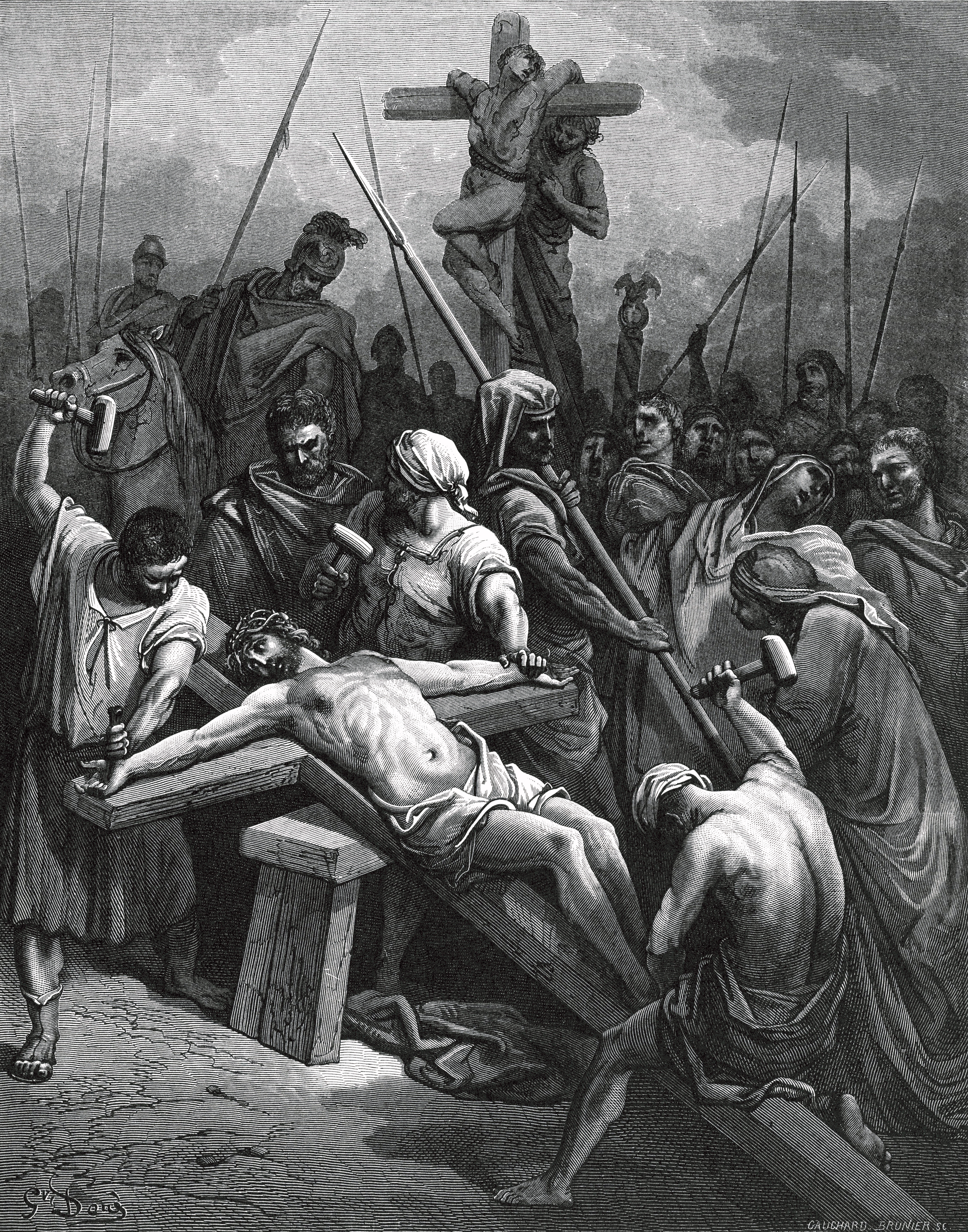
"My God, my God, why hast thou forsaken me?" (Ps 22:1) — quoted by Jesus from the cross (Matt 27:46; Mark 15:34). Pierced hands and feet (v. 16, contested textual reading: Masoretic ka'ari "like a lion" vs. LXX ōryxan "they pierced"; DSS 5/6HevPs supports a verbal form closer to the LXX). Casting lots for garments (v. 18, Matt 27:35; John 19:23–24). The crimson worm imagery of v. 6 ([[crimson-worm]]) cross-references [[scarlet-thread]]. The closing eleven verses (22:22–31) reverse from cry to declaration of victory — Christ rising from the cross to the Father's presence.
Psalm 110 — the most-cited OT passage in the NT
Quoted or alluded to roughly 25 times across the New Testament — the densest single-passage citation. Jesus uses Ps 110:1 to silence the Pharisees (Matt 22:41–46): "how then doth David in spirit call him Lord, saying, The LORD said unto my Lord, Sit thou at my right hand?" Peter cites it at Pentecost (Acts 2:34–36); Paul leans on it for the resurrection-session argument (Rom 8:34; 1 Cor 15:25; Eph 1:20–22; Col 3:1); Hebrews builds an entire Melchizedek-priesthood argument from v. 4 (Heb 5:5–6, 5:10, 6:20, 7:15–17, 7:21). The session is inaugurated at the ascension; the enemies-footstool is awaiting the second coming.
Tri-fold taxonomy per Vision §4.6
Every messianic psalm on this page is labeled with one of three categories: Fulfilled in First Coming (Ps 16, 22, 69 — completed in the first advent), Awaiting Second Coming (none on this page, but the category exists for honest taxonomy), or Progressively Fulfilled (Ps 2, 45, 110 — inaugurated in the first coming and consummated in the second). No "high / medium / speculative" confidence badges; just the tri-fold category. The taxonomy honors what is genuinely contested (timing of fulfillment, scope of inheritance) without flattening the text.
Spurgeon's Treasury of David as primary PD source
Charles H. Spurgeon, The Treasury of David (1869–1885, fully PD) is the standard 19th-century evangelical exposition of the Psalter. Each of the 150 psalms gets a verse-by-verse exposition, hints to homiletics, and a curated set of patristic / Puritan / Reformed quotations. The Treasury is the load-bearing featured commentary across all six drilldowns on this page. Calvin on the Psalms, Henry, and Gill provide secondary voices via "Show other voices" expansion per Doctrine A.
Follow a thread
- Psalm 2 — The Begotten SonPsalm 2:7
Progressively Fulfilled. Begotten-Son inaugurated at baptism / resurrection; worldwide inheritance awaiting consummation.
- Psalm 16 — The Holy One Not Left to SheolPsalm 16:10
Fulfilled in First Coming. Resurrection of the Holy One — fulfilled at Easter per Acts 2 and Acts 13.
- Psalm 22 — The Crucifixion PreviewPsalm 22:1
Fulfilled in First Coming. Crucifixion scene; Christ quotes v. 1 from the cross.
- Psalm 45 — The Royal WeddingPsalm 45:6
Progressively Fulfilled. Bridegroom typology inaugurated; marriage supper awaiting Rev 19.
- Psalm 69 — Zeal, Vinegar, and GallPsalm 69:9
Fulfilled in First Coming. Rejection, temple-zeal, vinegar-and-gall at the cross.
- Psalm 110 — The Priest-King at God's Right HandPsalm 110:1
Progressively Fulfilled. Session inaugurated at ascension; enemies-footstool subjugation awaiting second coming.
Christ's own hermeneutic — Luke 24:44
On the road to Emmaus the risen Christ said “all things must be fulfilled, which were written… in the psalms, concerning me” (Luke 24:44). The claim is not a mood; it is a set of receipts. What follows is the ledger: a psalm line on the left, the New Testament verse that quotes it on the right, and — the column the raw index cannot supply — the named person doing the quoting.

The curated ledger — line · quotation · speaker
This is the curated exhibit of the citation ledger: nine primary psalms, each with its Gunkel genre class and its named speaker. The live floor ledger below the study panel renders every raw psalm→NT pair on MannaFest's quotation index; this table adds the two things the raw floor cannot carry — who is speaking and what kind of song is being cited.
Formula counts across the whole NT — atlas lens 53, enumerated read-only against the live tagged-Greek floor (STEPBible TAGNT, CC BY 4.0), 2026-07-21.
“Thou art my Son; this day have I begotten thee.”
spoken by Paul, at Pisidian Antioch
“as it is written in the second psalm” — cited by canonical location, an ordered, numbered Psalter · also cited at Heb 1:5, Heb 5:5
citation, resurrection reign · also cited at Heb 2:6, Matt 21:16
“neither wilt thou suffer thine Holy One to see corruption.”
spoken by Peter, at Pentecost
“David speaketh concerning him” — the resurrection proof-text · also cited at Acts 13:35
◈Psalm 16:10 — is “thine Holy One” David, or the Christ?contested · tier 3
The claim. Peter (Acts 2:27) and Paul (Acts 13:35) argue the psalm cannot mean David, who did see corruption — so it speaks of the risen Christ.
The critique. The plain sense of the psalm is David's own confidence of preservation; the messianic reading is an apostolic argument built from the fact of David's death, not a claim the psalm predicts a distinct figure. Both columns stand. Source: atlas lens 23 prophecy-ledger.
direct citation (Aramaic sabachthani in Mark 15:34) · also cited at John 19:24, Heb 2:12
◈Psalm 22 — a prediction, or an individual lament read back through the cross?contested · tier 3
The claim. Psalm 22:1, 16, 18 map onto the crucifixion (Matt 27:46; John 19:24, 36) — the New Testament reads the whole psalm as fulfilled in Christ.
The critique. Formally, Psalm 22 is an individual lament (Gunkel): its “I” is the suffering righteous sufferer, and the NT use is typological / metaleptic, not a claim that David predicted the crucifixion. Porter further warns that Hays's metalepsis blurs authorial intent and reader-effect — quoting a psalm's first line is not automatically a claim on its whole content. Sources: Gunkel & Begrich (1933, cite-only); Hays, Echoes in the Gospels (2016, cite-only); Porter via lenses brief 16.
“when he cometh into the world, he saith”
◈Psalm 40:6 — “a body” or “ears”? (a candor point)contested · LXX vs MT
The claim. Hebrews 10:5 quotes “a body hast thou prepared me” and reads it as the incarnation.
The critique. The Masoretic Hebrew reads “ears hast thou opened / digged for me”; Hebrews follows the Greek (LXX) rendering. Show the difference; do not hide it. Source: PD-conv / Swete (LXX-vs-MT), atlas lens 02.
“but unto the Son he saith” — the Son addressed as God
“it was written” · also cited at Rom 15:3, John 15:25, Acts 1:20, Matt 27:34
“The LORD said unto my Lord, Sit thou at my right hand, until I make thine enemies thy footstool.”
spoken by Jesus (then Peter, Acts 2:34; Hebrews, 1:13)
“David himself said by the Holy Ghost” (Mark 12:36) — human author + inspiration named together · also cited at Mark 12:36, Luke 20:42, Matt 26:64, Mark 14:62, Acts 2:34, Heb 1:13, Heb 5:6, Heb 7:17
“The stone which the builders rejected is become the head of the corner.”
spoken by Jesus (then Peter, Acts 4:11; 1 Pet 2:7)
“did ye never read in the scriptures” · also cited at Mark 12:10, Acts 4:11, 1 Pet 2:7, John 12:13, Matt 23:39, Heb 13:6
▸How the New Testament reads the whole Psalter — not only the messianic psalms
Honesty about the field: the NT quotes the Psalms constantly, and much of it is not a messianic prediction — it is Paul reaching for a line about sin, or suffering, or ascent. These belong beside the messianic ledger, clearly labeled as a different use, so the messianic rows are not inflated by the Psalter's general reach.
- Ps 44:22 — “For thy sake are we killed all the day long.”→Rom 8:36Paul
- Ps 51:4 — “That thou mightest be justified when thou speakest.”→Rom 3:4Paul
- Ps 68:18 — “Thou hast ascended on high, thou hast led captivity captive.”→Eph 4:8Paul
- Ps 116:10 — “I believed, therefore have I spoken.”→2 Cor 4:13Paul
- Ps 140:3 — “the poison of asps is under their lips.”→Rom 3:13Paul (the sin-catena)
Source: PD-convergent quotation index (Westcott-Hort 1881 + Swete 1900 + Nicole 1958).
Exemplar I — Psalm 22, the Passion psalm
“They part my garments among them, and cast lots upon my vesture.”
John (the soldiers; “that the scripture might be fulfilled”)
Hebrew word-doors — Psalm 22
Strong's numbers from the PD lexicon; occurrence counts render live from the verse_words floor. Each opens the word workbench.
◈Psalm 22:16 — “they pierced my hands and my feet,” or “like a lion”?contested · textual crux
The claim. The reading kaʾaru / karu (from karah, “to dig / bore through”) gives “they pierced my hands and my feet” — supported by the Greek LXX ōryxan (“they dug”) and by the Naḥal Ḥever Psalms scroll (5/6 Ḥev), a pre-crucifixion Hebrew text carrying the pierced-form reading.
The critique. The Masoretic Text reads kaʾarî (ʾarî, “lion”), “like a lion [at] my hands and feet.” The “pierced” verb is a reconstruction of the same consonants. The honest form is the variant apparatus, not a settled gloss.
Naḥal Ḥever Psalms scroll (5/6 Ḥev) — Leon Levy DSS Digital Library ↗ (manuscript witness, link-only; image rights-restricted, not rehosted).
Sources: the Hebrew consonantal apparatus and the LXX reading, to be confirmed at build against the TAHOT Hebrew floor and a PD critical apparatus (dossier gap #2).
◈Psalm 22 — a prediction, or an individual lament read through the cross?contested · tier 3 · the honesty edge
The claim. Jesus quotes the lament's first line from the cross (Matt 27:46 / Mark 15:34); the form of the lament (dereliction → vindication) licenses reading the whole psalm's arc behind it — v.16 (the pierced hands), v.18 (John 19:24), v.22 (Heb 2:12).
The critique. Formally, Psalm 22 is an individual lament (Gunkel); its “I” is the suffering righteous one, and the NT use is typological / metaleptic — not a claim that David predicted the crucifixion. Porter warns that Hays's metalepsis blurs authorial intent and reader-effect: quoting a first line is not automatically a claim on the whole psalm.
Sources (cite-only): Gunkel & Begrich, Introduction to Psalms (1933); Hays, Echoes of Scripture in the Gospels (2016); Porter via lenses brief 16.
“Justin treats Psalm 22 as messianic at length — the pierced hands and feet, the parted garments, the whole passion arc — in his Dialogue with Trypho (chs. 97–106).”
Exemplar II — Psalm 110, the priest-king at God's right hand
Psalm 110:1 is the single most-cited Old Testament verse in the New Testament. MannaFest's quotation floor carries 9 marked quotations and allusions of Psalm 110 — more than any other Old Testament chapter on the index.
Count rendered from the live floor; the “most-cited verse” claim is atlas lens 02 + 23 (PD-convergent index). The often-quoted “~33 quotations and allusions” chapter figure (Hay, Glory at the Right Hand, 1973) is not printed here — unverified this pass (dossier gap #1).
“The LORD said unto my Lord, Sit thou at my right hand, until I make thine enemies thy footstool.”
Jesus (then Peter, Acts 2:34; Hebrews, 1:13)
Hebrew word-doors — Psalm 110
Strong's numbers from the PD lexicon; occurrence counts render live from the verse_words floor. Each opens the word workbench.
◈Psalm 110:1 — the Davidic-sonship puzzle Jesus himself setscontested · teaching edge
Jesus asks (Matt 22:45): if David, in the Spirit, calls the Messiah “my Lord,” how is the Messiah David's son? The knot is only visible in the Hebrew, where two different words stand behind the one English “Lord”: YHWH (the LORD who speaks) says to ʾadoni (David's Lord), “Sit at my right hand.” David's own son is David's own Lord — the data that unlocks the puzzle.
This is the psalm's teaching edge, not a critique of the claim. Word data: PD Strong's lexicon; occurrence counts from the live verse_words floor.
“Edersheim's Appendix IX records that the ancient synagogue read Psalm 110 as “applied throughout to the Messiah” (Midrash on Psalm xviii.36) — the rabbinic-reception ground beneath the New Testament's headline verse.”

The synagogue's own reading — Targum on the Psalms
Reception, not proof, and never flattened into the Christian claim: where the ancient Aramaic paraphrase of the Psalms names the King Messiah, it is worth hearing in its own voice.
“Thy beauty, O King Messiah.”
“the King Messiah… Son of David the King.”
Follow the threads
Sources
- Westcott & Hort, The New Testament in the Original Greek (1881, PD) — index of OT quotations; H.B. Swete, Introduction to the OT in Greek (1900, PD); Roger Nicole, “The NT Use of the OT” (1958, cite-only).
- Alfred Edersheim, The Life and Times of Jesus the Messiah, Appendix IX (1883, PD).
- STEPBible TAGNT / TAHOT tagged Greek & Hebrew (CC BY 4.0) — the live floor; formula census enumerated read-only 2026-07-21.
- Hermann Gunkel & Joachim Begrich, Introduction to Psalms (1933; ET 1998, cite-only) — form-critical psalm classes.
- Richard B. Hays, Echoes of Scripture in the Gospels (2016, cite-only) — metalepsis method + the Porter caution.
- Justin Martyr, Dialogue with Trypho (c. 160, PD, ANF vol. 1).
- Targum on the Psalms — Aramaic PD; English via PD translation, per-version license-checked at ingest.
- David M. Hay, Glory at the Right Hand: Psalm 110 in Early Christianity (1973, cite-only) — Psalm-110 count to verify at build.
- Leon Levy Dead Sea Scrolls Digital Library — Naḥal Ḥever Psalms scroll (Ps 22:16); rights-restricted images, link-only.
The live citation ledger — every psalm the New Testament quotes
The ledger — every quotation, from the floor
Drawn live from MannaFest's quotation index (72 rows touching the Psalms) — psalm line on the left, the New Testament receipt on the right.
Psalm 2
- PSA 2 1→ACT 4 25
'Why did the heathen rage' — the believers' prayer ('who by the mouth of thy servant David hast said')
- PSA 2 7→HEB 5 5
'Thou art my Son, to day have I begotten thee' (Christ's high-priestly appointment)
- PSA 2 7→HEB 1 5
'Thou art my Son, this day have I begotten thee' (Son superior to angels, w/ 2Sa 7:14)
- PSA 2 7→ACT 13 33
'Thou art my Son, this day have I begotten thee' ('as it is written in the second psalm')
Psalm 8
Psalm 14
Psalm 16
Psalm 18
Psalm 22
- PSA 22 1→MAT 27 46
'My God, my God, why hast thou forsaken me?' — cry of dereliction (invokes whole Psalm 22)
- PSA 22 1→MRK 15 34
'Eloi, Eloi, lama sabachthani' — cry of dereliction
- PSA 22 18→JHN 19 24
'They parted my raiment among them' (soldiers cast lots; 'that the scripture might be fulfilled')
- PSA 22 22→HEB 2 12
'I will declare thy name unto my brethren' (Christ not ashamed to call us brethren)
Psalm 24
Psalm 32
Psalm 40
Psalm 41
Psalm 51
Psalm 69
- PSA 69 22→ROM 11 9
'Let their table be made a snare' ('David saith')
- PSA 69 25→ACT 1 20
'Let his habitation be desolate' — on Judas ('it is written in the book of Psalms')
- PSA 69 4→JHN 15 25
'They hated me without a cause' ('that the word might be fulfilled that is written in their law', w/ Ps 35:19)
- PSA 69 9→JHN 2 17
'The zeal of thine house hath eaten me up' (temple cleansing, disciples remember)
- PSA 69 9→ROM 15 3
'The reproaches of them that reproached thee fell on me' (Christ pleased not himself)
Psalm 78
Psalm 89
Psalm 91
Psalm 95
Psalm 102
- PSA 102 25→HEB 1 10
'Thou, Lord, in the beginning hast laid the foundation of the earth'
Psalm 110
- PSA 110 1→MAT 22 44
'The Lord said unto my Lord' — the Davidic-sonship question (most-cited OT verse in NT)
- PSA 110 1→MAT 26 64
'sitting on the right hand of power' — before the Sanhedrin (w/ Dan 7:13)
- PSA 110 1→LUK 20 42
'The Lord said unto my Lord' (Davidic-sonship question)
- PSA 110 1→HEB 1 13
'Sit on my right hand, until I make thine enemies thy footstool'
- PSA 110 1→ACT 2 34
'The Lord said unto my Lord, Sit thou on my right hand' (ascension proof)
- PSA 110 1→MRK 12 36
'The Lord said to my Lord' ('David himself said by the Holy Ghost')
- PSA 110 1→MRK 14 62
'on the right hand of power' (before the high priest, w/ Dan 7:13)
- PSA 110 4→HEB 7 17
'Thou art a priest for ever after the order of Melchisedec' (eternal priesthood)
- PSA 110 4→HEB 5 6
'Thou art a priest for ever after the order of Melchisedec'
Psalm 112
Psalm 116
- PSA 116 10→2CO 4 13
'I believed, and therefore have I spoken' ('as it is written')
Psalm 118
- PSA 118 22→MRK 12 10
'the stone which the builders rejected' ('have ye not read this scripture')
- PSA 118 22→1PE 2 7
'The stone which the builders disallowed... head of the corner'
- PSA 118 22→MAT 21 42
'The stone which the builders rejected' ('did ye never read in the scriptures')
- PSA 118 22→LUK 20 17
'The stone which the builders rejected' ('what is this then that is written')
- PSA 118 22→ACT 4 11
'the stone... set at nought of you builders' (before the Sanhedrin)
- PSA 118 25→JHN 12 13
'Hosanna: Blessed is the King of Israel' (triumphal entry)
- PSA 118 26→MAT 23 39
'Blessed is he that cometh in the name of the Lord' (lament over Jerusalem)
- PSA 118 26→LUK 19 38
'Blessed be the King that cometh in the name of the Lord'
- PSA 118 26→MAT 21 9
'Hosanna... Blessed is he that cometh in the name of the Lord'
- PSA 118 26→MRK 11 9
'Blessed is he that cometh in the name of the Lord' (triumphal entry)
- PSA 118 6→HEB 13 6
'The Lord is my helper, and I will not fear what man shall do unto me'
Psalm 132
- PSA 132 11→ACT 2 30
'of the fruit of his loins... he would raise up Christ' (Davidic oath)