Why Four Gospels
One gospel 'according to' four witnesses — Matthew's King, Mark's Servant, Luke's Son of man, John's Son of God — and the honest history of how the four relate.
Not four gospels: one gospel, according to four.
Framework
One gospel, four witnesses
The church never titled these books as four different gospels. From the earliest manuscripts the headings read the Gospel according to (κατά) Matthew… Mark… Luke… John — one εὐαγγέλιον, four attested tellings. By the late second century the fourfold form was already fixed and defended: Irenaeus of Lyons argued that the gospels could be "neither more or fewer in number than they are" (Against Heresies 3.11.8, PD), and Tatian's Diatessaron (c. 170) wove exactly these four into a single harmony — independent evidence that precisely four made up the church's gospel corpus.
Scripture describes its own fourfold-ness without embarrassment. Luke opens by acknowledging that "many have taken in hand to set forth in order a declaration of those things which are most surely believed among us," and states his method: eyewitness sources, careful tracing, an orderly account written "that thou mightest know the certainty" (Luke 1:1–4, KJV). John closes by admitting selection: "many other signs truly did Jesus… which are not written in this book: but these are written, that ye might believe that Jesus is the Christ, the Son of God" (John 20:30–31). Four portraits, one subject — and the differences are design, not defect.
Framework summary drawn from the four-gospels research brief (2026-07-22): Scripture KJV (PD); Irenaeus per ANF vol. 1 (PD); Tatian per Schaff, History of the Christian Church vol. 2 (PD).
The synoptic question, stated honestly
Matthew, Mark, and Luke share extensive wording and ordering — they can be "seen together" (synoptic) — while John largely stands apart. Who used whom? The earliest view, Augustine's, took the canonical order as the writing order, with Mark as Matthew's "attendant and epitomizer" (De Consensu Evangelistarum 1.2.4, PD). The dominant modern academic view inverts it: Mark first, with Matthew and Luke drawing on Mark plus a shared sayings source ("Q") — the two-source hypothesis (Streeter, The Four Gospels, 1924). Between and against these stand the Farrer hypothesis (Markan priority without Q — Farrer 1955; Goodacre, The Case Against Q, 2002, cite-only), the revived Griesbach/two-gospel hypothesis (Matthew first, Mark third — Farmer, 1964, cite-only), and the independence view (common eyewitness testimony, not literary copying — Linnemann, 1992, cite-only).
This page steelmans each in the contested drawer below and adjudicates none. Every hypothesis must explain the same data; none is an article of faith. The church received four inspired, fully trustworthy accounts regardless of their literary genetics — and what the ten-second surface of this page shows is the part no hypothesis disputes: four distinct voices, four audiences, one Christ.
Source: the four-gospels brief §6 — positions and attributions carried as stated there; Augustine and Streeter PD, moderns cite-only.
Where the founder plants his flag
The site's confessional posture holds all four accounts fully trustworthy and their differences purposeful. The founder's own commentary on the fourfold portrait — and on how a student should use the four together — will be planted here. Until then the page speaks in two registers only: what the texts and the early witnesses plainly say, and what the named positions claim about them.
Follow a thread
- The Fourfold Witness of the Early ChurchRevelation 4:7
Papias, Irenaeus, Clement, the Diatessaron, the Muratorian list — the second-century paper trail.
- The Synoptic QuestionLuke 1:3
Five accounts of how Matthew, Mark, and Luke relate — each given its strongest voice.
- Matthew's Ten Fulfillment FormulasMatthew 1:22
"That it might be fulfilled which was spoken" — the mechanical fingerprint of the first gospel.
Featured study
The second-century paper trail
The fourfold gospel is not a later committee decision with a thin trail — it is among the best-attested facts of the early church. Papias, within living memory of the apostles, records that “Mark having become the interpreter of Peter, wrote down accurately whatsoever he remembered,” and that “Matthew put together the oracles in the Hebrew language” (via Eusebius, Hist. Eccl. 3.39, PD). Irenaeus names all four authors and their settings (Against Heresies3.1.1, PD). Clement of Alexandria preserves the tradition that “last of all John… composed a spiritual gospel” (via Eusebius 6.14, PD).
By about 170, Tatian’s Diatessaronhad woven exactly these four into a single harmony, and the Muratorian Fragment lists Luke as “the third book of the Gospel” and John as the fourth. Whatever question remains about how the four relate to each other, that there are four — these four — is where all the early evidence points.
Sources: ANF/NPNF translations and Schaff’s History of the Christian Church (all public domain), per the research brief.

Four portraits, facingThe quadriptych
Each spread confronts two voices. The juxtaposition is the argument: the same Christ, painted from four vantage points — keynotes quoted in full, KJV.
The King
According to Matthew
The book of the generation of Jesus Christ, the son of David, the son of Abraham.
Matthew 1:1 — the royal-messianic frame from the first verse: a genealogy from Abraham through David, five great discourse blocks, and ten “that it might be fulfilled” quotations.
The Servant
According to Mark
For even the Son of man came not to be ministered unto, but to minister, and to give his life a ransom for many.
Mark 10:45 — no genealogy, no infancy: a gospel of action, moving “straightway” from deed to deed, carrying Peter’s preaching per Papias.
The Son of Man
According to Luke
For the Son of man is come to seek and to save that which was lost.
Luke 19:10 — the historian’s gospel (1:1–4), written to Theophilus, tracing the genealogy past Abraham all the way to Adam: a Savior for the nations, attentive to outsiders, women, the poor, and prayer.
The Son of God
According to John
But these are written, that ye might believe that Jesus is the Christ, the Son of God; and that believing ye might have life through his name.
John 20:31 — the “spiritual gospel” (Clement, PD): the Word made flesh, seven signs, the I AM sayings — a stated purpose instead of a birth narrative.
The four voices, as a ledgerSide by side
The fingerprint column carries mechanical counts from the tagged Greek text (atlas quotation-formulas lens): “it is written” (γέγραπται) occurs exactly 67 times in the New Testament — Luke 9, Matthew 8, Mark 7 among the gospels.
| Gospel | How it opens | Audience | Portrait | Fingerprint |
|---|---|---|---|---|
| Matthew | Genealogy from Abraham through David (1:1–17) | Jewish readers — the kingdom and the King | The promised King, Messiah of Israel | Ten fulfillment formulas (lens 53); five discourse blocks each closed by “when Jesus had ended these sayings” (7:28; 11:1; 13:53; 19:1; 26:1); “it is written” 8× |
| Mark | No genealogy, no infancy — straight to the Jordan (1:1–9) | Roman/Gentile readers — Peter's preaching per Papias | The Servant who acts (10:45) | The famous “straightway/immediately” pacing across 16 chapters; “it is written” 7×; one unique parable (the seed growing secretly, 4:26–29) |
| Luke | Historian's preface to Theophilus (1:1–4); genealogy to Adam (3:38) | Gentile readers — “that thou mightest know the certainty” | The Son of man who seeks the lost (19:10) | “It is written” 9× — most of any gospel; the whole-canon formula at 24:44; fourteen parables kept nowhere else |
| John | The cosmic prologue — “In the beginning was the Word” (1:1–14) | All who will believe — stated purpose at 20:30–31 | The Son of God, the Word made flesh | Seven signs (2:11 “this beginning of miracles”; 4:54 “the second”); the I AM sayings; the fulfillment formula applied to Jesus' own words (18:9, 32) |
How do Matthew, Mark, and Luke relate?Contested
Contested
◈How do Matthew, Mark, and Luke relate?contested · five positions, none adjudicated
Two-source (Markan priority + Q)
Mark wrote first; Matthew and Luke each used Mark plus a shared sayings source. The dominant modern academic view. Its evidence: the great bulk of Mark reappears in the other two, and Mark preserves the harder readings and rougher Greek.
B. H. Streeter· The Four Gospels (1924); after Holtzmann (1863)
Farrer (Markan priority, no Q)
Mark first; Matthew used Mark; Luke used both — no hypothetical Q document required. The lost-source hypothesis is the theory under strain, not the data.
Austin Farrer· "On Dispensing with Q" (1955); Mark Goodacre, The Case Against Q (2002) — cite-only
Two-gospel / Griesbach
Matthew first — agreeing with the unanimous patristic order — then Luke; Mark conflates and abridges both. Where the external, historical testimony carries the most weight.
J. J. Griesbach· (1789, PD); revived by William Farmer, The Synoptic Problem (1964) — cite-only
Augustinian
Canonical order is compositional order; Mark is Matthew’s “attendant and epitomizer.” The near-universal view of the church for its first seventeen centuries.
Augustine· De Consensu Evangelistarum 1.2.4 (NPNF, PD)
Independence / eyewitness
The agreements come from common eyewitness testimony and a fixed oral tradition rather than literary copying — Luke names his sources as “eyewitnesses, and ministers of the word” (Luke 1:2), not documents.
Eta Linnemann· Is There a Synoptic Problem? (1992) — cite-only; cf. Richard Bauckham, Jesus and the Eyewitnesses (2006) — cite-only
Every hypothesis must explain the same data — the shared triple tradition, the material common to Matthew and Luke alone, and the order phenomena. None is an article of faith. The site’s confessional posture: four inspired, fully trustworthy accounts whose differences are design; no position here wears a confidence badge.
Scripture's own frameWhy these links
“They four had the face of a man, and the face of a lion…” (Ezek 1:10)
And the first beast was like a lion, and the second beast like a calf, and the third beast had a face as a man, and the fourth beast was like a flying eagle. (Revelation 4:7)
The four living creatures — the source of the evangelist symbols. Honest history: Irenaeus (AH 3.11.8, PD) first drew the map, but assigned John the lion and Mark the eagle; the familiar set (Matthew the man, Mark the lion, Luke the ox, John the eagle) is Jerome's. The symbols are reception history, not Scripture's own identification.
“Many have taken in hand to set forth in order a declaration…” (Luke 1:1)
…even as they delivered them unto us, which from the beginning were eyewitnesses, and ministers of the word; it seemed good to me also, having had perfect understanding of all things from the very first, to write unto thee in order… that thou mightest know the certainty of those things. (Luke 1:1–4)
Scripture's own account of how a gospel came to be written: many accounts, eyewitness sources, deliberate method. Every synoptic hypothesis is an attempt to explain this verse's world.
And there are also many other things which Jesus did, the which, if they should be written every one, I suppose that even the world itself could not contain the books that should be written. (John 21:25)
The corpus is a selection, not an exhaustion — each evangelist chose under the Spirit, and the four portraits differ by design.
Four voices the church has illuminated for twelve centuries
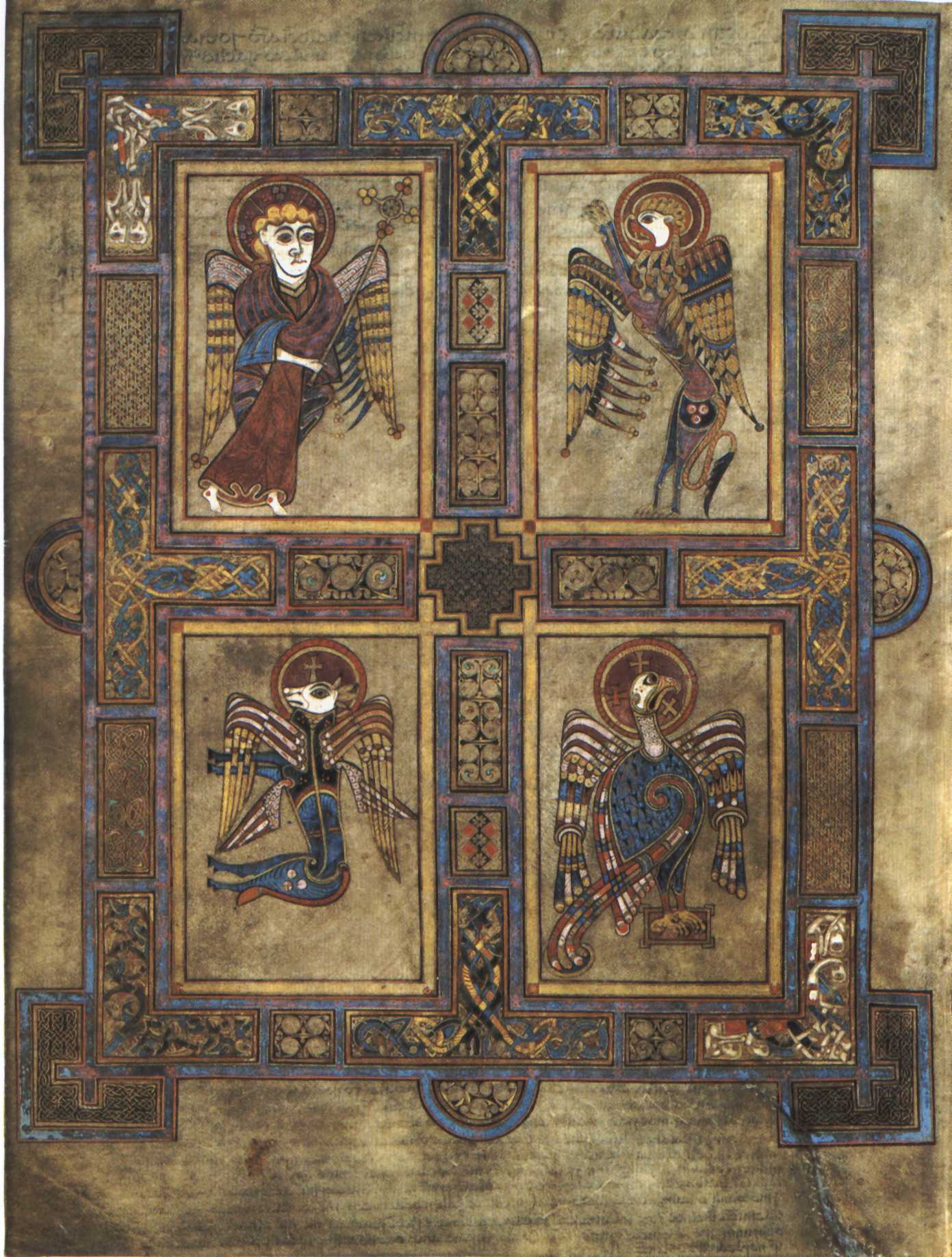
Walk into any of the fourGo deeper
Book hub
MatthewThe King's gospel — five discourses and ten fulfillment formulas, chapter by chapter.Book hub
MarkThe Servant's gospel — Peter's preaching at a runner's pace.Book hub
LukeThe historian's gospel — certainty for Theophilus, grace for the lost.Book hub
JohnThe spiritual gospel — seven signs written that you might believe.