
Genesis 1:1 to 2:3 · Story · Featured Study
The Creation Week
The account tells how God made the heavens, the earth, the sea and every living thing in them.
In six days God forms three empty parts of the world and then fills each one. He calls the finished whole “very good”, a world he made by his word, ordered by separation and made ready for rest.
- Who
- Adam, Eve
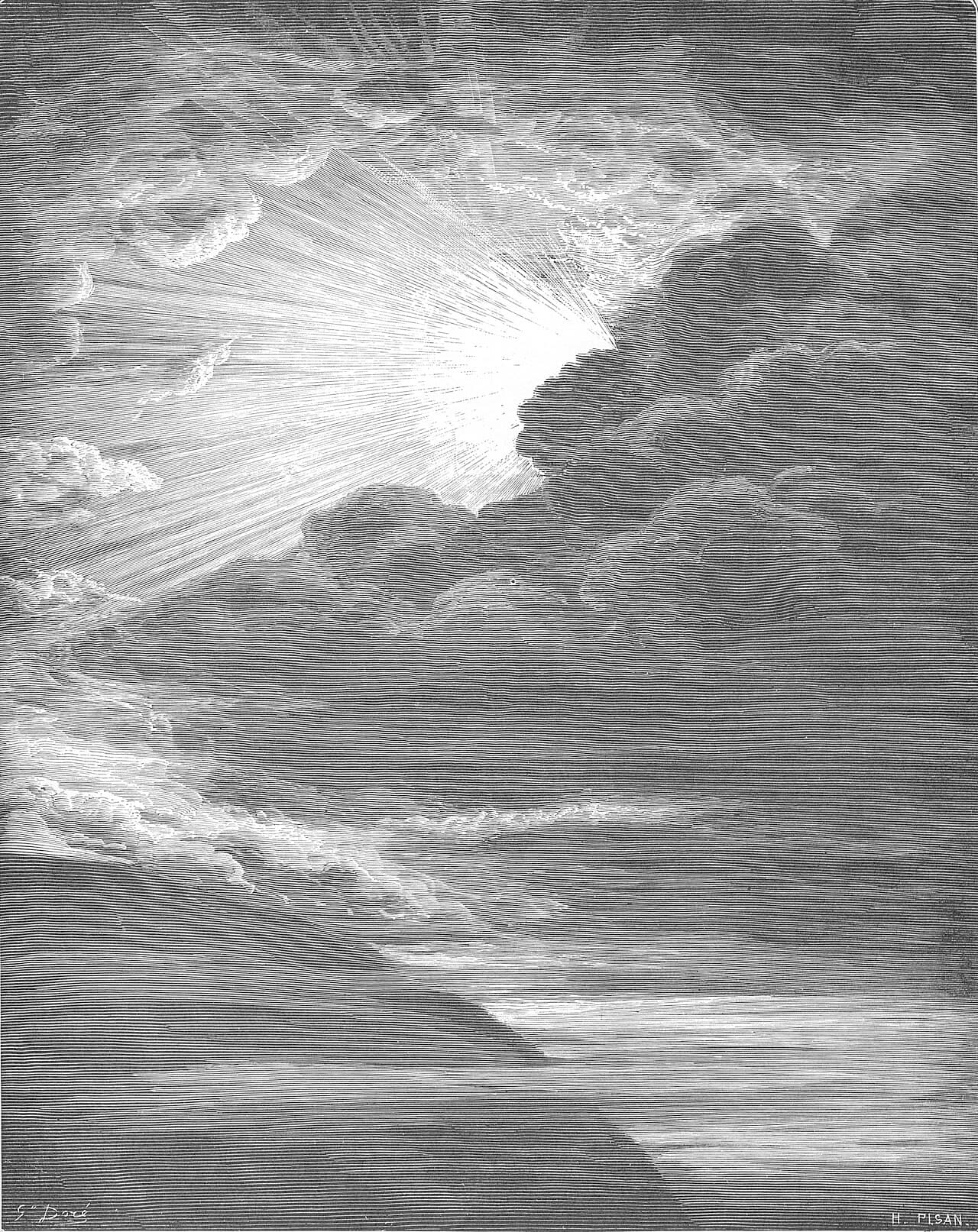
Gustave Dore, The Holy Bible, 1866. Public domain.
Summary
The creation week of Genesis 1 opens the Bible.
- Mankind alone is made in the image of God, male and female, and given rule over the creatures.
- Christ is the Word who made all things, and in him the first day's light shines in the heart and the image of God is made new.
- Christians read the days in five ways. These are six ordinary days, day-age, framework, analogical days and the gap.
The Seven Days in the Text
Each of the seven days with its verse
The account runs in seven days. Each of the first six opens with God speaking and closes with evening, morning and the day's number. Through the whole account God is named Elohim, the common Hebrew word for God.
In the beginning God created the heavens and the earth. Now the earth was formless and void, and darkness was over the surface of the deep. And the Spirit of God was hovering over the surface of the waters.The account opens before the first day, with the earth in the state the six days go on to change.
And God said, “Let there be light,” and there was light.These are the first words God speaks in Scripture.
So God made the expanse and separated the waters beneath it from the waters above. And it was so.On Day 2 God divides the waters, and the flood of Genesis 7:11 brings the two together again.
Then God said, “Let the earth bring forth vegetation: seed-bearing plants and fruit trees, each bearing fruit with seed according to its kind.” And it was so.This is the second command of Day 3, so the third day, like the sixth, holds two works.
God made two great lights: the greater light to rule the day and the lesser light to rule the night. And He made the stars as well.On Day 4 God makes the lights and leaves the sun and moon unnamed.
So God created the great sea creatures and every living thing that moves, with which the waters teemed according to their kinds, and every bird of flight after its kind. And God saw that it was good.Day 5 brings the first blessing of the account, given in the next verse to the creatures of the water and the air.
So God created man in His own image; in the image of God He created him; male and female He created them.The verb bara', create, stands three times in this verse, more often than in any other verse of the account.
And by the seventh day God had finished the work He had been doing; so on that day He rested from all His work. Then God blessed the seventh day and sanctified it, because on that day He rested from all the work of creation that He had accomplished.On Day 7 God rests, and this day alone has no evening and morning.
Genesis 1:7, Genesis 1:11, Genesis 1:16, Genesis 1:21, Genesis 1:27, Genesis 2:2 to 3
Forming and Filling
A table of three rows, one for each pair of days
Each cell gives its day's verse, its key Hebrew word and what the text says of its goodness.
| Part | Days 1 to 3, formed | Days 4 to 6, filled |
|---|---|---|
| Light & Time | On Day 1 (Genesis 1:3) God speaks light into being and calls the light day and the darkness night. The key word is 'or, light, and God sees that it is good. | On Day 4 (Genesis 1:14) God sets lights in the expanse of the sky to rule the day and the night and to mark the seasons. The key word is mo'adim, appointed times, and God sees that it is good. |
| Sky & Sea | On Day 2 (Genesis 1:6) God makes an expanse between the waters and calls the expanse sky. The key word is raqia, expanse, and on this one day the text does not say that God saw it was good. | On Day 5 (Genesis 1:20) God fills the waters with living creatures and the sky with birds, and he sees that it is good. They are the first beings called living souls, from the key word nephesh, living soul. |
| Land & Life | On Day 3 (Genesis 1:9) God gathers the waters so that dry land appears, and the land brings forth plants. Each plant and tree bears seed after its kind, from the key word lemino, and God calls it good twice on this day. | On Day 6 (Genesis 1:26) the land brings forth living creatures, and God makes man male and female in his image and gives them dominion. The key word is tselem, image, and God calls it all very good. |
God rests and sanctifies the seventh day, the goal the whole week moves toward.
The Word Day in the Account
The senses of the Hebrew word yom
The Hebrew word for day, yom, carries more than one sense in the account. The heading of Genesis 2 uses it for the whole of the making of the heavens and the earth.
God called the light “day,” and the darkness He called “night.” And there was evening, and there was morning—the first day.In this one verse day names the hours of light and also the first day, counted from evening to morning.
The Ancient Near Eastern Texts
Three creation texts from Israel's neighbours, named and dated
ENUMA ELISH, BABYLON
The Babylonian Epic of Creation, on seven tablets, tells how Marduk kills the sea goddess Tiamat and builds the world from her body. Its tablets were found at Nineveh in the library of Ashurbanipal from 1849, and a translation was in print by 1876. Its composition is usually placed late in the second millennium BC.
ATRAHASIS, BABYLON
The Atrahasis epic survives in copies made in the seventeenth century BC. In it the gods make mankind from clay and a slain god's blood, to do the gods' labour.
THE MEMPHITE THEOLOGY, EGYPT
The Memphite Theology was cut on the Shabaka Stone about 700 BC and claims to copy an older text. It credits the god Ptah with making the world by his heart and his tongue.
Genesis 1 and Enuma Elish both move from watery darkness to an ordered world with mankind and a divine rest. On that ground Genesis 1 was once argued to be drawn from the Babylonian text. The Assyriologist W. G. Lambert, editor of Babylonian Creation Myths (2013), judged Enuma Elish an unusual and partisan combination of threads from several myths, which weakens the case that Genesis borrowed from that text.
Set beside these cosmologies, Genesis 1 can be read as a polemic against them. The sun, the moon and the great sea creatures are gods or monsters in the neighbours' myths, and in Genesis they are things God made.
Why the Account Was Given
Its purpose, and how the second chapter stands to the first
Moses wrote Genesis for the people the LORD brought out of Egypt, to teach them who the LORD is and who they are before him. The account gives what that teaching needs.
Rashi opens his commentary with the question of Rabbi Isaac, why the Torah begins with the creation and not with the first command given to Israel at Exodus 12:2. His answer is that the whole earth belongs to the God who made it, and he gives the land to whom he pleases.
Genesis 2:4 opens with a heading, the first of the headings that begin each new section of the book, and the next stands at Genesis 5:1. Conservative commentators such as Keil and Delitzsch read Genesis 2 as a closer telling of the sixth day.
This is the account of the heavens and the earth when they were created, in the day that the LORD God made them.The historical-critical reading takes Genesis 1 and 2 as two sources that first stood apart, pointing to the different order in which plants, animals and the man appear.
What the Text Leaves Unsaid
Three questions Genesis 1 leaves open
How old the earth isGenesis 5 and 11
Genesis 1 gives no date and no total of years. A date for creation comes from adding the ages in the genealogies of Genesis 5 and 11, as James Ussher did when he placed creation at 4004 BC.
How long the earth stood formlessthe gap reading
The text gives no length of time for the formless and empty earth of the second verse. The gap reading places a long age at this point, and the other readings place none.
When the angels were madeJob 38:7
Genesis 1 names no day for the making of the angels. Job sets the joy of the sons of God at the laying of the earth's foundations.
Rashi, the French Jewish commentator of the eleventh century, notes that Genesis 1:5 says one day in Hebrew, where the days after it are numbered second to sixth. He reads it as a sign that God was alone on the first day, since Genesis Rabbah 3:8 holds that the angels were not made until the second.
while the morning stars sang together and all the sons of God shouted for joy?Christ in the Week
John opens his Gospel with “In the beginning”, the first words of Genesis, and names the Word who made all things (John 1:1 to 3; Colossians 1:16), the Word who became flesh (John 1:14). The image of God given to man on the sixth day is restored in Christ, “the image of the invisible God” (Colossians 1:15).
For God, who said, “Let light shine out of darkness,” made His light shine in our hearts to give us the light of the knowledge of the glory of God in the face of Jesus Christ.Paul sets this verse against the blindness of 2 Corinthians 4:4, so the first day becomes the pattern of the new creation in a believer.
How the Week Has Been Taught
Seven readings from Basil, Augustine, Wesley, Spurgeon, Missler and Piper
died 379 · Basil of Caesarea
The Hexaemeron, Homily 2: The Earth Was Invisible and Unfinished
Day and night before the sun
The quotation1 quotation
“Since the birth of the sun, the light that it diffuses in the air, when shining on our hemisphere, is day; and the shadow produced by its disappearance is night. But at that time it was not after the movement of the sun, but following this primitive light spread abroad in the air or withdrawn in a measure determined by God, that day came and was followed by night.”
Basil of Caesarea · The Hexaemeron, Homily 2: The Earth Was Invisible and Unfinished · on Genesis 1:5Patristic
died 430 · Augustine of Hippo
ON THE LITERAL INTERPRETATION OF GENESIS 5.19
How God spoke the first command
The quotation1 quotation
“We ought to understand that God did not say ‘Let there be light’ by a sound brought forth from the lungs or by the tongue and teeth. Such thoughts are those of persons physically preoccupied. To be wise in accord with the flesh is death. ‘Let there be light’ was spoken ineffably.”
Augustine of Hippo · On the Literal Interpretation of Genesis 5.19 · on Genesis 1:3Patristic
died 430 · Augustine of Hippo
TWO BOOKS ON GENESIS AGAINST THE MANICHAEANS 1.21.32
Good in each part and very good in the whole
The quotation1 quotation
“Certainly we should not carelessly pass over the words of Scripture that say, ‘And God saw that all the things that he had made were very good.’ For when dealing with individual things, it only says, ‘God saw that it is good,’ but in speaking of all things, it was not enough to say ‘good’ without adding ‘very’ as well.”
Augustine of Hippo · Two Books on Genesis Against the Manichaeans 1.21.32 · on Genesis 1:31Patristic
1703 to 1791 · John Wesley
Explanatory Notes upon the Old Testament
The world made out of nothing
The quotation1 quotation
“The manner how this work was effected; God created, that is, made it out of nothing. There was not any pre-existent matter out of which the world was produced.”
John Wesley · Explanatory Notes upon the Old Testament · on Genesis 1:3Evangelical
1834 to 1892 · Charles Spurgeon
The Metropolitan Tabernacle Pulpit, Sermon No. 3064: “'And It Was So'” (lightly modernized text, CCEL edition)
The refrain “And it was so”
The quotation1 quotation
“You will find those words six times upon the first page of Scripture. God spoke and said, ‘Let there be a firmament.’ ‘And it was so.’ He said, ‘Let the dry land appear.’ ‘And it was so.’ He bade the earth bring forth grass, ‘And it was so.’ He ordained the sun and moon for lights in the firmament of Heaven. ‘And it was so.’ Whatever it was that He willed, He did but speak the Word, ‘and it was so.’ In no single case was there a failure.”
Charles Spurgeon · The Metropolitan Tabernacle Pulpit, Sermon No. 3064: “'And It Was So'” (lightly modernized text, CCEL edition) · on Genesis 1:7
born 1946 · John Piper
He Commanded and They Were Created (sermon)
The week in one line
The quotation1 quotation
“God the Father through the Son created out of nothing everything that is not God.”
John Piper · He Commanded and They Were Created (sermon) · on Genesis 1:1Reformed Baptist
1934 to 2018 · Chuck Missler
The "Gap" Theory: An Exegetical Controversy (article)
A judgment before the six days
The quotation1 quotation
“It would seem that the earth was not originally ‘without form and void,’ but had been subjected to some kind of catastrophic judgment prior to the sequence that continues in Genesis 1.”
Chuck Missler · The "Gap" Theory: An Exegetical Controversy (article) · on Genesis 1:2Evangelical
Augustine of Hippo, John Wesley, Charles Spurgeon, John Piper, Chuck Missler
The Day-Length Readings, Who Holds Each
Five readings, each with its holders, its case and the strongest objection to it
Six ordinary daysHenry Morris & John Whitcomb, The Genesis Flood (1961)
The Genesis Flood is the founding text of the modern young-earth reading, which takes the days as periods of twenty-four hours and reads them with the genealogies of Genesis 5 and 11. The reading is widely held in the church.
Holders: Answers in Genesis, the Institute for Creation Research, and the older Protestant commentators Matthew Henry and Jamieson, Fausset and Brown. Jamieson, Fausset and Brown read the first day in 1871 as a natural day. The case: Exodus 20:11 sets the six days of work on the six days of creation.
The strongest objection is that Exodus 20:11 gives a pattern of work and rest without fixing the length of a day, since Leviticus 25:4 calls a whole year a sabbath.
For in six days the LORD made the heavens and the earth and the sea and all that is in them, but on the seventh day He rested. Therefore the LORD blessed the Sabbath day and set it apart as holy.The LORD gives this reason for the Sabbath command at Sinai, in the Ten Commandments (Exodus 20:8 to 10).
But in the seventh year there shall be a Sabbath of complete rest for the land—a Sabbath to the LORD. You are not to sow your field or prune your vineyard.The verse belongs to the law of the sabbath year, which the LORD gave Moses on Mount Sinai (Leviticus 25:1).
Day-ageHugh Ross, A Matter of Days (2004)
This reading takes each day as a long era of unstated length, in which the created order unfolds over deep time under God's direct command.
Holders: Hugh Ross and Reasons to Believe, founded in 1986. The case: the order of the days tracks the order science proposes, and the rule that a numbered day is always ordinary is a modern construction with no ancient grammar behind it.
Holders of six ordinary days answer that the word day joined to a number and to evening and morning is ordinary everywhere else in the Old Testament.
FrameworkMeredith G. Kline, “Space and Time in the Genesis Cosmogony,” Westminster Theological Journal (1996)
This reading takes the six days as a literary structure of forming and then filling, which orders the account by subject and leaves its sequence in time unstated.
Holders: Meredith G. Kline of Westminster Theological Seminary, from his article “Because It Had Not Rained” of 1958. The case: Days 1 to 3 make the kingdoms and Days 4 to 6 their rulers, so the week is a picture drawn in two panels. Kline called it a lower-register time metaphor for an upper-register, heavenly reality.
The strongest objection: Answers in Genesis and the ministry of John MacArthur answer that Genesis 1 reads as narrative, with each day following the one before it.
Analogical daysC. John Collins, Genesis 1-4 (2006)
Holders: C. John Collins of Covenant Theological Seminary, in Genesis 1-4: A Linguistic, Literary, and Theological Commentary. The case: the days are God's workdays, told by analogy with a man's working week so that Israel may copy the pattern, and their length is left unstated.
The strongest objection comes from the six-day reading, which holds that days that set the pattern for Israel's working week must be of the same kind as its days.
The gap readingThomas Chalmers (1814); the Scofield Reference Bible (1909)
Holders: Thomas Chalmers of Edinburgh, G. H. Pember in Earth's Earliest Ages, the Scofield Reference Bible, and Chuck Missler. The case: the first verse tells of a first creation, a judgment left the earth formless and empty, and the six ordinary days tell of its remaking.
The strongest objection rests on the grammar of the second verse, a clause describing the state of the earth God had just made. On that grammar its verb reads “was”, where the gap reading needs it to read “became”.
Books to Read Next
Six works on Genesis 1 and the length of its days
Commentary on the Old Testament
C. F. Keil and Franz Delitzsch · 19th century
It gives the classic reading of Genesis 1 and 2 from the Hebrew.
The Genesis Flood
John Whitcomb and Henry Morris · 1961
It joins the six-day reading to a flood geology of Genesis 6 to 9.
In print: find it wherever books are sold.
A Matter of Days
Hugh Ross · 2004
Its title names the question the book answers, how long the days of Genesis 1 were.
In print: find it wherever books are sold.
Genesis 1-4: A Linguistic, Literary, and Theological Commentary
C. John Collins · 2006
It reads Genesis 1 to 4 verse by verse from the Hebrew.
In print: find it wherever books are sold.
The Lost World of Genesis One
John H. Walton · 2009
It reads Genesis 1 beside the temple texts of Israel's neighbours.
In print: find it wherever books are sold.
Kingdom Prologue: Genesis Foundations for a Covenantal Worldview
Meredith G. Kline · 2006
It reads the opening chapters of Genesis as the prologue to the covenants of Scripture.
In print: find it wherever books are sold.
Made by a Word and Made for Rest
The week begins with God speaking and ends with God resting. The Son through whom it was made is the one who gives rest. Hebrews reads the seventh day as a rest still open to the reader, and it asks him to enter it today, while the call of Psalm 95 still stands (Hebrews 4:7).
There remains, then, a Sabbath rest for the people of God. For whoever enters God’s rest also rests from his own work, just as God did from His.Hebrews quotes Genesis 2:2 a few verses earlier, in Hebrews 4:4, and these verses draw its conclusion.
Sources
Scripture is the Berean Standard Bible.
- STEP Bible TBESH and TBESG lexicons and the word index.
- C. John Collins, Genesis 1-4: A Linguistic, Literary, and Theological Commentary, P&R Publishing, 2006.
- C. I. Scofield, The Scofield Reference Bible, Oxford University Press, 1909.
- Thomas Chalmers, his review of Cuvier's Theory of the Earth, 1814.
- G. H. Pember, Earth's Earliest Ages, 1876.
- W. G. Lambert and A. R. Millard, Atra-Hasis: The Babylonian Story of the Flood, Oxford, 1969.
- W. G. Lambert, Babylonian Creation Myths, Eisenbrauns, 2013.
- Meredith G. Kline, Kingdom Prologue: Genesis Foundations for a Covenantal Worldview, Wipf and Stock, 2006.
- Rashi on Genesis, in Pentateuch with Rashi's commentary, translated by M. Rosenbaum and A. M. Silbermann (1929 to 1934)
- The Memphite Theology, the Shabaka Stone, British Museum EA 498.
Keep Studying
Studies7
Places1
Symbols11
Doctrines10
Go further1