Creation to New Creation
The Bible begins in a garden and ends in a city — and the city has the garden in the middle of it. Seven explicit textual echoes bind Genesis 1–2 to Revelation 21–22.
Behold, I make all things new.
Genesis 1–3
The garden — the wound opened.
Revelation 20–22
The city — the wound cured.
- Genesis 1:5
And God called the light Day, and the darkness he called Night. And there was evening and there was morning, one day.
Revelation 22:5And there shall be night no more; … for the Lord God shall give them light: and they shall reign for ever and ever.
- Genesis 1:10
And God called the dry land Earth; and the gathering together of the waters called he Seas: and God saw that it was good.
Seas → no seacontestedRevelation 21:1And I saw a new heaven and a new earth: for the first heaven and the first earth are passed away; and the sea is no more.
- Genesis 3:24
So he drove out the man; and he placed at the east of the garden of Eden the Cherubim, and the flame of a sword which turned every way, to keep the way of the tree of life.
Revelation 22:14Blessed are they that wash their robes, that they may have the right to come to the tree of life, and may enter in by the gates into the city.
- Genesis 3:17
… cursed is the ground for thy sake; in toil shalt thou eat of it all the days of thy life.
Revelation 22:3And there shall be no curse any more: and the throne of God and of the Lamb shall be therein.
- Genesis 2:8
And Jehovah God planted a garden eastward, in Eden; … And a river went out of Eden to water the garden.
Revelation 21:2And I saw the holy city, new Jerusalem, coming down out of heaven from God, made ready as a bride adorned for her husband.
- Genesis 2:24
Therefore shall a man … cleave unto his wife: and they shall be one flesh.
Revelation 19:7… for the marriage of the Lamb is come, and his wife hath made herself ready.
- Genesis 3:8
And they heard the voice of Jehovah God walking in the garden in the cool of the day: and the man and his wife hid themselves from the presence of Jehovah God amongst the trees of the garden.
God walking → God dwellingcontestedRevelation 21:3… Behold, the tabernacle of God is with men, and he shall dwell with them, and they shall be his people, and God himself shall be with them.
The Bible begins in a garden and ends in a city — and the city has the garden in the middle of it.
Text: American Standard Version (1901), public domain — MannaFest floor.
Framework
Eden was a sanctuary — the intersection of heaven and earth
Modern readers tend to read Eden as a pleasant park. A careful reading of Genesis 2 against Exodus and Leviticus reveals Eden as sanctuary. God walks in Eden (Gen 3:8) — the same Hebrew verb (hithallek) describes God walking in the Tabernacle (Lev 26:12). Adam's task to "work and keep" the garden (Gen 2:15) uses the exact verb-pair (abad + shamar) that describes Levitical service (Num 3:7–8; 8:26). Cherubim guard the way after the Fall (Gen 3:24); the same cherubim are woven into the Tabernacle veil. The tree of life stands at center (Gen 2:9); the menorah at the center of the Tabernacle's Holy Place is stylized as a tree (Ex 25:31–40). Rivers flow out — from Eden (Gen 2:10), from the restored Temple (Ezek 47), from God's throne in the New Jerusalem (Rev 22:1). Precious stones (gold, onyx) appear in Eden (Gen 2:11–12) and later in the high-priestly breastplate. East-facing entrance in each. Eden is the original cosmic temple. The whole biblical story is the story of access being progressively restored.
Set apart from, set apart to — the grammar of holiness
Holiness has two directions in biblical theology. Set apart from — separated from defilement. Set apart to — dedicated to God's presence and purpose. The two cannot be split. The Mosaic clean/unclean regulations (Lev 11–15) train Israel in the from dimension; the sacrificial system, priesthood, and sabbath train them in the to dimension. Both culminate in Christ's finished work. The New Jerusalem is perfectly holy because the from is complete (nothing defiled ever enters, Rev 21:27) and the to is complete (God Himself dwells with His people, Rev 21:3).
The progressive re-joining of heaven and earth
The Fall (Gen 3) does not just expel humanity from Eden. It establishes a separation between divine and human space that structures the rest of redemptive history. Each subsequent stage partially restores the join. Tabernacle — God descends to dwell among Israel, but in restricted space. Temple — a permanent form, fixed at Jerusalem; High Priest only, once a year. Incarnation — heaven and earth actually joined in one Person; the Word becomes flesh and tabernacles (eskēnōsen, John 1:14) among us. Torn Veil — the Temple's restriction torn open by Christ's death. Church as Temple — the Spirit indwells believers; the space of God's dwelling shifts from a building to a people. New Jerusalem — Rev 21:1–3: "Behold, the tabernacle of God is with men, and he will dwell with them." The fracture is closed.
The seven Gen 1–2 / Rev 21–22 echoes
(1) Heavens and earth (Gen 1:1 / Rev 21:1) — the same creation, renewed. (2) Light — sun and moon (Gen 1:14–19) / no need of either; the Lamb is the light (Rev 21:23). (3) Tree of life (Gen 2:9 / Rev 22:2, 14) — the same tree, now accessible. (4) River flowing out of Eden (Gen 2:10) / the river of water of life from God's throne (Rev 22:1). (5) Precious materials (Gen 2:11–12 / Rev 21:18–20) — the same materials, now the city itself. (6) God's presence walking with humanity in Eden (Gen 3:8) / the tabernacle of God with men (Rev 21:3). (7) The curse pronounced (Gen 3:14–19) / "there shall be no more curse" (Rev 22:3). The two passages were written by human authors separated by a thousand years to be read together.
Kainos — the grammar of renewal, not replacement (with the no-more-sea question)
Greek has two words for "new." Neos = new in time (recently created). Kainos = new in quality (renewed). When Revelation 21:1, 21:5, John 13:34, and 2 Cor 5:17 say new, the Greek is kainos. God does not discard what He made; He renews it. The resurrection of the body, not the flight of a disembodied soul, is the Christian hope. Contested echo: Rev 21:1's "no more sea" — does it imply a literally sea-less new earth (one reading) or the Johannine sea-as-chaos motif being abolished (another)? Both presented; founder editorial slot reserved.
The mirror engine
Six canon-level inclusio pairs bracket the whole Bible: the same words — light and night, sea, the tree of life, the curse, the river, the marriage, God dwelling — stand at both edges of Scripture, the opening’s wound answered by the closing’s cure. What follows opens each mirror row: the two texts in full, the Hebrew and Greek doors that carry the echo, the prophetic mediators between, and the public-domain witnesses. Everything here is a proposal for Marc’s approval queue — nothing auto-publishes.
The seven rows, opened7 mirror pairs
1Darkness / no night
Open the drilldown → Light · the lamp of GodGenesis 1:5And God called the light Day, and the darkness he called Night. And there was evening and there was morning, one day.
Revelation 22:5And there shall be night no more; and they need no light of lamp, neither light of sun; for the Lord God shall give them light: and they shall reign for ever and ever.
Mediators & cross-links
- Isaiah 60:19“The sun shall be no more thy light… the LORD shall be unto thee an everlasting light” → the city needs no sun (Rev 21:23).
- Isaiah 60:20“Thy sun shall no more go down… the days of thy mourning shall be ended” → “no night there” (Rev 22:5).
- Genesis 1:4 → Rev 21:23The God who divided light from darkness becomes the city’s own lamp.
Witness: Beale, A New Testament Biblical Theology (2011) — cite-only ≤50 words.
2Sea / no sea
Open the drilldown → Water · sea · river of lifeGenesis 1:10And God called the dry land Earth; and the gathering together of the waters called he Seas: and God saw that it was good.
Revelation 21:1And I saw a new heaven and a new earth: for the first heaven and the first earth are passed away; and the sea is no more.
Mediators & cross-links
- Psalm 74:13“Thou didst divide the sea… thou brakest the heads of the sea-monsters” — the chaos-sea strand the “no sea” resolves (contested; see drawer).
- Job 38:8The sea shut in with doors at creation — the bounded deep, not a rival god.
◈Is Rev 21:1’s “no sea” resolving a Chaoskampf?contested · Row 2 · the sea
Claim
The sea carries a chaos / hostility charge (the tehom of Gen 1:2, the split sea of the Exodus, “the heads of leviathan,” Ps 74:13; Job 38:8–11), so “the sea is no more” reads as the final abolition of the chaos-threat. Source: Gunkel, Schöpfung und Chaos (1895, PD); Day (1985); Levenson (1988) — cite-only.
The other reading (at full strength)
Tsumura (Creation and Destruction, 2005, cite-only) argues tehom is simply “the deep,” not a personified chaos-monster, and Genesis shows no combat myth — Gen 1:10 calls the Seas “good.” On this reading “no sea” is the end of separation, not a demythologized dragon. The datum the page must not hide: Gen 1:10 calls the Seas good.
Ps 74:13; Job 38:8–11; Gen 1:2, 1:10; Rev 21:1 (ASV/WEB, PD). Presented and attributed; not adjudicated.
3Tree barred / tree open
Open the drilldown → Tree of life — the structural bookendGenesis 3:24So he drove out the man; and he placed at the east of the garden of Eden the Cherubim, and the flame of a sword which turned every way, to keep the way of the tree of life.
Revelation 22:14Blessed are they that wash their robes, that they may have the right to come to the tree of life, and may enter in by the gates into the city.
The xylon crossing. The tree of life is one word across the translation layer: LXX Gen 2:9 renders ʿēṣ ha-ḥayyim as xylon tēs zōēs, the exact phrase Rev 22:2 reuses (xylon zōēs, G3586). Hebrew H6086 and Greek G3586 share no Strong’s number — the bridge is the LXX word alone. The same xylon bears the curse of Row 4 (Deut 21:23 → Gal 3:13).
→ the Trees feature (the same G3586 door)Mediators & cross-links
- Revelation 22:2“…the tree of life, bearing twelve manner of fruits… and the leaves of the tree were for the healing of the nations” — the way reopened.
- Genesis 3:24 → Exodus 25:18Cherubim bar the tree; cherubim over the mercy-seat guard the Holy of Holies — the sanctuary faces east.
Witness: John Calvin, Commentary on Genesis (2:9, PD) — the tree of life as a sign/sacrament of life in God.
Read the ending for yourself
Enter the reader at Revelation 21 →4Curse / no curse
Open the drilldown → Sin and death · no more curseGenesis 3:17And unto Adam he said, Because thou hast hearkened unto the voice of thy wife, and hast eaten of the tree, of which I commanded thee, saying, Thou shalt not eat of it: cursed is the ground for thy sake; in toil shalt thou eat of it all the days of thy life.
Revelation 22:3And there shall be no curse any more: and the throne of God and of the Lamb shall be therein: and his servants shall serve him.
Mediators & cross-links
- Deuteronomy 21:23 → Galatians 3:13“Cursed is every one that hangeth on a tree (xylon)” — the curse of Row 4 is lifted at Rev 22:3 because it was borne on the xylon (same G3586 as the tree of life).
Witness: Matthew Henry, Commentary (Rev 22:3, PD) — paradise restored beyond paradise lost.
5Garden / garden-city
Open the drilldown → Heaven and earth made newGenesis 2:8And Jehovah God planted a garden eastward, in Eden; and there he put the man whom he had formed. (2:10) And a river went out of Eden to water the garden; and from thence it was parted, and became four heads.
Revelation 21:2And I saw the holy city, new Jerusalem, coming down out of heaven from God, made ready as a bride adorned for her husband. (22:1) And he showed me a river of water of life, bright as crystal, proceeding out of the throne of God and of the Lamb.
Mediators & cross-links
- Ezekiel 47:1 → Rev 22:1River from under the temple threshold → the river of water of life from the throne.
- Ezekiel 47:12 → Rev 22:2Riverside trees, fruit every month, “the leaf shall be for healing” — the clearest OT source of Rev 22:2.
- Revelation 21:12 → 21:14Twelve gates (tribes) and twelve foundations (apostles): the city sums OT + NT Israel.
Witness: Wenham, Sanctuary Symbolism in the Garden of Eden (1986); Beale, The Temple and the Church’s Mission (2004) — both cite-only ≤50 words.
6Marriage / marriage supper
Genesis 2:24Therefore shall a man leave his father and his mother, and shall cleave unto his wife: and they shall be one flesh.
Revelation 19:7Let us rejoice and be exceeding glad, and let us give the glory unto him: for the marriage of the Lamb is come, and his wife hath made herself ready. (19:9) Blessed are they that are bidden to the marriage supper of the Lamb.
Mediators & cross-links
- Revelation 22:17 → Gen 2:24“The Spirit and the bride say, Come” closes the arc the Eden wedding opened; the canon’s frame is a marriage.
- Isaiah 54:5 → Rev 21:2“Thy Maker is thine husband” → the bride adorned for her husband.
- Hosea 2:23 → Rev 21:3“Thou art my people… Thou art my God” — the marriage IS the covenant (bridges Rows 6 and 7).
Witness: Bernard of Clairvaux, Sermons on the Song of Songs (PD) — the allegorical bridal reading, labeled tradition, not asserted as the plain sense.
7God walking / God dwelling
Open the drilldown → God’s presence with humanityGenesis 3:8And they heard the voice of Jehovah God walking in the garden in the cool of the day: and the man and his wife hid themselves from the presence of Jehovah God amongst the trees of the garden.
Revelation 21:3And I heard a great voice out of the throne saying, Behold, the tabernacle of God is with men, and he shall dwell with them, and they shall be his people, and God himself shall be with them, and be their God.
H1980halak (hithpael) — to walk aboutH7931shakan — to dwell (mishkan)G4633skēnē — tent / tabernacleG4637skēnoō — to dwell / tabernacleMediators & cross-links
- Genesis 3:8 → Leviticus 26:12The same hithpael “walk” verb — God walking among his people in the tabernacle covenant.
- Revelation 21:3 → Exodus 25:8“That I may dwell among them” (skēnoō) reaches its telos — same roots as John 1:14 “tabernacled among us.”
- Revelation 21:3 → Ezekiel 37:27“My tabernacle also shall be with them” — the return consummated.
◈“God walking” — Eden-as-temple, or an overstated parallel?contested · Row 7 · the dwelling
Claim
Gen 3:8’s God “walking” (hithpael halak) is the same reflexive-presence verb used of God dwelling among Israel in the tabernacle (Lev 26:12; Deut 23:14), so Eden is a proto-sanctuary and Rev 21:3’s “dwell with them” closes that thread. Source: Wenham, Sanctuary Symbolism (1986); Beale (2004) — cite-only.
The other reading (at full strength)
Daniel Block, “Eden: A Temple? A Reassessment” (2013, cite-only) argues the Eden-temple parallels are read back into the text and overstated; Sandmel’s “Parallelomania” (JBL 1962, cite-only) warns against building doctrine on verbal echoes alone. Present the inclusio as the frame Scripture invites, attributed — not as proven authorial intent.
Gen 3:8; Lev 26:12; Deut 23:14; Rev 21:3 (ASV/WEB, PD). Presented and attributed; not adjudicated.
Witness: Beale & Kim, God Dwells Among Us (2014) — cite-only ≤50 words; Fairbairn, Typology (1845, PD).
The mirror in paint
Painters have stood at both ends of the canon. Two works face two works — creation and Eden on the left page, the new heaven and the City on the right — the same mirror the seven rows trace.
The opening — Genesis


The closing — Revelation
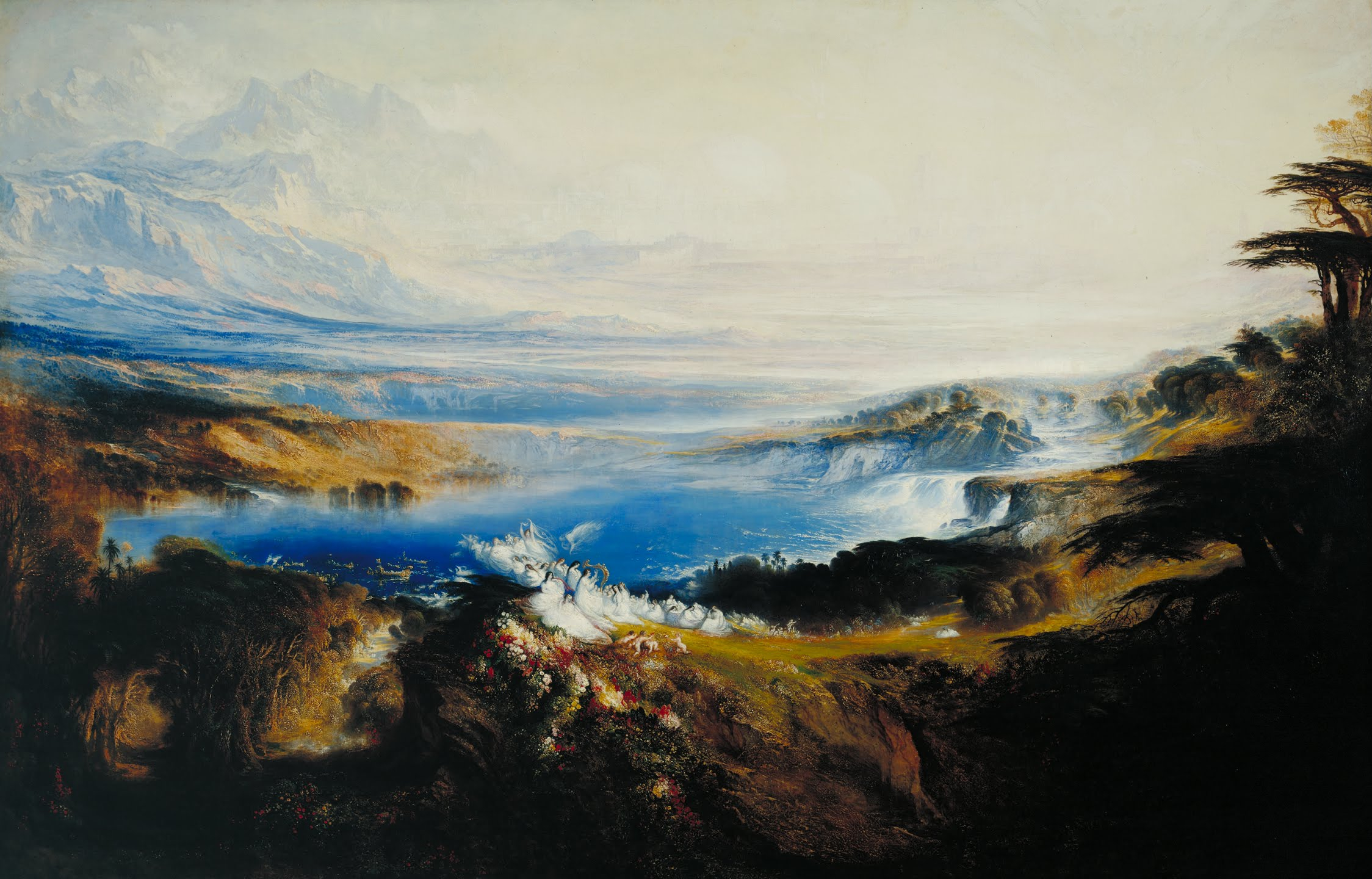

All four works are public domain; license and attribution verified live against Wikimedia Commons on every fetch, and shown under each image.
The xylon crossing — the Trees-thread hinge
The single most load-bearing datum on the page: the tree of life barred in Eden and reopened in the City is legible only across the Greek layer, because the Septuagint chose one word — xylon — for Eden’s ʿēṣ. That word also names the curse-tree of the cross.
…the tree of life also in the midst of the garden. LXX: xylon tēs zōēs (Swete, PD) — “the tree of life.”
Revelation 22:2 (Greek)…on this side of the river and on that was the tree of life. Greek: xylon zōēs (G3586) — the same word the LXX chose for Eden’s tree.
On the tagged floor: ʿēṣ (H6086) 328 occurrences (live) · xylon (G3586) 20 (live) · zōē (G2222) 135 (live).
Live counts from the verse_words floor (STEPBible TAHOT/TAGNT, CC BY 4.0). Dossier fallback for H6086 = 328 occurrences (verified). LXX strings: Swete, The Old Testament in Greek (1909, PD).
→ Trees (the same G3586 door — the whole orchard)The city is the Holy of Holies
Why is there “no temple” in the New Jerusalem? Because the city is the temple. The Most Holy Place was a perfect cube; the New Jerusalem (Rev 21:16) is that cube expanded to city-scale — the Holy of Holies grown to hold everyone.
And I saw no temple therein: for the Lord God the Almighty, and the Lamb, are the temple thereof.
1 Kings 6:20And within the oracle was a space of twenty cubits in length, and twenty cubits in breadth, and twenty cubits in the height thereof — a perfect cube, the Holy of Holies. The New Jerusalem (Rev 21:16) is that cube expanded to a city, so “I saw no temple therein.”
Rev 21:16, 21:22; 1 Kgs 6:20 (ASV, PD). Beale, The Temple and the Church’s Mission (2004) — cite-only ≤50 words.
The morning-star capstone
On the last page of the canon, the one who spoke the light into being names himself: the star out of Jacob (Num 24:17), the root of Jesse (Isa 11:1), the bright morning star.
There shall come forth a star out of Jacob, and a sceptre shall rise out of Israel — Balaam’s oracle of the star.
Revelation 22:16I Jesus… am the root and the offspring of David, the bright, the morning star. On the last page of the canon, Jesus claims Balaam’s star and David’s root (Isa 11:1) in one line.
Num 24:17; Isa 11:1; Rev 22:16 (ASV, PD).
The honest shadow
The seven bright rows all land in Revelation 21–22. But the plan names 20–22, and the canon’s frame has a dark counterpart the page will not hide: the first death threatened in Eden answered by the second death at the end. It is surfaced here, not buried; whether it stands as the page’s shadow or is held back is Marc’s call.
WitnessesPD, attributed
Public-domain voices, full-quote eligible; traditions labeled. Modern authors are cite-only (≤50 words) and never full-quoted.
Featured witness
On Rev 22:3 “no more curse” — the reversal of Gen 3:17, paradise restored beyond the paradise lost.
Matthew Henry· Commentary on the Whole Bible (1708–10)Reformation / Puritan
https://ccel.org/ccel/henry/mhc6- John CalvinCommentary on Genesis (2:9)
The tree of life as a sign / sacrament of life in God, not a magical fruit — anchors the Eden column.
Reformationhttps://ccel.org/ccel/calvin/calcom01 - H. B. Swete (ed.)The Old Testament in Greek (LXX), Genesis 2:9
xylon tēs zōēs = “the tree of life” — the exact phrase Rev 22:2 reuses as xylon zōēs. The crossing datum.
Greek OT — LXXhttps://archive.org/details/theoldtestamenti01swetuoft - Sir Lancelot Brenton (tr.)The Septuagint with Apocrypha: Greek and English (1851)
English gloss of the LXX Gen 2:9 tree-of-life phrase.
Greek OT — LXX (English)https://archive.org/details/TheSeptuagintWithApocrypha - Bernard of ClairvauxSermons on the Song of Songs (12th c.)
The allegorical bridal reading behind Row 6’s Song → Rev 22:17 — labeled as tradition, not asserted as the plain sense.
medieval allegorical — LABELEDhttps://ccel.org
Modern works — cite-only (≤50 words each, not ingested)
G. K. Beale, A New Testament Biblical Theology (2011) and The Temple and the Church’s Mission (2004); Beale & Kim, God Dwells Among Us (2014); T. D. Alexander, From Eden to the New Jerusalem (2008); Gordon Wenham, Sanctuary Symbolism (1986); the Chaoskampf debate (Day 1985; Levenson 1988; Tsumura 2005); Daniel Block, “Eden: A Temple?” (2013); Sandmel, “Parallelomania” (JBL 1962). Each is referenced for a single point above; none is quoted at length.
Sources
Genesis 1–3 & Revelation 20–22 — American Standard Version (1901), public domain (MannaFest floor text). LXX — H. B. Swete, The Old Testament in Greek (1909, PD); Sir Lancelot Brenton, The Septuagint with Apocrypha (1851, PD). Word / floor data — STEPBible TAHOT/TAGNT tagged words (CC BY 4.0); Strong’s lexicon (PD); OpenBible.info cross-references (CC BY 4.0). Matthew Henry, Commentary (1708–10, PD); John Calvin, Commentary on Genesis (1554, PD); Bernard of Clairvaux, Sermons on the Song of Songs (PD); Fairbairn, Typology (1845, PD). Chaoskampf debate — Gunkel (1895, PD); Day / Levenson / Tsumura (cite-only). Modern scholarship (Beale; Alexander; Wenham; Block; Sandmel) cite-only ≤50 words. Imagery (mounted, license-verified via the Wikimedia Commons API on every fetch) — Gustave Doré, The Creation of Light and The New Jerusalem (La Grande Bible de Tours, 1866, PD); Lucas Cranach the Elder, Paradise (1530, PD); John Martin, The Plains of Heaven (1851–53, PD) — attribution and license shown under each image. Everything above is a proposal for Marc’s approval; nothing publishes.