
Romans 5:12–21 · 1 Corinthians 15:45–49 · Featured Study
The Two Adams
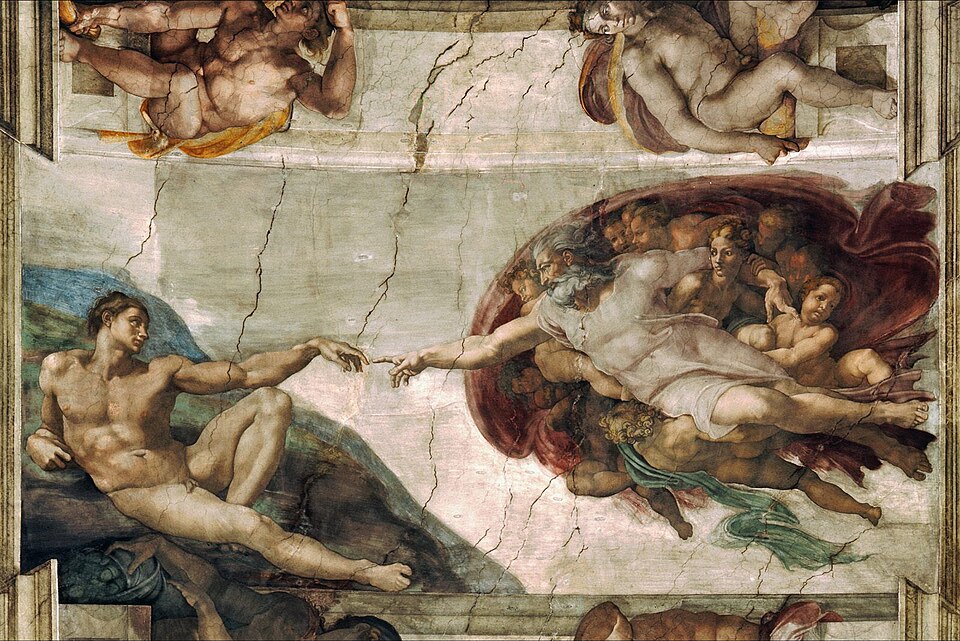
The human race has had exactly two representatives, and everyone alive stands under one or the other. One man, one act, one result, twice over, in mirror image. Paul's paragraph is not a meditation on original sin; it is a ledger, and the point of the ledger is that the two columns do not balance. Grace does not merely cancel the ruin. It overtops it.
Summary
This page reads Romans 5:12-21 as a mirrored ledger, running five antitheses between Adam and Christ side by side, and traces the same argument into 1 Corinthians 15.
- Five antitheses run Adam's side against Christ's side, each weighted by Paul's own "much more"
- Romans 5:14 names Adam as a typos, a real man whose pattern runs the opposite direction from Christ's
- Federal headship is laid out as the doctrine that makes both the ruin and the gift possible
- Romans 5:20's hyperperisseuō is treated as a word built to overshoot, grace outrunning sin rather than merely matching it
One Man · One Act · One Result
the frame Paul builds, then builds again in mirror image
Adam: “through one man sin entered into the world” (5:12)
Christ: “the one man, Jesus Christ” (5:15)
The trespass: a single act of disobedience (5:15, 19)
One act of righteousness: a life of obedience ending at a cross (5:18–19)
Death reigning over a whole race (5:12, 14, 17)
Justification of life, and a race reigning in life (5:17–18)
Adam: the first head
Christ: the last Adam
The Mirrored Ledger
five antitheses, and the right column always outweighs the left
The trespass
“by the trespass of the one the many died.” One act, and a whole race is in the ground. The arithmetic is brutal and it is not disputed: Paul builds on it.
The free gift
“much more did the grace of God, and the gift by the grace of the one man, Jesus Christ, abound unto the many.” The parallel is deliberately not symmetrical: it is one-sided in favour of grace.
“Much more” (polla mallon) is the engine of the whole chapter: an argument from the lesser to the greater, run five times.
Condemnation
“the judgment came of one unto condemnation”: katakrima, the adverse sentence. The word occurs three times in the New Testament, all of them in Romans, and this is two of the three.
Justification of life
“the free gift came of many trespasses unto justification.” Note the asymmetry again: judgment followed one trespass; the gift had to answer many, and did.
Death reigned
“by the trespass of the one, death reigned through the one.” Death is not pictured as an event but as a monarch: a reign with subjects, from Adam to Moses and past them.
They shall reign
The mirror breaks open: not “life shall reign” but “they that receive the abundance of grace… reign in life.” The abdicated crown is handed to the pardoned. Recipients become regents.
The one place Paul refuses to keep the parallel tidy, and the place the doctrine turns into worship.
Disobedience
“through the one man's disobedience the many were made sinners”: constituted, placed in that legal standing, not merely influenced toward it.
Obedience
“through the obedience of the one shall the many be made righteous”: the same verb, the same kind of constituting. Whatever “made sinners” means in Adam, “made righteous” means in Christ.
This is the hinge verse for imputation: the standing is conferred by the head's act, on both sides of the mirror.
Sin abounded
“the law came in besides, that the trespass might abound.” The law's arrival does not fix the problem: it enlarges the reading on the gauge, so the true size of the ruin is visible.
Grace super-abounded
“where sin abounded, grace did abound more exceedingly”: hyperperisseuō, a compound built to overshoot: grace not merely meeting the flood but overtopping it.
Calvin, commenting on 5:20, presses exactly this, grace overtopping the flood of sin rather than balancing it (Calvin, Commentary on Romans, 1540).
The bars are a reading aid, not a measurement: Paul gives no numbers. What he gives is a word, repeated: much more. The comparison runs from the lesser to the greater every time, so the ledger is deliberately unbalanced in one direction. Read the chapter and the tilt is unmistakable: Romans 5.
“A Figure of Him That Was to Come”
Romans 5:14: Paul names his own typology
“Nevertheless death reigned from Adam until Moses, even over them that had not sinned after the likeness of Adam's transgression, who is a figure of him that was to come.”Romans 5:14 · ASV
“Figure” is typos: a stamp, a die, the impression a seal leaves. It is Paul's own word for typology, used here of a real historical man. That matters twice over. It means Adam is not a symbol Paul invented to make a point about Christ: he is a person from whom a pattern was taken, standing at the head of a genealogy Luke traces without a seam. And it means the pattern is a contrast-type: the die and its impression run opposite ways. Adam is like Christ precisely in being one man whose single act settled the standing of everyone he represented. In everything else he is the negative of the plate.
Paul draws the same line in 1 Corinthians 15:45–49: “The first man Adam became a living soul. The last Adam became a life-giving spirit… The first man is of the earth, earthy: the second man is of heaven.” Note what he calls Him: the last Adam, not the latest. There will not be a third head of the human race.

In Adam / In Christ
federal headship: why one man's act can settle another man's standing
In Adam
- A real man, at a real beginning, acting for a race that was not yet born.
- “So death passed unto all men, for that all sinned” (5:12): the solidarity is why the sentence reaches everyone, including those who never had a commandment to break (5:14).
- Not a bad example inherited by imitation. A standing inherited by representation, which is why infants die.
In Christ
- A second head, at a second beginning, acting for a race not yet born again.
- “As in Adam all die, so also in Christ shall all be made alive”: the first man became a living soul; the last Adam, a life-giving spirit (1 Corinthians 15:22, 45).
- This is why imputation is not a legal fiction: what is true of the Head is reckoned to the members. Union is the ground of the exchange.
The modern ear resists representation: we want to answer for ourselves and no one else. But the objection cuts both ways, and Paul knows it. If it is unjust for Adam's act to count against me, it is equally unjust for Christ's act to count for me; and the whole hope of the gospel is that the second reckoning stands. The two are one doctrine. Refuse the first head and you have no ground for the second.
Where Sin Abounded
Romans 5:20–21: the word built to overshoot
The logic of 5:20 is the one that makes people nervous, and Paul knows that too: the very next line of chapter 6 is the objection, “shall we continue in sin, that grace may abound?” with its flat refusal. But he will not soften the sentence to prevent the misreading. The law came in alongside so that the trespass would show its true size, and exactly where sin reached flood height, grace stood higher.
And then the two reigns of 5:21 close the paragraph: sin reigned in death; grace reigns through righteousness unto eternal life. Same verb, opposite thrones. The question the chapter leaves is not whether you are ruled: it is which reign you are living under, and under whose head you stand.
“As the reign of a tyrant and oppressor is a foil to set off the succeeding reign of a just and gentle prince and to make it the more illustrious, so doth the reign of sin set off the reign of grace. Sin reigned unto death; it was a cruel bloody reign.”
Matthew Henry, Commentary on the Whole Bible (1710), on Romans 5:21 · public domain
The Words on the Axis
the vocabulary the ledger is written in
Matthew Henry, on 5:19, takes “through the obedience of the one” as the parallel that grounds both the inherited standing and the credited one (Henry, Exposition of the Old and New Testaments, 1710). Calvin, on 5:20, has grace overtopping the flood rather than merely matching it (Calvin, Commentary on Romans, 1540). John Wesley's notes on the passage press that the “many” made righteous are made so by the same kind of act that made the many sinners (Wesley, Explanatory Notes upon the New Testament, 1765). Chuck Missler read the two-Adams structure as one of the canon's deliberate architectural signatures (Missler, Learn the Bible in 24 Hours, 2002).
Word studies
The Hebrew and Greek under this study, each word in its own room.
Keep Studying
Read it1
On this page
Studies4
People and groups3
Symbols1
Go further1