Taw — The Mark of God
The last letter of the Hebrew alphabet — drawn in the Sinaitic script as a cross — appears at the decisive moments of judgment and rescue: the doorposts of Goshen, the foreheads in Jerusalem, the sealing of the 144,000, and the cross at Golgotha.
The letter that meant 'mark' kept showing up at the moments that needed marking.
Taw — The Mark of God
Ezekiel 9:4Framework
The Last Letter
The Hebrew alphabet ends with taw. Twenty-two letters, and taw is the twenty-second — the closing signature of the alphabet. In the Sinaitic script (the earliest stage of the alphabet, c. 1500 BC, attested in inscriptions at Serabit el-Khadim and Wadi el-Hol), taw was drawn as a simple cross or X. The shape is plain and load-bearing: two strokes intersecting, the most basic possible "mark."
The form is conserved across the early Semitic family. Phoenician inscriptions of the 11th–9th centuries BC keep the X. Old Aramaic and the early Hebrew inscriptions (the Gezer Calendar, the Siloam tunnel inscription) show a slightly tilted X, the bottom-right stroke beginning to curl. Only after the Babylonian exile, when the square Aramaic script displaces paleo-Hebrew for sacred writing, does taw take its modern form: ת — closed on the right, open on the left, no longer recognizable as a cross.
That matters for one specific reason. When the prophet Ezekiel writes c. 593–571 BC and the man clothed in linen is told to "set a taw upon the foreheads of the men that sigh and that cry" (Ezek 9:4), the script the prophet would have used was paleo-Hebrew. The mark on the foreheads of the righteous in Jerusalem — by the most direct reading of the text and the script of its writing — was a cross.
What "Mark" Means in Hebrew
The noun taw (תָּו) and the verb formed from it both mean mark, sign, signature — the act of inscribing a sign on something or someone. The same root surfaces in 1 Samuel 21:13, where David, feigning madness before Achish, "scrabbles on the doors of the gate" — the verb is yetav, "made marks." A mark is what a seal does. A mark identifies, claims, and protects.
Ezekiel 9:4 is the load-bearing text. The vision falls in 592 BC, six years before the Babylonian destruction of Jerusalem. The glory of the LORD is preparing to depart from the Temple (chs. 8–11). Six executioners are summoned, but before they begin, a seventh man — clothed in linen, with a writing case at his side — is sent through the city. His instructions:
"Go through the midst of the city, through the midst of Jerusalem, and set a mark (וְהִתְוִיתָ תָּו) upon the foreheads of the men that sigh and that cry for all the abominations that be done in the midst thereof."
The Hebrew is doubled for emphasis: vehitvita tav — "and you shall mark a mark." The marked are spared. The unmarked are slain. The geography is precise: the executioners begin at the sanctuary itself, with the elders, and work outward. The mark is the pivot between judgment and rescue.
The grammar of the verb (hitpa'el of the root t-v-h) is unusual enough that medieval Jewish commentators noticed it. Rashi reads the cognate accusative as a hint that the taw is the literal letter taw — written, in the script of the day, as a cross on each forehead. The Babylonian Talmud (b. Shabbat 55a) preserves a debate between R. Aha b. R. Hanina and Rab on what was actually inscribed; Aha argues for taw of tichyeh (you shall live) on the righteous and taw of tamut (you shall die) on the wicked, but the text of Ezekiel itself names only one mark on the spared.
The Passover Connection
Eight centuries before Ezekiel, Israel was first marked. Exodus 12:13: "And the blood shall be to you for a token (אוֹת — ot) upon the houses where ye are: and when I see the blood, I will pass over you, and the plague shall not be upon you to destroy you, when I smite the land of Egypt."
The Hebrew ot is the umbrella category — "sign," "mark," "token" — that covers both the Passover blood and the Ezekiel taw. The blood is a sign; the taw is a sign; both are inscribed in the moment before the destroyer passes. The structural identity is exact: in each case, a household or person is marked, a destroyer comes, the marked are spared, the unmarked die.
The geometry of the Passover application — Exodus 12:7 specifies lintel and the two side posts — has been the subject of typological reading since at least the 2nd century. Hyssop dipped in blood, struck on the lintel and the two doorposts (Ex 12:22), creates a mark with three points: top, left, right. Some Christian readers (Tertullian, Against Marcion 3.22; Justin Martyr, Dialogue with Trypho 40) extend the line of blood downward with the natural drip and read the resulting four-point figure as a cross. The page does not insist on this; the editorial drawer carries the founder's position.
What the Passover and the Ezekiel mark plainly share is the function. Hebrews 11:28 names Moses' Passover faith in the same lexicon used for the taw: "Through faith he kept the passover, and the sprinkling of blood, lest he that destroyed the firstborn should touch them." The marked-and-spared pattern is one pattern with two instances. Revelation will give a third.
The Revelation Sealing
Revelation 7 freezes the action between the sixth and seventh seals. Four angels hold back the four winds. A fifth angel ascends from the east "having the seal of the living God," and cries with a loud voice to the four:
"Hurt not the earth, neither the sea, nor the trees, till we have sealed the servants of our God in their foreheads." (Rev 7:3)
The Greek verb is sphragizō — to seal, to impress with a signet, to certify ownership. The number sealed is 144,000, twelve thousand from each tribe of Israel. Two chapters later (Rev 9:4) the locust plague is told explicitly to "hurt only those men which have not the seal of God in their foreheads." Five chapters later (Rev 14:1) the same 144,000 stand on Mount Zion with the Lamb, "having his Father's name written in their foreheads."
The Ezekiel echo is structural and intentional. John, writing in the 90s AD, has Ezekiel in front of him: the executioners-before-the-mark, the sealing-before-the-judgment, the forehead as the location, the remnant identified by the visible sign. What changes between Ezekiel and Revelation is the content of the mark. In Ezekiel it is taw — the letter that means "mark." In Revelation it is, by Rev 14:1 and 22:4, the Father's name.
That progression — mark → seal → name — is not casual. The mark identifies the spared. The seal certifies them as owned. The name discloses the owner. By Revelation 22 the work of marking is finished; the marked are with God, his name is on them, they see his face, and they reign.
The Name on the Forehead
Revelation 22:4 closes the arc:
"And they shall see his face; and his name shall be in their foreheads."
The progression that began in Ezekiel — a mark that means "spared" — has matured into a name that means "his." It is the same forehead, the same act of marking, the same divine signature. What is being shown across the canon is one visible sign, taking three forms as the work of redemption advances:
- In Egypt and Jerusalem, the mark is a sign of judgment averted. The mark is tactical: it tells the destroyer to pass.
- In John's vision of the seventh seal, the mark is a seal of identification. The seal certifies ownership before the trumpets blow.
- In the New Jerusalem, the mark is the name itself. There is no destroyer to pass over and no judgment to seal against. The forehead simply shows whose face the bearer sees.
The forehead is the same surface across all three episodes. What changes is what is written there.
There is also a structural counter-image the book of Revelation refuses to leave implicit. The beast of Revelation 13:16 marks his own on the forehead and the right hand. Two marks; two ownerships; the same surface. The book is naming the question every reader has to answer — whose mark do you bear — and refusing to let it be ambiguous.
The Cross as the Culminating Taw
Three witnesses converge here.
Tertullian (c. 200 AD), Against Marcion 3.22, reads Ezekiel 9 explicitly as cross-typology: the mark on the forehead in the prophet's vision is the very letter that, in the script the prophet wrote, was shaped like a cross — and is the visible sign of the cross to come. He is the earliest Christian writer to make the connection in print, and he treats it as obvious.
The Epistle of Barnabas 9:8 (early 2nd c.), reading Genesis 14, claims the 318 servants Abraham takes to rescue Lot represent "Iēsous + cross" by Greek numerical value (IH = 18, T = 300). The argument is fanciful and the page does not lean on it; what is durable is that within a generation of the apostles, Christian readers were already seeing the shape of the cross as a key encoded across the canon.
The apostles themselves name the seal-and-name pattern as Christ's. Paul, twice, ties the believer's identity to a seal: "in whom also after that ye believed, ye were sealed with that holy Spirit of promise" (Eph 1:13); "and grieve not the holy Spirit of God, whereby ye are sealed unto the day of redemption" (Eph 4:30). The Greek is sphragizō — the same verb John uses in Revelation 7. The seal Paul names is the Spirit; the sealing is at belief; the destination is "the day of redemption." The Ezekiel-Revelation forehead is the church's present possession.
If the mark on the forehead in Ezekiel was a taw — and if the taw in the prophet's hand was a cross — and if the seal in Revelation is the Father's name and the seal in Paul is the Spirit, then the cross at Golgotha is the culmination of the mark, not its substitute. The shape of the letter that meant "spared" became, at one point in history, the shape of the wood that did the sparing. This reading is offered by the church fathers but goes beyond what the text of Ezekiel can compel; the founder's drawer carries the position.
And the LORD said unto him, Go through the midst of the city, through the midst of Jerusalem, and set a mark upon the foreheads of the men that sigh and that cry for all the abominations that be done in the midst thereof.The mark motif — one motif, four words
Every canonical occurrence of the protective forehead-mark at judgment. The recurrence is real — but the words are not the same. Each row is labeled with its own lemma; only Ezekiel is literally a taw.
| # | Reference | Word | Gloss | Role in the motif |
|---|---|---|---|---|
| 1 | Eze 9:4 | taw H8420taw | set a mark | The literal taw — the exhibit's core scene |
| 2 | Eze 9:6 | taw H8420taw | upon whom is the mark | The mark spares from slaughter |
| 3 | Gen 4:15 | ʾôṯ H226 | set a mark / sign upon Cain | Protective mark — a different word (ʾôṯ, not taw) |
| 4 | Exo 12:13 | ʾôṯ H226 | the blood shall be to you for a token | Blood as protective sign on the lintel |
| 5 | Rev 7:3 | sphragizō G4972 | sealed in their foreheads | NT sealing — the curated link from Ezek 9:4 |
| 6 | Rev 14:1 | name written G1125 / G3686 | the Father's name written in their foreheads | The sealed identified by the Name |
| 7 | Rev 22:4 | name written G1125 / G3686 | his name shall be in their foreheads | The motif's consummation |
| — | Rev 13:16 | charagma G5480 | a mark in their foreheads | Antitype — the beast's counter-mark (Rev 13:16–17; 14:9) |
Integrity note. Only Ezek 9:4 / 9:6 is literally a taw (H8420). Gen 4:15 and Exod 12:13 use ʾôṯ (H226); Revelation uses seal (G4972) and name-written. The motif — a protective, identifying forehead-mark at judgment — is real and canonical; the word-identity claim (“all these are the taw”) is false. Show the motif; label each word honestly.
Source: H8420 vs H226 vs G4972 / G5480; biblical text (STEPBible TAHOT floor, CC BY 4.0).
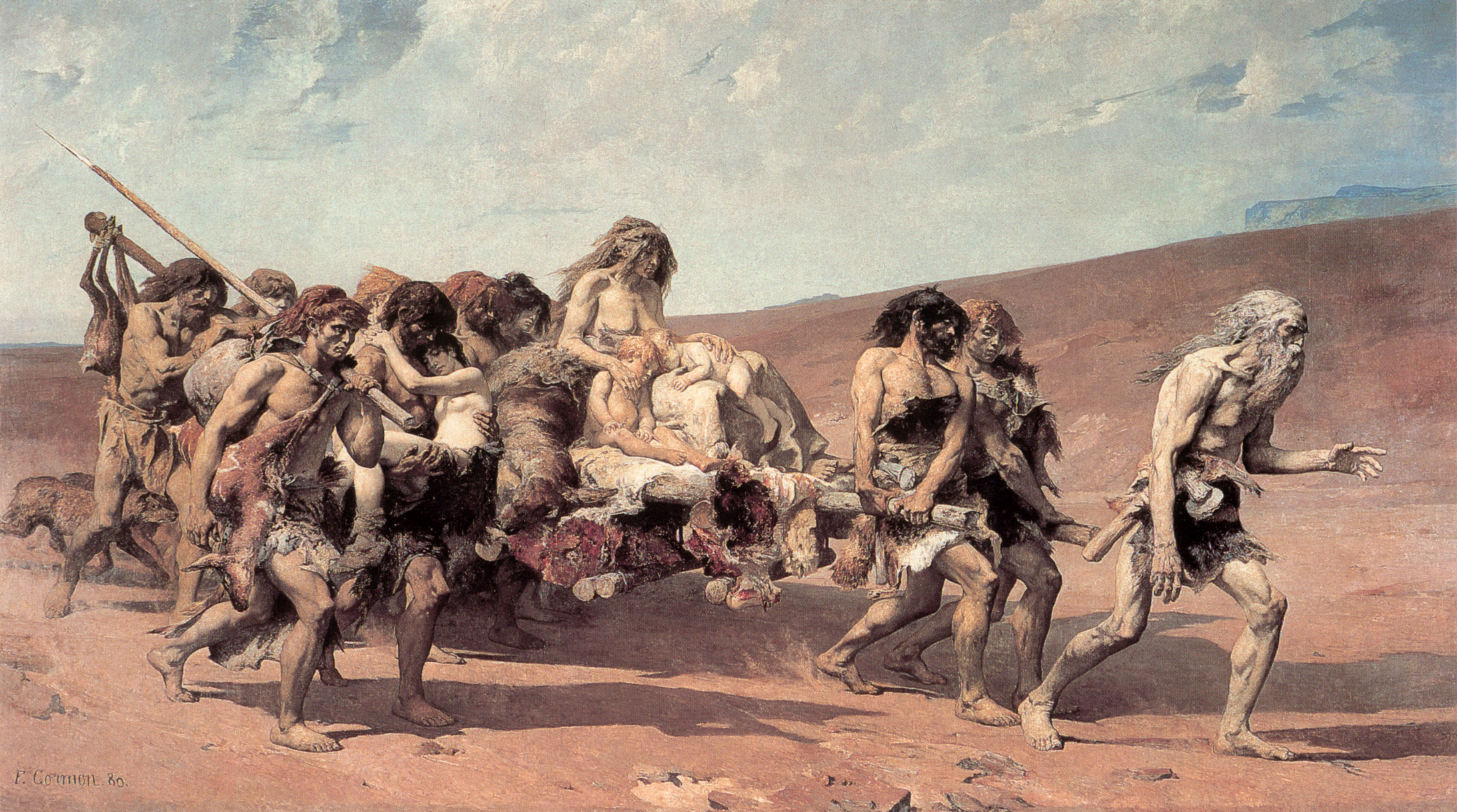
The motif on canvas
The same scenes, as the masters saw them — each painting labeled with its own word, exactly like the rows above.


Mark → seal → name
The motif deepens as it moves through the canon: a mark set in ink, then a seal, then a Name written — the sealed at last known by the One whose they are. And beneath it, the deliberate counterfeit.
A taw set on the foreheads of those who sigh over the abominations — the mark that spares.
The servants of God sealed on the forehead before the winds of judgment are loosed.
His name in their foreheads — the mark's consummation: identity, not mere protection.
The mark motif has a shadow: the mark of the beast — a forehead-and-hand mark of allegiance (Rev 13:16–17; 14:9). It is the deliberate counterfeit of the seal of God — the inverse of the taw, not a decoding of it.
Source: Rev 13:16–17; 14:9 (biblical text). Present as the motif's inverse, never as decoding.
The mark in its own chapter
See the mark in Ezekiel 9 →The last letter — paleo ✕ to square ת
The taw kept its name and its place — the 22nd and last letter — across the great script change. Only its shape changed: the pictographic cross-mark of the older Hebrew script became the square Aramaic ת.
| Era | Script | Taw | Epigraphic exemplar | Approx. date |
|---|---|---|---|---|
| Bronze Age | Proto-Sinaitic / Proto-Canaanite | ✕ | Serabit el-Khadim / Wadi el-Hol corpus | c. 1800–1500 BC |
| Iron Age | Paleo-Hebrew | ✕ / + | Gezer Calendar; Siloam Inscription; Lachish letters; Izbet Sartah abecedary | c. 925–586 BC |
| Post-exile | Aramaic “square” (Ashuri) | ת | Dead Sea Scrolls; Masoretic tradition | c. 5th c. BC onward |
The script-change dispute. The Talmud itself preserves the tradition that the Torah was first given in ktav ʿIvri (the old paleo-Hebrew script) and later changed to ktav Ashuri (the square “Assyrian” letters) in Ezra's day — with R. Yose and Rebbi disputing which script was the original. This is the primary source for the letterform history above, and it makes an honest, open question of it: what shape was the taw Ezekiel actually saw? Epigraphy shows pre-exilic Israel wrote paleo-Hebrew (the ✕); the square ת is post-exilic. Present both; adjudicate neither.
b. Sanhedrin 21b–22a · rabbinic (Jewish tradition) · sefaria.org/Sanhedrin.21b · public domain
From aleph to taw — first letter to last, the whole of a thing. In Greek: Alpha to Omega. The taw is Hebrew's Omega, hence “the End.”
Rev 1:8; 21:6; 22:13 (Christ, applying Isa 44:6, YHWH “the first and the last”). Devotional resonance and history of interpretation only — it fails availability and volume (a Greek alphabet idiom, no verbal borrowing). Not proof. Source: Motyer, NIDB “Acrostic” (cite-only); lens 11 divine-names.

The witnesses — the taw read across the traditions
The taw is a real scribal datum that readers across two traditions interpreted. The governing rule of this exhibit: present the Christological reading as patristic interpretation of a real paleographic fact, never as an encoded prediction — dated, attributed, and never asserted as the text's own claim.
“The Lord said unto me, Go through the gate, through the midst of Jerusalem, and set the mark Tauupon the foreheads of the men.” … “Now the Greek letter Tau and our own letter T is the very form of the cross, which He predicted would be the sign on our foreheads in the true Catholic Jerusalem.”
Tertullian· Against Marcion III.22 (ANF vol. 3)patristic · public domain
ccel.org/ccel/schaff/anf03 (verbatim Tau/cross passage)
Records a convert-from-Judaism's report that in the older Hebrew script the taw had the form of a cross, and weighs it.
Origen· Selecta in Ezechielem (on 9:4), PG 13patristic · public domain
Attributed summary — verbatim PD English not yet pulled (see gaps); not quoted.
Notes that the ancient Hebrew / Samaritan taw resembled a cross, and that the faithful are marked with it.
Jerome· Commentary on Ezekiel (on 9:4)patristic · public domain
Attributed summary — cite-only pending verbatim pull; not quoted.
On Ezekiel 9:4's taw, the Amoraim dispute its sense — one reading takes it for tiḥyeh (“you shall live,” marked on the righteous), another for tam (“it is finished; the merit of the fathers is exhausted,” on the wicked). Reish Lakish: the taw is the last letter of ʾemet (“truth”), the seal of the Holy One. The righteous were marked in ink, the wicked in blood.
Babylonian Talmud· b. Shabbat 55arabbinic (Jewish)
Ancient text public domain; the available English (Sefaria / Davidson) is CC-BY-NC — rendered as an attributed summary, not a block quote. sefaria.org/Shabbat.55a
The scribal-script witness: the Torah was first given in ktav ʿIvri (paleo / old-Hebrew) and the script was later changed to ktav Ashuri (the square letters) in Ezra's day — R. Yose and Rebbi disputing which was the original.
Babylonian Talmud· b. Sanhedrin 21b–22arabbinic (Jewish)
Public domain. sefaria.org/Sanhedrin.21b
The workbench doors
Every mark-word opens onto its own lexicon entry — the elephant-depth into the original language. Follow any door.
- tāwH8420a mark; by implication, a signature
The exhibit's core word — the mark of Ezek 9:4 / 9:6; the 22nd and last Hebrew letter; from H8427; 3 occurrences (Ezek 9:4; 9:6; Job 31:35). Job 31:35 = “signature,” grounding the rabbinic seal-of-God reading.
- ʾôṯH226sign, token, mark
The mark word in Gen 4:15 (Cain) and Exod 12:13 (Passover blood-token) — NOT taw. The integrity door.
- sphragizōG4972to seal, to mark with a seal
The NT sealing of Rev 7:3 — the Greek half of the motif.
- charagmaG5480a stamp, a mark
The mark of the beast (Rev 13:16–17; 14:9) — the motif's dark antitype.
- tôrâH8451instruction, law
Adjacent — the “TORH” ELS string (contested drawer) and the aleph-to-taw completeness of God's word.
Source: Strong's / Blue Letter Bible lexicon (BDB, PD): blueletterbible.org/lexicon/h8420
◈The ELS “taw” — visible vs. persuadedcontested · equidistant-letter-sequence
The claim. Weissmandl observed that, counting every 50th letter from the first taw of Genesis, the letters spell TORH, with a parallel 50-interval TORH near the start of Exodus.
Weissmandl (posthumous); Chabad, “The Purim Code.”
The critique. A historically real observation, but statistically trivial for short strings — an equidistant-letter sequence that short can be found in many long texts, and is invisible without an algorithm. It is the exact opposite of the Ezekiel taw, which is a letter you can see on the page. Included here only as the foil: the visible mark versus the one that must be computed.
McKay, Bar-Natan, Bar-Hillel & Kalai, “Solving the Bible Code Puzzle,” Statistical Science 14(2):150–173 (1999); Aumann committee (2004). Contested — never a published connection row.
Sources
- Strong's H8420 tāw (BDB, PD) — gloss, root H8427, 3 occurrences: blueletterbible.org/lexicon/h8420
- Tertullian, Against Marcion III.22 (ANF vol. 3, PD): ccel.org/ccel/schaff/anf03 — verbatim Tau/cross passage.
- Origen, Selecta in Ezechielem (on 9:4), PG 13 — cite-only pending verbatim PD pull.
- Jerome, Commentary on Ezekiel 9:4 — cite-only pending verbatim PD pull.
- b. Shabbat 55a — ancient text PD; Davidson English CC-BY-NC (summary only): sefaria.org/Shabbat.55a
- b. Sanhedrin 21b–22a — ktav ʿIvri → ktav Ashuri (PD): sefaria.org/Sanhedrin.21b
- J. A. Motyer, “Acrostic,” New International Dictionary of the Bible (Zondervan, 1987) — cite-only, in copyright.
- McKay, Bar-Natan, Bar-Hillel & Kalai, “Solving the Bible Code Puzzle,” Statistical Science 14(2):150–173 (1999); Aumann committee (2004) — contested-drawer refutation literature.
- STEPBible TAHOT (CC BY 4.0) — resident floor for H8420 occurrence counts and per-verse lemma tags: github.com/STEPBible/STEPBible-Data
- Imagery: Commons Siloam_inscription.jpg (CC0); Gezer_calendar_close_up.jpg (CC BY-SA 3.0); Leon Levy DSS Digital Library (© IAA, link-only).