For forty years Israel carried a tent through the desert, built to a plan God gave Moses down to the last board and curtain. None of it was decoration. The tent was a picture of how a holy God lets people come near him — and every step inward cost blood. Walk it from the gate to the innermost room and you walk the gospel, laid out in furniture.
The Tabernacle plan, entered from the east (right).Adik86 · CC BY-SA · Wikimedia Commons
Tap a numbered point to see what it was and where it led.
The Most Holy Place is a perfect cube — the same proportion given for the innermost sanctuary of Solomon’s temple (1 Kings 6:20) and for the New Jerusalem (Revelation 21:16).
▸The complete study — word tools, cross-references, the honest pattern exhibit, and sources
Depth 3 · the walk
The seven stations
The plan above is the index; every station opens here in walk order, from the east gate inward. The numbers are the biblical text's own (cubits, the primary figure) — and where Scripture gives no dimension, the table says not given, not a guessed size. Each station carries its warrant tier: whether the New Testament makes the typological link, or a tradition reads it so.
The menorah relief, Arch of Titus, Rome (AD 81) — the seven-branched lampstand of Exodus 25:31 carried in Titus's triumph: the closest surviving eyewitness image of the temple lampstand.
Veil: blue/purple/scarlet linen with cherubim on 4 gold-overlaid pillars, silver sockets. Ark & mercy seat: pure gold (ark overlaid within and without); 2 cherubim of beaten gold
The innermost room; God speaks “from between the two cherubim” (Ex 25:22). A 10×10×10 cube (derived).
Scripture on Scripture: Heb 10:20 — “the veil, that is to say, his flesh”; Heb 9:4–5; Rom 3:25 — the mercy seat, hilastērion
Typology: the veil torn (his flesh) opening the way; the mercy seat = Christ the propitiation; the ark where law and mercy meet— Hebrews (in-canon); Rom 3:25; ark reading, Habershon 1898
The Discovery dossier maps 40 connections across 15 lenses into this walk (2026-07-21). A common cubit ≈ 18 in / ~45 cm (approximate — the ancient cubit is itself debated, ~17.5–20.6 in; cubits are the text figure, metric a labeled approximation).
Depth 3 · the workbench
The word doors
Ten words carry the tent. Each door opens the workbench — the full lexicon entry and every tagged occurrence, live from the floor. The spine is a Hebrew-to-Greek dwelling chain: mishkan (H4908, Exod 25:9) → skēnoō (G4637, John 1:14) → skēnē (G4633, Rev 21:3).
mishkan— tabernacle, dwelling-place
The building's own name (root shakan, “to dwell”); first occurs Exod 25:9 — the page's title-word.
Hebrews argues from the tent by quoting the Old Testament directly. Five explicit pairs — the in-canon commentary, checkable against the text.
Old Testament
Hebrews quotes it
The point
Exodus 25:40
Hebrews 8:5
“Make all things according to the pattern shewed thee in the mount” — the heavenly-sanctuary argument.
Jeremiah 31:31
Hebrews 8:8
“I will make a new covenant” — the longest OT quotation in the NT; Hebrews' pivot from old tent to new.
Exodus 24:8
Hebrews 9:20
“This is the blood of the testament which God hath enjoined unto you.”
Psalm 40:6
Hebrews 10:5
“A body hast thou prepared me” (LXX-form) — sacrifice and offering superseded by Christ's body.
Jeremiah 31:33
Hebrews 10:16
“I will put my laws into their hearts” — the new-covenant reprise perfecting the worshippers.
Sources: KJV/ASV/WEB (PD); cross-checked against UBS. Hebrews 9:2–5 is Scripture's own room-by-room walk of the furniture — the model this page follows.
Depth 3 · the geometry
The cube and the climbing metals
The Most Holy cube (derived, not verbatim)
From the board dimensions (each 10 × 1.5 cubits, Exod 26:15–16) and the veil's placement, the standard reconstruction yields a tent 30 × 10 × 10 cubits, split by the veil into a 20-cubit Holy Place and a 10 × 10 × 10 Most Holy cube — the same cube form as Solomon's inner sanctuary (1 Kgs 6:20) and the New Jerusalem (Rev 21:16).
Labeled derived — the Exodus text gives board dimensions, not room totals.
The metals climb toward God
Bronze in the court — gate pillars, altar, laver.
Silver at the thresholds — socket bases, pillar capitals, the redemption-money (Exod 38:25–28).
Gold throughout the Holy Place and Most Holy — lampstand, table, incense altar, ark, mercy seat.
Sourced from the Exodus text; the floorplan shades each zone by its metal.
Depth 2 · the dwelling thread
The Shekinah arc — dwelling lost and regained
The whole Bible is a story about where God dwells. It brackets the canon: Gen 3:8 (God walking in the garden, then hidden) to Rev 21:3 (“the tabernacle of God is with men”) — a CANON-LEVEL inclusio, the tent in the middle.
1. Dwelling lostGen 3:8
God walking in the garden — then hidden. The canon's first end of the dwelling thread.
2. PillarEx 13:21
Cloud and fire lead Israel out.
3. TabernacleEx 40:34
The glory fills the finished tent.
4. Temple1 Kgs 8:10
The glory fills Solomon's house.
5. DepartureEzek 10–11
The glory (kabod) departs eastward, stage by stage — the sanctuary emptied.
6. OvershadowLuke 1:35
“The power of the Highest shall overshadow thee” — the glory-cloud over Mary, the new dwelling.
7. IncarnationJohn 1:14
The Word tabernacled (skēnoō) among us.
8. Believer1 Cor 6:19
The body, a temple of the Spirit.
9. Dwelling regainedRev 21:3
“The tabernacle (skēnē) of God is with men” — the thread's other end; the Gen 3:8 inclusio closed.
Depth 3 · an attributed reading
Eden's echo — the first sanctuary
A whole scholarly frame reads the tabernacle as Eden rebuilt. Held here as an attributed reading — rich, and with its critique beside it (see the contested drawer below).
Gen 3:24 → Ex 25:18
Cherubim (kerub) guard the way to the tree of life at Eden's east; cherubim over the mercy seat and woven into the veil guard the Holy of Holies. The sanctuary faces east.
Wenham 1986; Beale 2004 · cite-only
concept:tree → Ex 25:31
The tree of life stylized as the seven-branched golden lampstand — a tree of light in the Holy Place.
Beale 2004 · cite-only
Gen 2:12 → Ex 25:7
Eden's gold and onyx reappear saturating the tabernacle and on the high priest's ephod; sacred materials mark sacred space.
Wenham 1986 · cite-only
Gen 2:11 → the gold thread (zahav H2091)
“Gold” first occurs in Eden's river land, then saturates tabernacle, temple, and the New Jerusalem.
STEPBible floor; lens 08 · cite-only
Depth 3 · the voices
The witnesses
The best apparatus is Scripture on Scripture (Hebrews, in-canon). The per-furniture typology is public-domain tradition, quoted with attribution always visible and labeled as tradition — never flattened into asserted fact.
“Who serve unto the example and shadow of heavenly things, as Moses was admonished of God when he was about to make the tabernacle: for, See, saith he, that thou make all things according to the pattern shewed to thee in the mount.”
Epistle to the Hebrews· Hebrews 8:5 (KJV)public domain
Public domain. The best apparatus this page can have: the New Testament reading the tent.
“…the candlestick, and the table, and the shewbread… the golden censer, and the ark of the covenant… the golden pot that had manna, and Aaron's rod that budded, and the tables of the covenant; and over it the cherubims of glory shadowing the mercyseat.”
Epistle to the Hebrews· Hebrews 9:2–5 (KJV) — the furniture catalogpublic domain
Public domain. The in-canon parallel to this page's method — the candlestick, table, shewbread; the golden censer, ark, pot of manna, Aaron's rod, tables of the covenant, and the cherubim over the mercyseat.
“Having therefore, brethren, boldness to enter into the holiest by the blood of Jesus, by a new and living way, which he hath consecrated for us, through the veil, that is to say, his flesh.”
Epistle to the Hebrews· Hebrews 10:19–20 (KJV)public domain
Public domain. The one place the barrier-veil is named a type explicitly.
The Study of the Types (1898)
Ada R. Habershon· laver, lampstand, showbread, incense altar, ark, Aaron's rod, breastplate, daily lambpublic domain
Public domain (archive.org). The per-furniture typology carried on this page is presented as her tradition, attributed — not as asserted fulfillment.
The Law of the Offerings (1854); The Types in Genesis (1858)
Andrew Jukes· the bronze altar and lampstand; the offerings frameworkpublic domain
Public domain. Traditional typology, labeled as such.
The Typology of Scripture (1845–47)
Patrick Fairbairn· the high-priestly garments; the governing methodpublic domain
Public domain (CCEL). His rule — a type must be divinely intended, not merely resembling — is the site's own warrant-tier discipline in seed form.
Types of the Messiah; Images of Divine Things (1740s)
Jonathan Edwards· posthumouspublic domain
Public domain (CCEL). Figural readings, attributed.
Modern authors — cited only (≤50 words, never ingested)
G. K. Beale, The Temple and the Church's Mission (NSBT 17, 2004) — Traces the arc Eden → tabernacle → temple → Christ → church → New Jerusalem: the whole cosmos as the dwelling God always intended.
Gordon J. Wenham, Sanctuary Symbolism in the Garden of Eden Story (1986) — Reads Eden as the first sanctuary — the cherubim, the eastward gate, the gold, and Adam's priestly “keep and till.”
Daniel I. Block, Eden: A Temple? A Reassessment (2013) — Argues the Eden-temple parallels are overdrawn — a caution held beside the reading, not buried.
Leonhard Goppelt / G. K. Beale, TYPOS (ET 1982); Handbook on the NT Use of the OT (2012) — The warrant-tier distinction: NT-identified types vs. edifying traditional readings.
Depth 3 · honest apparatus
Where the reading is contested
Two drawers, each carrying the claim and its strongest critique at full strength, both cited. No confidence badges — the reader weighs it.
◈Each piece of furniture “is” a specific picture of Christcontested · warrant-tiered
The claim (the typological tradition)
The laver is regeneration, the showbread the bread of life, the lampstand the light of the world, the incense altar intercession — a complete portrait of Christ in the tent's furniture (Habershon 1898; Jukes 1854).
The critique
Classical method (Fairbairn 1845; and the modern discussion, Goppelt 1982, cite-only) distinguishes NT-warranted types — where Hebrews or the Gospels make the link (copy/shadow Heb 8:5, veil = flesh Heb 10:20, mercy seat Rom 3:25) — from traditional/extended readings, which are edifying tradition, not asserted fulfillment.
Verdict
Both are shown. Every station carries its warrant tier — “Scripture makes the link” vs. “a tradition reads it so” — never a confidence score.
Sources: Heb 8:5; Heb 10:20; Rom 3:25; Fairbairn 1845; Goppelt 1982.
◈The tabernacle recapitulates Eden (Eden-as-sanctuary)contested · attributed reading
The claim
Eden is the first sanctuary: cherubim guard its east as they guard the mercy seat; its gold and onyx reappear in the tent; the tree of life is the lampstand; Adam is a priest. Later temple imagery reads Eden backward as holy space (Wenham 1986; Beale 2004).
The critique
Daniel Block, Eden: A Temple? A Reassessment (2013, cite-only), argues the parallels are overdrawn; and Sandmel's Parallelomania (JBL 81, 1962, cite-only) warns generally against stacking loose verbal parallels into a system.
Verdict
Keep the Eden frame as an attributed reading, not a given — a rich lens, held with its critique beside it.
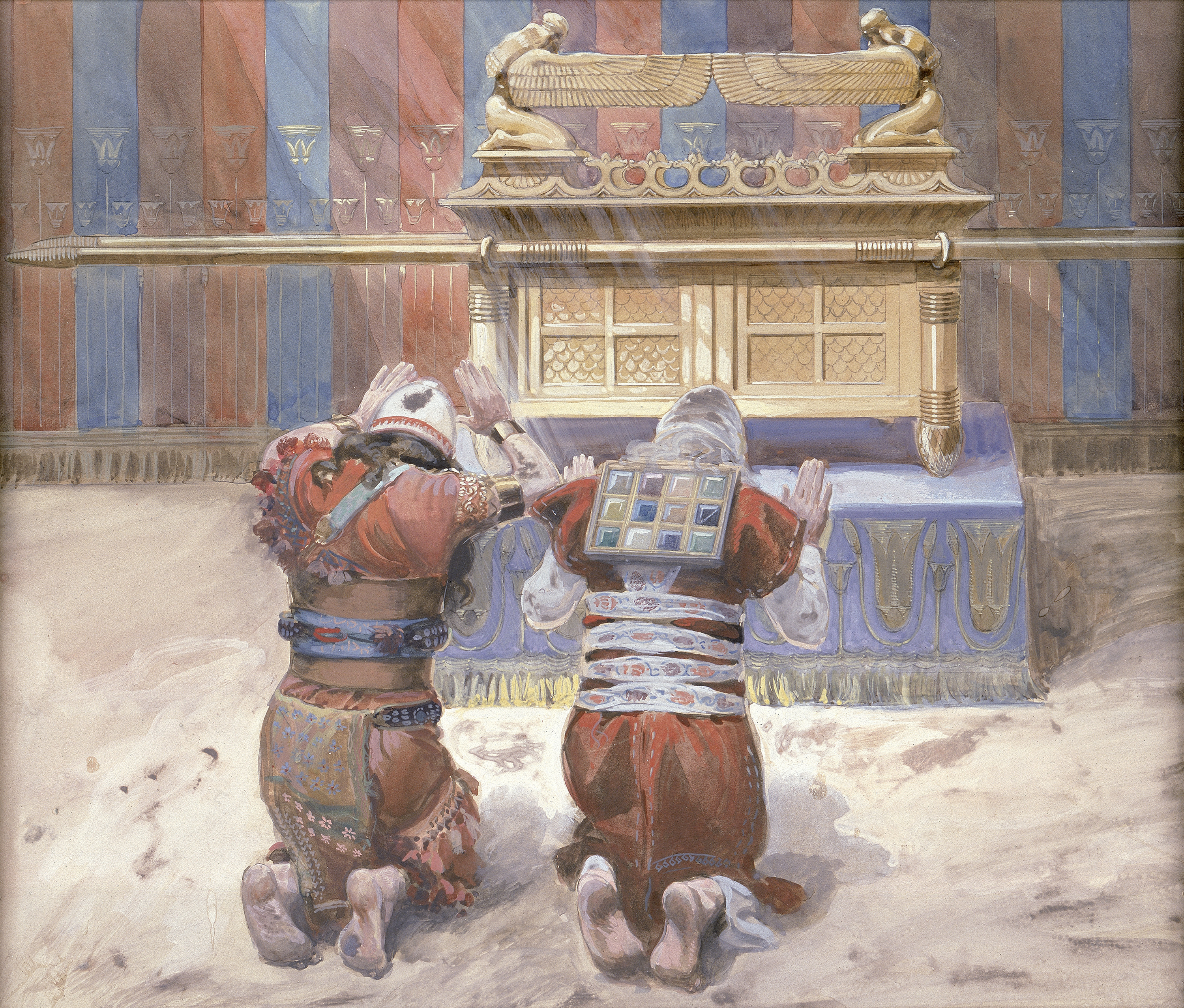
Three centuries of famous depictions — an engraved reconstruction, a Bible-atlas panorama, and Tissot's watercolor from inside the Holy Place. Shown as art of the text, not as archaeology; every image carries its attribution and license beneath it.
The Erection of the Tabernacle and the Sacred Vessels — Gerard Hoet, Figures de la Bible, 1728 — the tent raised and the furniture set in order (Exodus 40:17–33).
Public domainillustrators of the 1728 Figures de la Bible , Gerard Hoet (1648–1733) and others, published by P. de Hondt in The Hague in 1728Wikimedia Commons →
The Tabernacle in the Wilderness — Holman Bible, 1890 — the court and tent at the center of the camp, the cloud of glory above (Exodus 40:34–38).
Biblical text — Exodus 25–31, 35–40; Hebrews 8–10; Rom 3:25; John 1:14, 6:35, 8:12; Rev 21 (KJV 1769 / ASV 1901 / WEB). Public domain; full quotation permitted; the reader is the verifier.
STEPBible (Tyndale House) — TAHOT/TAGNT tagged text + Strong's lexicon (the word floor). CC BY 4.0 / PD.
H. B. Swete, The Old Testament in Greek (LXX) — Exod 25:17 kapporet → hilastērion bridge. Public domain.
Ada R. Habershon, The Study of the Types (1898); Andrew Jukes, The Law of the Offerings (1854); Patrick Fairbairn, The Typology of Scripture (1845–47); Jonathan Edwards (1740s). Public domain.
G. K. Beale, The Temple and the Church's Mission (2004); Gordon J. Wenham (1986); Daniel I. Block (2013); Samuel Sandmel, Parallelomania (JBL 81, 1962); Leonhard Goppelt, TYPOS (ET 1982) — copyrighted; cite-only ≤50 words.
Wikimedia Commons imagery (mounted; license verified server-side on every fetch, attribution shown under each image) — Gerard Hoet, Figures de la Bible (1728, PD); Holman Bible, The Tabernacle in the Wilderness (1890, PD); James Tissot, Moses and Joshua in the Tabernacle (c. 1896–1902, PD); the Arch of Titus menorah relief, Rome, AD 81 (photo PD).