The Scarlet Thread
One scarlet line runs unbroken from the coats of skin to the blood of the Lamb — fifteen scenes on a single thread. The Talmud records that the Yom Kippur crimson cord ceased turning white some forty years before the Temple fell (b. Yoma 39b); what that timing means is weighed honestly on this page.
Cut the Bible anywhere, and it bleeds.
scarlet — the symbol
blood — the substance
Scarlet is the dyed symbol; blood is the substance. The two are held apart and bound only where the canon binds them — Hebrews 9:19, the knot at the center of the line.
On the Yom-Kippur strap (scene 09): the Talmud reports that the crimson strap ceased to turn whitein the forty years before the Temple was destroyed (AD 70), b. Yoma 39b. Aligning that with AD 30 and the crucifixion is a later Christian interpretation — the rabbis admit nothing about AD 30, and “forty years” is a stylized round number.
Framework
Literal threads surveyed
Eight literal scarlet/crimson occurrences thread the canon: Tamar's scarlet thread (Gen 38:28–30); the Tabernacle curtains and priestly garments (Ex 25:4; 26:1; 28:5); the cleansing of the leper (Lev 14:4); Rahab's scarlet cord (Josh 2:18–21; 6:25); the Yom Kippur scarlet cord (Lev 16; Mishnah Yoma 4:2); the crimson worm (tola'at shani, Ps 22:6); the scarlet robe of mockery (Matt 27:28); the robes washed white in the blood of the Lamb (Rev 7:14).
Yoma 39b — the forty-year witness
The Mishnah (Yoma 6:8) preserves a Yom Kippur ritual in which a scarlet cord was tied to the Temple door; when Israel's sins were forgiven the cord turned white (per Isaiah 1:18). The Babylonian Talmud (Yoma 39b) records that for forty years before the Temple's destruction (destroyed AD 70 — so c. AD 30 onward) the scarlet cord ceased to turn white. AD 30 is the widely-held date of the crucifixion. This is a Jewish text, preserved by Jewish scribes, recording that the ritual sign of atonement failed in the year Christians say the true atonement was made. Citation via Rodkinson's 1903 public-domain translation (Soncino is copyrighted).
Isaiah 1:18's scarlet-to-white cleansing
"Though your sins be as scarlet, they shall be as white as snow; though they be red like crimson, they shall be as wool." Isaiah 1:18 is the textual root of the Yom Kippur scarlet-to-white ritual — and the explicit promise that the prophet places in God's mouth. The ritual is a sign of the promise; the thread turning white means the promise has been kept.
Revelation's blood-of-the-Lamb motif
"These are they which came out of great tribulation, and have washed their robes, and made them white in the blood of the Lamb." (Rev 7:14). The paradox of scarlet-washing-to-white resolves at the end: robes made white by blood, not despite it. The thread's final transformation. William Evans's line: "the atonement is the scarlet cord running through every page in the entire Bible."
Depth 2 · the method
The spine — fifteen scenes on one thread
15 scenes · 66 books · one line of blood.
The line above is the index; here the same line carries the freight. Every bead hangs on the ribbon in canonical order and expands in place; the beads with their own page carry an “open the full scene” door. The scarlet symbol and the blood substance are held apart and bound only where the canon binds them — scene 12, Hebrews 9:19.
The fifteen scenes on the thread15 scenes · 66 books
01Coats of skin — the covering
both — boundGen 3:21(contrast Gen 3:7)→ Rev 7:14The opening covering: God replaces human fig-leaves with a God-provided one. The animal-death-for-atonement reading is inference, not stated in the text (see contested drawer).
Tier: inferred — flagged · Witness: ISBE 1915 “Colors”
02Abel's blood — the better word
blood · substanceGen 4:10→ Heb 12:24The first shed blood “crieth from the ground”; Jesus' blood “speaketh better (kreitton) than that of Abel” — the vengeance-cry answered by a mercy-word.
Tier: NT-warranted (Abel named) · Witness: Text; kreitton G2909
03Passover lintel — blood applied
blood · substanceExod 12:7Exod 12:13Exod 12:22→ 1 Pet 1:19Blood applied with hyssop to lintel and side-posts: “when I see the blood, I will pass over you.” The sign is the applied blood.
Tier: NT-warranted · Witness: Edersheim, The Temple (Passover blood-rite)
 The Firstborn of the Egyptians Are Slain — Gustave Doré, 1866; the night the blood on the lintel divides — Exodus 12:13.
04Covenant blood at Sinai & the cup
blood · substanceExod 24:8→ Heb 9:20→ Matt 26:28“Behold the blood of the covenant” dashed at Sinai → Hebrews quotes it word-for-word → the cup: “my blood of the covenant… unto remission of sins.”
Tier: NT-warranted (highest — verbatim quotation) · Witness: Text (Hebrews quotes Exodus verbatim)
05The scarlet-and-blood rites
both — boundLev 14:4Num 19:6The leper's cleansing (cedar, scarlet, hyssop) and the red-heifer triad are the same three ingredients — an objective place where dye and blood already sit in one rite.
Tier: floor (objective vocabulary link) · Witness: ISBE 1915 “Scarlet”
06Rahab's scarlet cord — the emblem
scarlet · symbolJosh 2:18Josh 2:21word:h8615→ Heb 11:31The page's one wordplay: Rahab binds “this line (tiqvat) of scarlet thread,” and tiqvah (H8615) is HOPE — the cord that saves is, lexically, her hope. The “cord = the blood of Christ” reading is the oldest Christian typology (1 Clement) but is inference (see contested drawer).
Tier: wordplay = floor-verifiable; cord = blood = inferred · Witness: 1 Clement 12:7–8 (PD)
 The Harlot of Jericho and the Two Spies — James Tissot, c. 1896–1902; Rahab binds the scarlet cord in the window — Joshua 2:18.
07“Though your sins be as scarlet”
scarlet · symbolIsa 1:18→ Rev 7:14The color thread's resolution and the surprise the whole page turns on: sins “as scarlet… white as snow.” The ribbon begins to whiten here.
Tier: thematic-paradox · Witness: Text (scarlet → white / blood → white)
08The crimson worm
scarlet · symbolPs 22:6 (tolaʿat)→ Matt 27:46The psalm Jesus quotes from the cross uses the very word (tolaʿat) that names the crimson dye-grub. Surface the lexical fact only — the “mother-worm dies on a tree, turns white after three days” sermon is entomological folklore (see contested drawer).
Tier: lexical fact; folklore FLAGGED · Witness: ISBE 1915 “Worm”
09The crimson strap (Yom Kippur)
scarlet · symbolIsa 1:18↔ b. Yoma 39b / m. Yoma 6:8The Day-of-Atonement strap turned white as a sign of forgiveness (cf. Isa 1:18) and “ceased to turn white” in the forty years before the Temple fell (AD 70). Report the datum faithfully; the AD-30 / crucifixion alignment is a Christian interpretive overlay, not the Talmud's claim (see contested drawer).
Tier: rabbinic datum; Christ-overlay FLAGGED · Witness: Edersheim, The Temple; b. Yoma 39b (verify license)
10The mock scarlet robe
scarlet · symbolMatt 27:28word:g2847Royal scarlet draped in mockery on the one about to shed the blood it symbolizes. Matthew reads scarlet (kokkinos); Mark and John read purple — note the Gospel variance, do not harmonize silently.
Tier: motif-irony; scarlet/purple variance FLAGGED · Witness: Text (Matt vs Mark 15:17 / John 19:2)
11The temple veil torn
both — boundExod 26:31→ Heb 10:20“Through the veil, that is, his flesh.” The woven-scarlet barrier becomes the opened way; the two strands begin to rejoin.
Tier: NT-warranted (typology lens) · Witness: Text
12Hebrews 9 — the keystone / hinge
both — boundNum 19:6→ Heb 9:19Heb 9:22The verse where the New Testament itself binds scarlet wool + blood + water + hyssop into one rite. The two strands cross here — the knot at the center of the line, and the guardrail drawer below opens from it.
Tier: NT-warranted (scarlet named in the NT) · Witness: Text (the canon's own knot)
13The cross — the substance shed
blood · substanceJohn 19:29 (hyssop)Exod 12:22word:g3586 (xylon)Gal 3:13The blood the whole line pointed to is shed. Hyssop lifts the sponge as it lifted the Passover blood; the cross crosses here into the Trees feature via xylon. A minority reading of John 19:29 has “javelin” for “hyssop” (see contested drawer).
Tier: NT-warranted; John 19:29 variant FLAGGED · Witness: Text (John frames the true Passover, 19:36)
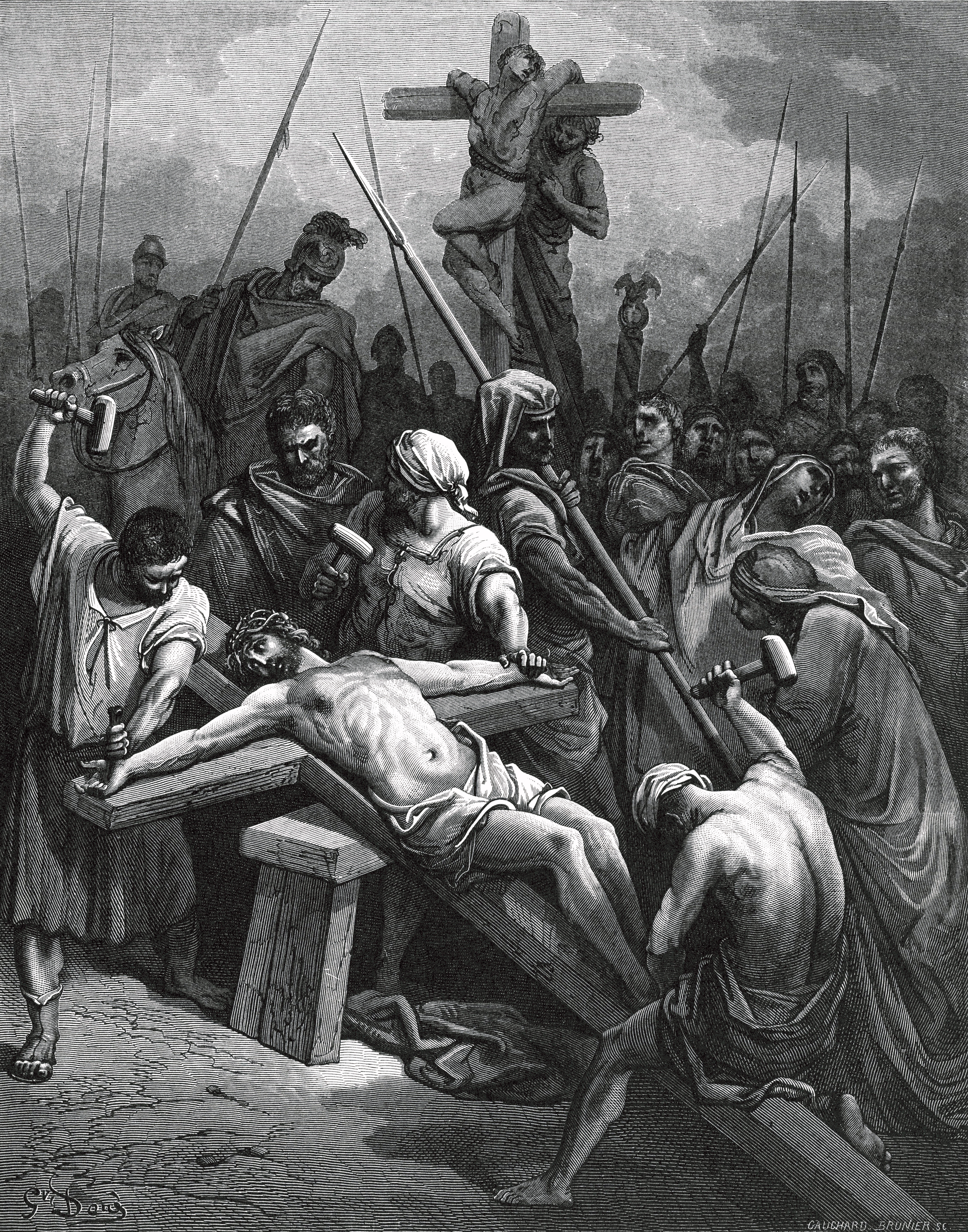 Crucifixion of Jesus — Gustave Doré, 1866; the blood the whole line pointed to is shed — John 19:34.Public domainDrawn by Gustave Doré , engraved by J. Gauchard Brunier . Scanned by Michael Gäbler with Epson Perfection 4490 Photo.Wikimedia Commons →
14The precious blood
blood · substance1 Pet 1:19The lamb without blemish — the redemption price named.
Tier: NT-warranted · Witness: Text
15Robes made white in the Lamb's blood
both — boundRev 1:5→ Rev 5:9→ Rev 7:14The doxological endpoint: the ribbon finishes white. The child's read of the whole line — the red thread turns white at the end, because the blood is the bleach.
Tier: theme (recurrence + satisfaction) · Witness: Text (answers Isa 1:18)
The word doorsDepth 3 · the workbench
The nine words the thread rides on. Each door opens the workbench — the full lexicon entry and every tagged occurrence, live from the floor. Note beside the wordplay: a shared root proves vocabulary, not theology (the Carson / Barr caution) — tiqvah's dual sense is a lexical fact, held as such.
THE PAGE'S ONE WORDPLAY — Rahab's emblem; dual sense verified in two independent lexicons
The guardrail — two threads, one weaveThe site's rule · scene 12
⟡Scarlet vs. blood — the difference this page will not blur
The dye is a symbol; the blood is the substance. Not every red thing in Scripture is the blood of Christ, and the page refuses that overclaim. Scarlet (shani / kokkinos) and blood (dam / haima) travel as two distinct strands — the woven color, and the life poured out.
They are bound only where the canon itself binds them: Hebrews 9:19, where Moses takes “the blood… with water, and scarlet wool, and hyssop” and sprinkles the book and the people. That verse — scene 12, the knot at the center of the line — is the one place the New Testament ties the scarlet symbol to the blood substance. Everywhere else the two are shown side by side, not collapsed into one.
This is why the inferred readings on this page (Rahab's cord, the coats of skin, the crimson-worm folklore, the Yoma AD-30 overlay) are each labeled as inference, with their strongest critique beside them.
Where the thread is contestedDepth 3 · honest apparatus
Each drawer carries the claim and its strongest critique at full strength, both cited. No confidence badges — the reader weighs it.
◈Rahab's scarlet cord “is” the blood of Christcontested · inferred
The claim (ancient, strong pedigree)
1 Clement 12:7–8 (c. AD 95) reads the cord as a sign of “redemption through the blood of the Lord”; the reading recurs through Justin, Origen, and the whole “scarlet thread” homiletical tradition.
The critique
When the New Testament praises Rahab (Heb 11:31; Jas 2:25) it commends her faith and works, not the cord's color. The historical-grammatical rule (Bishop Marsh: only NT-identified types are types) treats the color-symbolism as edifying allegory, not typology.
Verdict
Label the row inferred; show 1 Clement as reception history, not proof.
Sources: 1 Clement 12 (PD); Origen; Heb 11:31; Jas 2:25; Matt 1:5.
◈“Coats of skin” as the first sacrifice / first shed bloodcontested · inferred
The claim
God's clothing of Adam and Eve in skins (Gen 3:21) required a death — the Bible's first blood shed to cover sin.
The critique
The text states only that God made garments of skin and clothed them — no sacrifice, altar, or atonement language. The “first sacrifice” is a theological inference read back from Leviticus and Hebrews.
Verdict
Present the inference AS inference — separate “the text says” from “the tradition reads.”
Sources: Gen 3:21; Isa 61:10; Edwards, Images of Divine Things.
◈The crimson worm (tolaʿat) natural history as Christ-typologycontested · folklore-flagged
The claim (popular preaching)
The female Coccus worm affixes herself to a tree, dies giving her crimson to her young, stains the wood, and after three days the residue turns white — a detailed foreshadowing of the cross.
The critique
The legitimate datum is only that tolaʿat shani denotes crimson dye from a Kermes / Coccus insect (ISBE 1915) and that Ps 22:6 uses tolaʿat. The elaborate life-cycle sermon is entomological folklore of uncertain provenance and shaky accuracy.
Verdict
Surface the lexical fact; drop or explicitly label the natural-history claims as unverified popular tradition.
Sources: ISBE 1915 “Worm”; Ps 22:6; STEPBible.
◈The Yoma 39b crimson strap stopped whitening c. AD 30 = the crucifixioncontested · Christ-overlay flagged
The datum (primary; verify license)
b. Yoma 39b / m. Yoma 6:8 report that the strap turned white as a sign of forgiveness (cf. Isa 1:18) and ceased to during the forty years before AD 70; 70 − 40 = AD 30.
The critique
The Talmud reports the phenomenon and its cessation; it does NOT connect it to Jesus. The AD-30 alignment is a Christian interpretive overlay, and “forty years” is a stylized round number.
Verdict
Present the rabbinic text faithfully; label the Christ-application as interpretation, never as a rabbinic admission.
Sources: b. Yoma 39b; m. Yoma 6:8; Isa 1:18.
◈Hebrews 12:24 — “better than that of Abel”: whose blood?contested · textual variant
The reading
KJV / ASV / WEB render “than that of Abel” (Abel's blood): Abel's cried for vengeance (Gen 4:10), Christ's speaks pardon (kreitton, G2909).
The critique
A minority reads “than Abel” (Abel himself, whose blood also still speaks, Heb 11:4).
Verdict
The point — mercy-word vs. vengeance-cry — holds either way; note the alternative rendering.
Sources: Heb 12:24; Heb 11:4; Gen 4:10.
◈John 19:29 — hyssop or javelin?contested · textual variant
The reading
The majority text reads hyssōpōi (“hyssop”), echoing the Passover hyssop (Exod 12:22); John frames the crucifixion as the true Passover (19:36).
The critique
A minority textual tradition reads hyssōi (“javelin”). The Passover-hyssop echo is theologically apt but rests on the majority reading.
Verdict
Flag the variant; do not build a load-bearing claim on it.
Sources: John 19:29; Exod 12:22; John 19:36.
◈The mock robe was scarletcontested · Gospel variance
The reading
Matthew 27:28 reads scarlet (kokkinos).
The critique
Mark 15:17 / John 19:2 read purple.
Verdict
Note the Gospel variance in the scene rather than harmonizing silently.
Sources: Matt 27:28; Mark 15:17; John 19:2.
The witnessesDepth 3 · the voices
Public-domain sources, quoted or paraphrased with attribution always visible. Traditions are labeled, never flattened.
“…they gave her a sign, that she should hang out from her house a scarlet thread, thereby making it manifest that through the blood of the Lord there shall be redemption unto all them that believe and hope on God.”
Clement of Rome (attrib.)· 1 Clement 12:7–8 — the oldest surviving Christian reading of Rahab's cordpublic domain
Public domain (Lightfoot / Ante-Nicene Fathers). Cite as history-of-interpretation, NOT as proof of authorial intent.
The Temple: Its Ministry and Services as They Were at the Time of Jesus Christ (1874)
Alfred Edersheim· Passover blood-rite; the Day-of-Atonement crimson strappublic domain
Public domain (d. 1889). His description of Temple procedure is prime quarry; verify his rabbinic datings against the primary text before excerpting.
Entries “Colors,” “Scarlet,” “Worm” — the tolaʿat-shani dye is crimson from the Kermes / Coccus ilicis insect
International Standard Bible Encyclopedia (Orr, ed.)· 1915 edition ONLYpublic domain
The 1915 edition is public domain; the 1979–88 Bromiley revision is copyrighted and never ingested.
b. Yoma 39b / m. Yoma 6:8 — the crimson strap that turned white and then ceased to
Babylonian Talmud· verify Sefaria license per textpublic domain
Primary rabbinic text; only the factual report is paraphrased here until the per-text license is confirmed. Present the phenomenon faithfully — the crucifixion overlay is interpretation (see contested drawer).
Glosses: H8615 tiqvah (cord + hope, root H6960); H8438 tolaʿat (worm + crimson); H8144 shani (scarlet); G2909 kreitton (better)
James Strong / Brown-Driver-Briggs· 1890 / 1906public domain
Glosses and references are public domain and not copyrightable; cite Strong's / BDB, not any site's prose.
Modern authors — cited only (≤50 words, never ingested)
- Leon Morris, The Apostolic Preaching of the Cross (1955) — The landmark word-study on “blood” (dam / haima): the term evokes life yielded up in death, not merely life released.
- Peter T. O'Brien, The Letter to the Hebrews (PNTC, 2010) — A modern commentary on the Hebrews 9 gathering of the strands.
- W. A. Criswell, The Scarlet Thread Through the Bible (1888 sermon lineage) — Named only as the homiletical tradition this page catalogs — never as a source of claims.
Where the thread crosses