The Nephilim and the Giants
Four words in Genesis 6 open two family trees — and a line of giants that Israel would meet at Hebron and finally bury at Gath.
Framework
The sons of God and the sons of Anak
The whole question hangs on one phrase in Genesis 6:2 — the sons of God (Hebrew bnei ha'elohim). Everywhere else the phrase appears it names angelic beings (Job 1:6; 2:1; 38:7), and this is the reading the site holds: the Watchers view. Angelic transgressors took human wives, and their offspring were the Nephilim, "mighty men which were of old, men of renown" (Gen 6:4, KJV). The corruption helps account for the flood's severity, and the New Testament reads the episode the same way — Jude 6 and 2 Peter 2:4-5 speak of angels who "kept not their first estate," chained under darkness and tied to the flood generation. The Septuagint simply translates Nephilim as gigantes, "giants."
The word Nephilim itself (H5303) is nearly a hapax, surfacing only twice: Genesis 6:4, before the flood, and Numbers 13:33, long after it. That second passage is deliberate. Israel's spies return from Canaan reporting, "there we saw the Nephilim, the sons of Anak, who come of the Nephilim: and we were in our own sight as grasshoppers" (Num 13:33, ASV). The text ties the giant clans of Canaan back to the antediluvian Nephilim — without narrating how they reappear on the far side of a flood that drowned all flesh. That seam is left open, not smoothed over.
The giant clans through the conquest
The giants of Canaan are not a fading legend; they are a mapped, named military obstacle. Deuteronomy keeps a careful ledger. The Emim of Moab were "accounted Rephaim, as the Anakim" (Deut 2:10-11); the Zamzummim of Ammon likewise (Deut 2:20-21). Og, king of Bashan, is called the last "remnant of the Rephaim," and his iron bedstead ran nine cubits long (Deut 3:11). At Hebron the sons of Anak — Ahiman, Sheshai, and Talmai — held "cities great and walled up to heaven," and Israel asked, "Who can stand before the children of Anak?" (Deut 9:2; Num 13:22, 28).
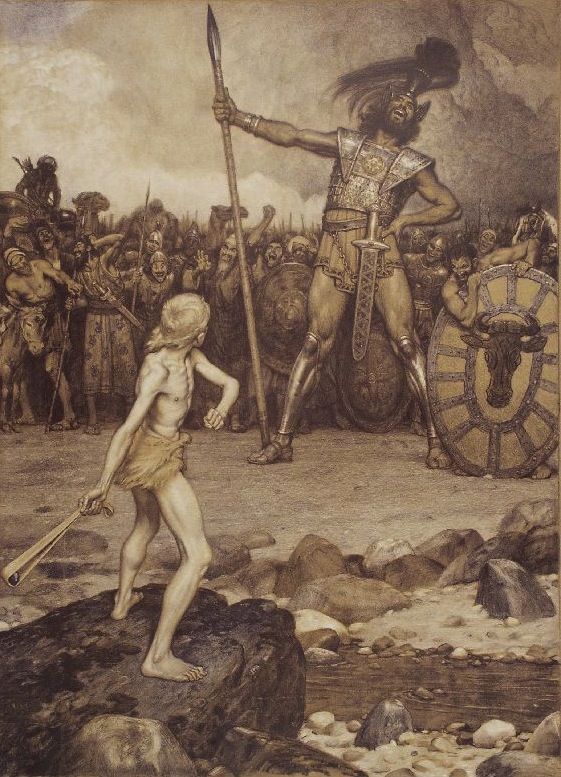
Then they fall. Caleb drives the three sons of Anak from Hebron (Josh 15:13-14). Joshua "cut off the Anakim," leaving a remnant only in Gaza, Gath, and Ashdod (Josh 11:21-22). That surviving pocket at Gath is where the line ends: Goliath, "six cubits and a span" (1 Sam 17:4), and the four men "born to the giant [Rapha] in Gath" — including one with six fingers on each hand and six toes on each foot (2 Sam 21:15-22). Amos later remembers the Amorite as one whose "height was like the height of the cedars" (Amos 2:9). The arc runs from the shepherd's stone back to Genesis 6.
Where the reading divides
The site names its posture plainly, and sets the alternatives beside it in full — because each takes the text seriously. Three readings of "the sons of God" descend from Genesis 6:2.
The Watchers / angelic view (the site's) reads bnei ha'elohim as angelic beings, consistent with its usage in Job, confirmed in force by Jude 6 and 2 Peter 2:4-5, and expanded in 1 Enoch (a labeled study resource, never treated as canon) and Josephus (Antiquities 1.3.1). The Sethite view, steelmanned, takes the sons of God as the godly line of Seth and the daughters of men as the line of Cain: the sin is covenant-breaking marriage, not angelic union, and the "mighty men" are tyrants, with no giants required. It carries Augustine's weight (City of God 15) and preserves the sexlessness of angels (cf. Matt 22:30). The dynastic view reads the sons of God as divinized kings whose sin is despotic polygamy — a minority position that fits ancient royal titulary.
The genuinely unresolved point is the post-flood reappearance of giant clans. Numbers 13:33 links the Anakim to the Nephilim but supplies no mechanism. The honest posture is to hold that seam open rather than invent a bridge the text never builds. Every claim here is Scripture or public-domain source; what cannot be sourced is left out.
Genesis 6 · two readings4
One text, two family trees
Everything turns on four words in Genesis 6:2 — the sons of God. Two readings descend from them. The site holds the Watchers view; the Sethite view is set beside it in full, because both take the text seriously and both must be met.
The site's posture
The Watchers descent
Read forward by Jude 6 and 2 Pet 2:4-5; the LXX renders the word gigantes, giants.
Steelmanned
The Sethite descent
Augustine, City of God 15; keeps angels sexless (cf. Matt 22:30).
The two witnesses
The word appears twice
Nephilim is nearly a hapax — it surfaces once before the flood and once at its far side, and the second passage reaches back to the first on purpose.
There were giants in the earth in those days; and also after that, when the sons of God came in unto the daughters of men, and they bare children to them, the same became mighty men which were of old, men of renown.The Nephilim enter — and the flood narrative begins in the next breath.
And there we saw the Nephilim, the sons of Anak, who come of the Nephilim: and we were in our own sight as grasshoppers, and so we were in their sight.The spies name the sons of Anak as descended from the Nephilim — the seam the text leaves open.
Named, then cut down
Giants through the conquest
The giant clans are not a legend that fades; they are a military obstacle that Israel meets, fears, and finally overcomes — Hebron to Gath, Caleb to David.
The witness of the brush
Rebellion and its reckoning

Held open, not settled
Where the readings divide
◈The three readings of “the sons of God”contested · Contested
Watchers / angelic (the site’s posture). Bnei ha’elohimmeans angelic beings everywhere else it occurs (Job 1:6; 2:1; 38:7). Their union produced the Nephilim and helps account for the flood’s severity. Jude 6 and 2 Pet 2:4-5 read it this way; 1 Enoch (a labeled study resource, never canon) and Josephus (Antiquities 1.3.1) expand it.
Sethite.The sons of God are the godly line of Seth, the daughters of men the line of Cain; the sin is covenant-breaking marriage, not angelic union, and the “mighty men” are tyrants. Augustine, City of God 15; it keeps angels sexless (Matt 22:30).
Dynastic / royal. The sons of God are divinized kings and nobles; the sin is despotic polygamy. Fits ancient royal titulary; a minority reading.
The post-flood puzzle — how giant clans reappear after Gen 6 — the text links but does not narrate. It is left as a seam, not smoothed over.
Keep walking