The Day of Atonement
Leviticus 16, walked in the chapter's own order — one man, one day a year, within the veil; two goats that are one offering; and the letter to the Hebrews reading the whole day as a shadow of Christ.
One man, one day, within the veil.
The point
The floorplan is the sermon: one man, once a year, never without blood — “the way into the holy place hath not yet been made manifest” (Heb 9:8).
Waypoints follow the order of service in Leviticus 16 — walked station by station below.
Framework
One day of the year
The chapter opens on a funeral: “after the death of the two sons of Aaron, when they drew near before Jehovah, and died” (Lev 16:1). The liturgy that follows is God’s answer to Nadab and Abihu — the terms on which a priest may come near and live. Its governing warning stands at the door: “that he come not at all times into the holy place within the veil” (16:2).
Once a year — “in the seventh month, on the tenth day of the month” (16:29) — one man entered the innermost room alone, and only with blood. The walk below follows the day’s service station by station, in the order the chapter itself gives it. Every verse on this page loads from the text; where a question is genuinely contested (the meaning of azazel), the positions are presented at full strength behind a labeled door and adjudicated by no one but the reader.
The day in four numbers
Everything below is counted by the chapter itself
Eight stations of one dayThe walk · in the chapter's order
The service in the order Leviticus 16 gives it — each station is the verse itself with one line of why. Every card opens its verse page; the floorplan above is the same road drawn as a map.
Station 1 of 8
The threshold warning
and Jehovah said unto Moses, Speak unto Aaron thy brother, that he come not at all times into the holy place within the veil, before the mercy-seat which is upon the ark; that he die not: for I will appear in the cloud upon the mercy-seat.
Leviticus 16:2ASV The chapter opens after the death of Nadab and Abihu (16:1) — access to God is the question this whole day answers, and it opens with a door that is shut.
Station 2 of 8
Linen, not glory
He shall put on the holy linen coat, and he shall have the linen breeches upon his flesh, and shall be girded with the linen girdle, and with the linen mitre shall he be attired: they are the holy garments; and he shall bathe his flesh in water, and put them on.
Leviticus 16:4ASV The high priest sheds the golden garments and enters washed, in plain linen — the one day of the year he dresses like a servant, not a king.
Station 3 of 8
First, his own house
And Aaron shall present the bullock of the sin-offering, which is for himself, and make atonement for himself, and for his house.
Leviticus 16:6ASV Before he can carry anyone else's sins, the priest must offer for his own — the pressure point Hebrews later leans on hardest (Heb 7:27).
Station 4 of 8
Two goats, two lots
And he shall take the two goats, and set them before Jehovah at the door of the tent of meeting. And Aaron shall cast lots upon the two goats; one lot for Jehovah, and the other lot for Azazel.
Leviticus 16:7–8ASV One lot for Jehovah, one for Azazel — yet verse 5 has already called the pair a single sin-offering. Two goats, one atonement: the hinge of the page.
Station 5 of 8
The cloud within the veil
And he shall take a censer full of coals of fire from off the altar before Jehovah, and his hands full of sweet incense beaten small, and bring it within the veil: and he shall put the incense upon the fire before Jehovah, that the cloud of the incense may cover the mercy-seat that is upon the testimony, that he die not:
Leviticus 16:12–13ASV Incense goes in before blood — even atonement approaches veiled, “that he die not.”
Station 6 of 8
Blood on the mercy-seat
and he shall take of the blood of the bullock, and sprinkle it with his finger upon the mercy-seat on the east; and before the mercy-seat shall he sprinkle of the blood with his finger seven times. Then shall he kill the goat of the sin-offering, that is for the people, and bring his blood within the veil, and do with his blood as he did with the blood of the bullock, and sprinkle it upon the mercy-seat, and before the mercy-seat:
Leviticus 16:14–15ASV The bull's blood for the priest, the goat's for the people, sprinkled on the mercy-seat seven times as the chapter counts it — the innermost act of the entire year.
Station 7 of 8
The sins walk away
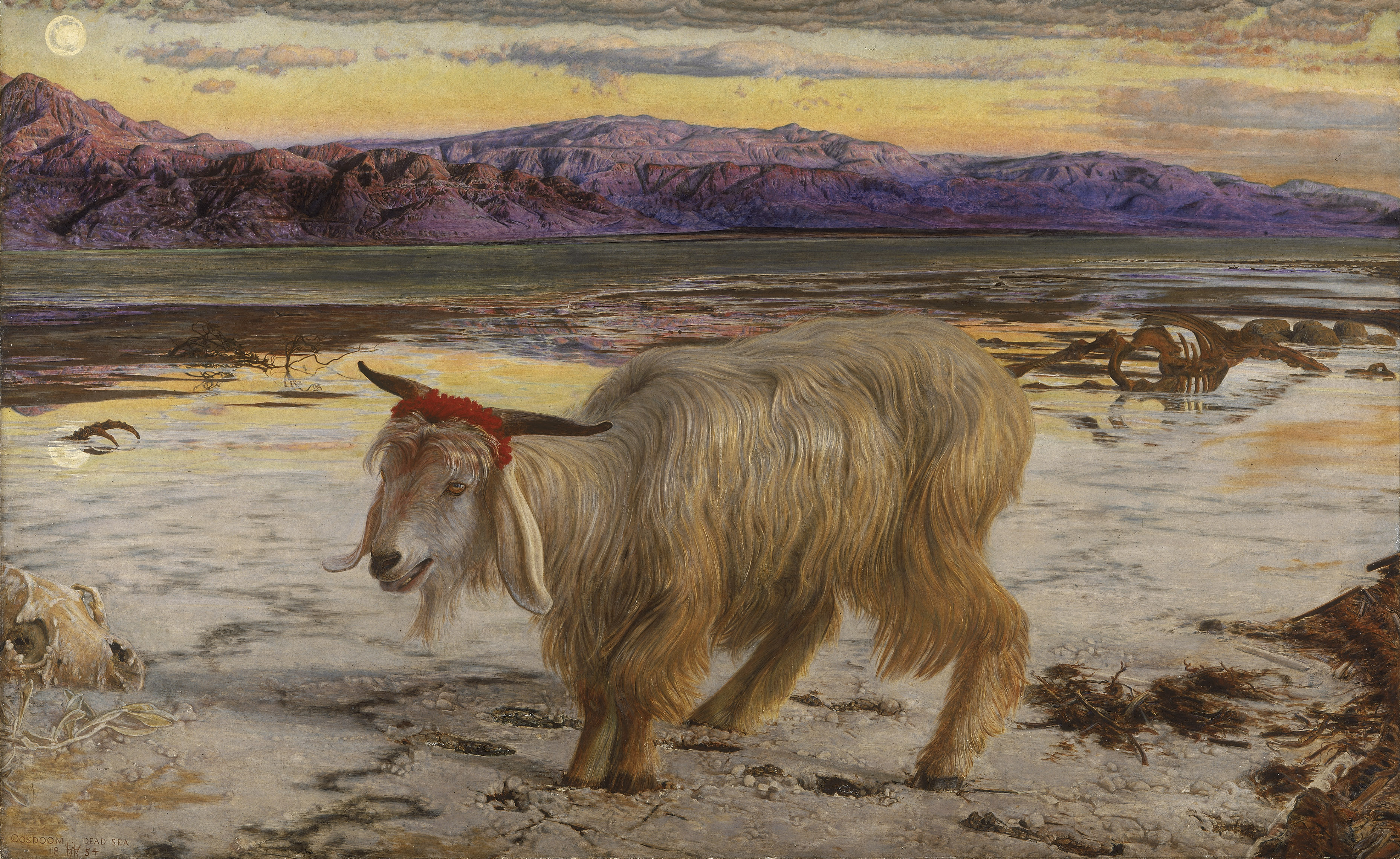
and Aaron shall lay both his hands upon the head of the live goat, and confess over him all the iniquities of the children of Israel, and all their transgressions, even all their sins; and he shall put them upon the head of the goat, and shall send him away by the hand of a man that is in readiness into the wilderness: and the goat shall bear upon him all their iniquities unto a solitary land: and he shall let go the goat in the wilderness.
Leviticus 16:21–22ASV Both hands, all the iniquities, a land apart: guilt is not only paid for at the altar — it is carried out of the camp and gone.
Station 8 of 8
A statute for ever
And it shall be a statute for ever unto you: in the seventh month, on the tenth day of the month, ye shall afflict your souls, and shall do no manner of work, the home-born, or the stranger that sojourneth among you: for on this day shall atonement be made for you, to cleanse you; from all your sins shall ye be clean before Jehovah.
Leviticus 16:29–30ASV The day returns every year — which is exactly the observation Hebrews presses: what must be repeated has not yet finished (Heb 10:1–3).
One offering, torn in half so we could watch both halvesThe two goats
Verse 5 calls the two goats a single sin-offering. One dies before Jehovah and its blood goes within the veil; the other lives, and carries every confessed iniquity out of the camp. Payment and removal — set face to face.
For Jehovah
The goat that dies
And Aaron shall present the goat upon which the lot fell for Jehovah, and offer him for a sin-offering. Then shall he kill the goat of the sin-offering, that is for the people, and bring his blood within the veil, and do with his blood as he did with the blood of the bullock, and sprinkle it upon the mercy-seat, and before the mercy-seat:
For Azazel
The goat that lives
But the goat, on which the lot fell for Azazel, shall be set alive before Jehovah, to make atonement for him, to send him away for Azazel into the wilderness. and the goat shall bear upon him all their iniquities unto a solitary land: and he shall let go the goat in the wilderness.
Leviticus 16:9, 15 (left) · 16:10, 22 (right), ASV. The spine glyph opens 16:5 — where the pair is called one offering.

What does azazel mean?A word the church still weighs
The word occurs four times in Scripture, all in this chapter. Three readings have real followings; each is given at its strongest below, attributed, and adjudicated by no one — the atlas presents, the reader weighs, and Marc plants his own flag in his own voice.
◈Azazel — three readings, steelmannedcontested · H5799 · Lev 16:8, 10, 26
1 · An abstract noun — the “escape goat”
The ancient versions read the word functionally: the Septuagint renders it apopompaios(“the one carrying away”), the Vulgate caper emissarius(“the emissary goat”) — whence Tyndale’s coinage “(e)scape goat” (1530) and the KJV’s “scapegoat.” Some parse the Hebrew as ʿēz ʾōzēl, “the goat that departs,” or an intensive “entire removal” (an option BDB lists, 1906). Its strength is the rite’s own logic: the goat exists to carry iniquity away (16:22). Its weakness: “one lot for Jehovah and the other lot for Azazel” (16:8) reads most naturally as two names in parallel.
2 · A proper name — a wilderness demon or fallen angel
The parallelism of 16:8 is this view’s engine, joined to Scripture’s own picture of the wilderness as the haunt of unclean spirits (Lev 17:7; Isa 13:21; 34:14; Matt 12:43). Second Temple tradition named Azazel chief among the fallen Watchers, and much modern scholarship follows the proper-name reading (Milgrom’s Leviticus — cite-only). The guardrail is in the text itself and both sides grant it: the goat is not a sacrifice to anyone— both goats stand “before Jehovah” (16:7), the lot alone assigns them, and the live goat is not killed for Azazel but sent away carrying sin. The rite banishes; it does not appease.
the whole earth has been corrupted through the works that were taught by Azazel: to him ascribe all sin.
1 Enoch 10:8· tr. R. H. Charles — a labeled study resource, not Scripture, 1917Second Temple
cf. Lev 16:8
draft selection — awaiting the founder’s edit
3 · A place — the jagged cliff
Rabbinic tradition took the word for the destination: a rough, rocky precipice to which the goat was led by stations (Mishnah Yoma 6; the derivation is discussed at b. Yoma 67b; Saadia Gaon read a mountain name). Its strength is that it matches attested Second-Temple practice; its weakness is that Leviticus itself says only “into the wilderness” — the cliff belongs to later custom, not to the chapter.
Sources: LXX & Vulgate at Lev 16:8 (PD); KJV (1611); ASV (1901, transliterating “Azazel”); BDB (1906, PD); Talmud Yoma (Rodkinson tr. 1903, PD); 1 Enoch (Charles tr. 1917, PD, labeled study resource); Jacob Milgrom, Leviticus (Anchor Bible) — modern, cite-only.
Four words that carry the doctrineThe workbench
Counts are live from the tagged-text floor. The last door is the bridge: the Greek OT’s word for the mercy-seat is the word the New Testament applies to Christ.
Strong's H3722102
kaphar — make atonementThe chapter's verb. Its range — cover, purge, ransom — is the whole doctrine of atonement in one root.Strong's H372727
kapporeth — the mercy-seatThe slab over the ark where the blood goes (16:14). The Greek OT renders it hilastērion — hold that thought.Strong's H57994
azazelFour occurrences in all of Scripture, every one in this chapter (16:8, 10, 26). Its meaning is the contested door above.Strong's G24352
hilastērion — mercy-seat / propitiationThe LXX's word for the mercy-seat is the word Paul applies to Christ in Romans 3:25 — the lexicon itself preaches the fulfillment.The day Hebrews readsThe fulfillment
The letter to the Hebrews walks this same floorplan and announces that every station was a shadow with a body. One column, four platforms — read them against the walk above.
but into the second the high priest alone, once in the year, not without blood, which he offereth for himself, and for the errors of the people:Hebrews' one-verse summary of Leviticus 16 — the walk above, compressed.
But Christ having come a high priest of the good things to come, through the greater and more perfect tabernacle, not made with hands, that is to say, not of this creation, nor yet through the blood of goats and calves, but through his own blood, entered in once for all into the holy place, having obtained eternal redemption.Every station kept and exceeded: a greater tent, better blood, and “once for all” where the calendar said “yearly.”
For Christ entered not into a holy place made with hands, like in pattern to the true; but into heaven itself, now to appear before the face of God for us:The floorplan's referent: not a sanctuary made with hands, but heaven itself.
Having therefore, brethren, boldness to enter into the holy place by the blood of Jesus, by the way which he dedicated for us, a new and living way, through the veil, that is to say, his flesh;Station 1's shut door becomes a doorway — the veil of the warning is now “the way which he dedicated for us.”
Shadow and body, row by rowThe ledger
Claim and receipt: the left column is Leviticus, the right is Hebrews reading it. Every reference on both sides is a door.
| The shadow (Leviticus 16) | The body (Hebrews) |
|---|---|
| Once in the year, the high priest alone Lev 16:2, 34 | “through his own blood, entered in once for all into the holy place” Heb 9:12 |
| The blood of bulls and goats Lev 16:14–15 | “it is impossible that the blood of bulls and goats should take away sins” Heb 10:4 |
| The priest offers first for his own sin Lev 16:6 | a high priest “holy, guileless, undefiled” who needs no such offering Heb 7:26–27 |
| Within the veil, behind which no man may live Lev 16:2 | a new and living way “through the veil, that is to say, his flesh” Heb 10:20 |
| The carcasses burned without the camp Lev 16:27 | “Jesus also… suffered without the gate” Heb 13:11–12 |
| The goat bears all their iniquities to a solitary land Lev 16:22 | “their sins and their iniquities will I remember no more” Heb 10:17 |
The witnessesThe voices
Public-domain witnesses are paraphrased with attribution — no verbatim quotation is rendered that has not been verified against a PD edition. Modern authors are cited only, never ingested.
Alfred Edersheim reconstructs the Second-Temple observance from Mishnah Yoma: the high priest’s seven days of preparation in the Temple, repeated immersions, the plain white linen, the two lots (of gold in the later Temple), a scarlet tongue of wool bound to the scapegoat’s horn, and the goat led east by relays of stations into the wilderness.
Alfred Edersheim, The Temple: Its Ministry and Services(1874, public domain), ch. on the Day of Atonement — paraphrase.
The Talmud preserves a striking tradition of its own: that for the forty years before the Temple’s destruction the lot “for Jehovah” ceased to come up in the right hand, and the crimson strap ceased turning white. Reported here as the Talmud’s own claim — attributed, not asserted.
b. Yoma 39b (Rodkinson tr., 1903, public domain) — paraphrase.

Sources
- Leviticus 16; 17:11; 23:26–32; Num 29:7–11; Exod 30:10; Hebrews 9–10; 13:11–12 · ASV / KJV / WEB — Public Domain; all verse text on this page loads live from the floor
- Septuagint & Vulgate at Lev 16:8 · Public Domain
- Alfred Edersheim, The Temple: Its Ministry and Services (1874) · Public Domain — paraphrase with attribution
- Mishnah Yoma; b. Yoma 39b, 67b (Rodkinson tr., 1903) · Public Domain — attributed tradition
- 1 Enoch 8–10 (R. H. Charles tr., 1917) · Public Domain — labeled study resource, never Scripture
- Gesenius (Tregelles tr.); Brown–Driver–Briggs (1906) · Public Domain — lexical options on H5799
- Jacob Milgrom, Leviticus (Anchor Bible) · in copyright — cite-only ≤50 words
- Artwork: W. Holman Hunt, The Scapegoat (1854–56); James Tissot, Agnus-Dei: The Scapegoat (c. 1886–94) and The Costume of the High Priest (1896–1901) · Public Domain — Wikimedia Commons, license verified server-side; attribution renders under each image