The Bronze Serpent
Christ's own chosen picture of his death. A four-moment story across 1,400 years: sin and plague, command and cure, idolatry and smashing, crucifixion and fulfillment.
Look, and live.
One object. 1,400 years. 3 moments — made, destroyed, fulfilled.
Look, and live.
Framework
Numbers 21 in historical and literary context
Israel on the long way around Edom (Num 20:14–21); grumbling against Moses and against God; "fiery serpents" (saraph serpents) sent; people bitten and dying. The command: make a nehash nehoshet — bronze-serpent thing — and set it on a pole. "Everyone who is bitten, when he looks at it, shall live."
Jesus' own interpretation in John 3
John 3:14–15 is the canonical interpretive key: "And as Moses lifted up the serpent in the wilderness, even so must the Son of man be lifted up: that whosoever believeth in him should not perish, but have eternal life." This is the type that Christ himself named — one of only two OT events he applies to his own death (the other being Jonah's three days, Matt 12:40).
The "lifted up" motif across John
The Greek hypsoō (ὑψόω) means both to lift up and to exalt. John uses this verb deliberately in 3:14, 8:28, and 12:32 — in each case Jesus is pointing forward to his own death as the lifting up. Crucifixion and exaltation share one verb.
The paradox: sin's symbol becomes salvation
A symbol of the curse (serpent — Eden, Satan, judgment) becomes the means of healing when lifted up. Paul unfolds the logic: Galatians 3:13 — "Christ became a curse for us"; 2 Corinthians 5:21 — "he made him who knew no sin to be sin for us"; Romans 8:3 — "in the likeness of sinful flesh."
Nehushtan — when a symbol becomes a shrine
Seven centuries later (c. 715 BC), Hezekiah finds Israel burning incense to the bronze serpent. He breaks it and gives it the mocking name Nehushtan ("Bronze Thing," 2 Kgs 18:4). The principle: a divinely-appointed symbol can become an idol when it eclipses the reality it points to. The Mishnah preserves the safeguard in its own words: "Could the serpent kill, or could the serpent keep alive? — but when Israel looked on high and subjected their heart to their Father in heaven, they were healed" (m. Rosh Hashanah 3:8).
The type and the antitype
One object across the canon, read forward. The escalation column is the point: the bronze serpent does not merely repeat in Christ — it is surpassed.
The full mirror table — six rows
| # | The type — Bronze Serpent (Num 21) | The antitype — Christ (John 3 / NT) | The escalation |
|---|---|---|---|
| 1 | Moses lifted up the serpent on a nes/pole (21:9) | “so must the Son of Man be lifted up” — hypsoō, cross + exaltation (Jn 3:14; 8:28; 12:32) | pole → cross that also enthrones |
| 2 | Look and live: “when he looketh upon it, he shall live” (21:8–9) | Believe and live: “whosoever believeth… have eternal life” (Jn 3:15) | looking = believing; bodily healing → eternal life |
| 3 | The healing image bore the likeness of the killer — a serpent (21:8; cf. Gen 3:1) | Christ “made sin” / “made a curse for us,” hanged on a tree (2 Cor 5:21; Gal 3:13) | the curse-form lifted, yet without venom / without sin |
| 4 | One serpent for all Israel; any who looked (21:8, “every one”) | One Christ; “whosoever” believes (Jn 3:15–16) | national remedy → worldwide “whosoever” |
| 5 | The venom of the fiery serpents (saraph, 21:6) | The venom of sin / the ancient serpent (Gen 3; Rev 12:9) | snakebite → the primal enmity resolved |
| 6 | Made by command, then rightly destroyed when worshiped (Nehushtan, 2 Kgs 18:4) | The antitype is worshiped rightly, forever | teaching edge: the type must never displace the God who gave it |
Source: John 3:14–15 (the NT states the type outright); ASV floor text; lens 21-typology. Explicit-NT warrant.
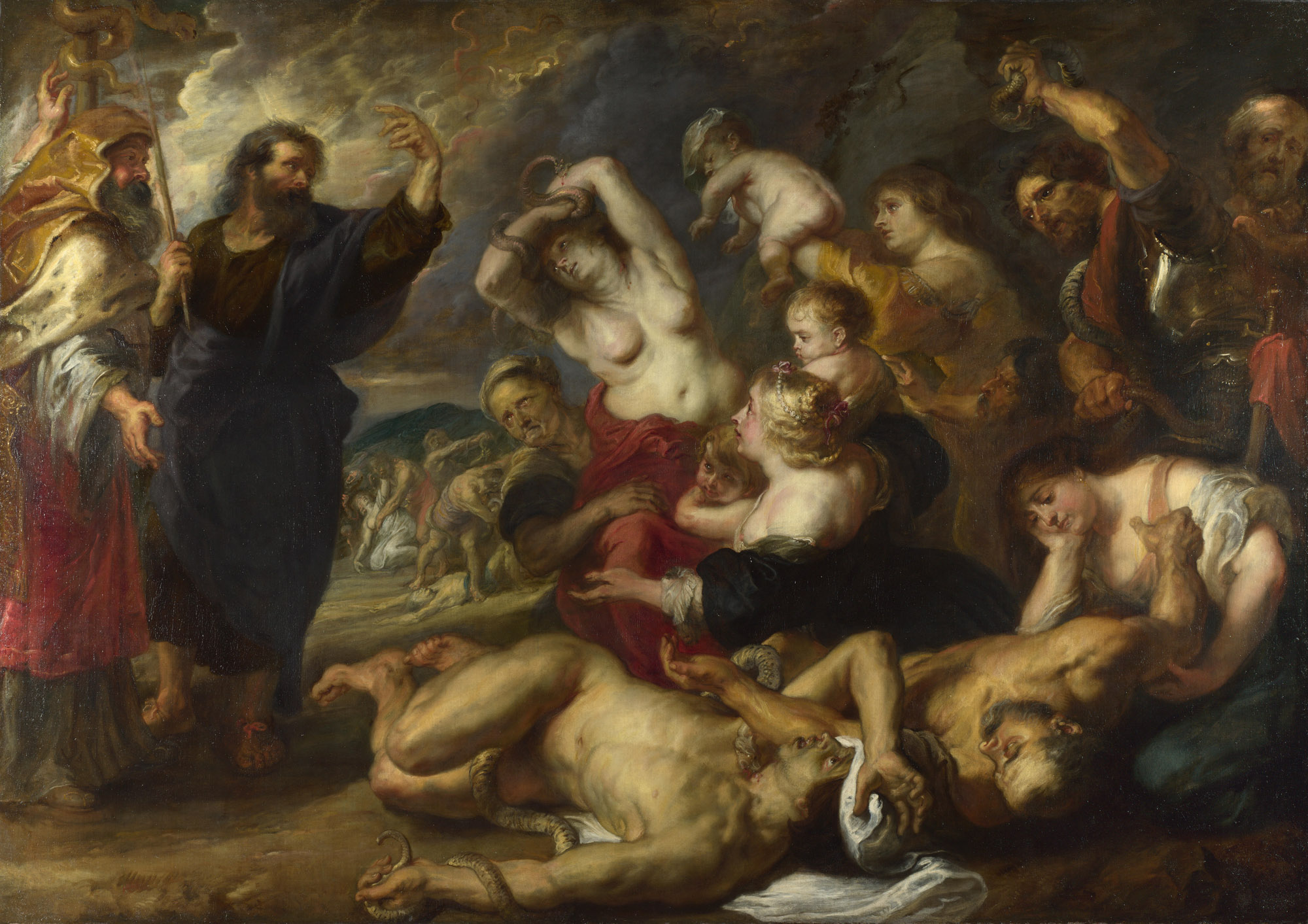
The serpent lifted, three times painted
Engraver, court painter, and watercolorist each staged the same verse — the bitten camp, the standard, the look that heals (Num 21:8–9).


The wordplay: nechash nechosheth — נְחַשׁ נְחֹשֶׁת
In the Masoretic text of Numbers 21:9 the phrase is an audible paronomasia: serpent and bronze chime on the shared consonantal sequence n-ch-sh, and the divination verb nachash(H5172) rings the same. The sound-play is real and text-supplied. The page presents the alliteration as a feature of the Hebrew and the meaning-web as a preacher’s resonance — never as lexical proof.
The etymological claim that serpent = bronze = omen-reading all descend from one root is a homiletic observation linguists treat with caution. Shared consonants are not shared meaning (compare: dynamis ≠ “dynamite”).Sources: James Barr, The Semantics of Biblical Language (1961); D. A. Carson, Exegetical Fallacies (2nd ed. 1996) — “root fallacy” and “illegitimate totality transfer.” Cite-only.
The word doors
Seven doors into the workbench. Occurrence counts are live from the tagged floor.
- נָחָשׁH5175nachash — serpent
The object itself (Num 21:9); first occurs Gen 3:1 — the Eden-serpent thread.
31 tagged occurrences in the floorOpen the workbench → - נְחֹשֶׁתH5178nechosheth — copper / bronze / brass
The material (Num 21:9); with H5175 forms nechash nechosheth, “serpent of bronze.”
140 tagged occurrences in the floorOpen the workbench → - נָחַשׁH5172nachash (verb) — to practice divination / observe omens
The third n-ch-sh resonance. Surfaces as a caution chip — not a claim.
◈ caution chip — see above11 tagged occurrences in the floorOpen the workbench → - שָׂרָףH8314saraph — “fiery (serpent)” / burning one / seraph
Num 21:6, 21:8 — the fiery serpents; the same word as the seraphim of Isa 6:2. God says make a saraph; Moses makes it of nechosheth.
7 tagged occurrences in the floorOpen the workbench → - נֵסH5251nes — standard / pole / banner / ensign
Num 21:8–9 “set it upon a pole”; the lift-up imagery is in the Hebrew (cf. Isa 11:10, the root of Jesse as a nes for the nations).
21 tagged occurrences in the floorOpen the workbench → - ὑψόωG5312hypsoō — to lift up / exalt
John 3:14 — the double meaning: raised on the cross AND exalted (Jn 8:28; 12:32–34).
20 tagged occurrences in the floorOpen the workbench → - ὄφιςG3789ophis — serpent
John 3:14 (LXX word for serpent); binds the Num 21 serpent to Rev 12:9’s “that old serpent.”
13 tagged occurrences in the floorOpen the workbench →
The witnesses
How the earliest readers heard the lifted serpent — the Christian typological reading, and the Jewish “not the object but God” reading, both attributed, neither flattened.
“And it seems that the type and sign, which was erected to counteract the serpents which bit Israel, was intended for the salvation of those who believe that death was declared to come thereafter on the serpent through Him that would be crucified, but salvation to those who had been bitten by him and had betaken themselves to Him that sent His Son into the world to be crucified.”
“was it not God who commanded by Moses that no image or likeness of anything which was in heaven above or which was on the earth should be made, and yet who caused the brazen serpent to be made by Moses in the wilderness, and set it up for a sign by which those bitten by serpents were saved?”
“Moses then makes a brazen serpent, and places it upon a beam, and by proclamation assembles the people. … Thou hast in this also [an indication of] the glory of Jesus; for in Him and to Him are all things.”
How the synagogue read it (steelmanned)
“The bronze serpent was “a symbol of salvation”; he that turned toward it was saved “not by that which he beheld, but by thee, the Saviour of all.””
“Did the serpent kill, or did the serpent keep alive? Rather, when Israel looked upward and subjected their heart to their Father in heaven, they were healed.”
◈Can a God-given means of grace itself become an idol?contested · the teaching edge
The claim. A God-commanded means of grace — the bronze serpent, made at God’s own word — can itself drift into an idol, and must then be destroyed. Roughly 500–700 years separate the making (the wilderness) from the breaking (Hezekiah’s reform); by then Israel “did burn incense to it.”
The assumption it answers. The reflexive belief that anything God once blessed stays holy of itself. Scripture supplies both sides: the veneration and its judgment sit in the same verse.
Both cited. 2 Kings 18:4 — Hezekiah “brake in pieces the brazen serpent that Moses had made; for unto those days the children of Israel did burn incense to it; and he called it Nehushtan.” Justin Martyr (Dial. 94, above) frames the image-command tension from the Christian side; Wisdom 16:7 and m. Rosh Hashanah 3:8 (above) supply the Jewish “not the object but God” reading. No adjudication is fabricated — the text and the witnesses carry it.
Sources: 2 Kgs 18:4 (ASV floor); Justin Martyr, Dial. 94 (ANF vol. 1, PD); Wisdom of Solomon 16:5–7 (Brenton, PD); m. Rosh Hashanah 3:8. This is Marc’s drawer — the founder’s framing is written and gated separately.
The real Hezekiah
The reformer who broke Nehushtan is not a devotional abstraction. He is a datable king (c. 726–697 BC), externally anchored — a David-benchmarked reformer (2 Kgs 18:3) whose reign left traces in stone and clay. Cite-only facts:
Sennacherib’s Prisms (the Taylor & Oriental Institute prisms) record the 701 BC campaign against Judah — Hezekiah “shut up like a bird in a cage” in Jerusalem.
D. D. Luckenbill, The Annals of Sennacherib (OIP 2, 1924) — public domain.
The Lachish reliefs from Sennacherib’s palace at Nineveh depict the Assyrian siege of Lachish, corroborating the same campaign.
British Museum Assyrian galleries; excavated by A. H. Layard, 1840s.
The Ophel Hezekiah bulla — wet-sifted 2009, scientifically excavated (distinguish sharply from unprovenanced market bullae) — reads “Belonging to Hezekiah [son of] Ahaz king of Judah.”
E. Mazar, R. Reich et al., “A Hezekiah Bulla from the Ophel,” The Ophel Excavations (2015).
Sources
- Biblical text (floor): ASV / STEPBible TAHOT+TAGNT tagged words (CC BY 4.0; text PD); verse_words live corpus; lexicon_entries.
- Justin Martyr, Dialogue with Trypho 91, 94 — ANF vol. 1 (Roberts-Donaldson, 1885), PD.
- Epistle of Barnabas 12 — ANF vol. 1 (Roberts tr.), PD.
- Wisdom of Solomon 16:5–7 — Brenton LXX/Apocrypha (1851), PD (labeled study resource).
- Mishnah Rosh Hashanah 3:8 — Tannaitic; PD-licensed translation to be sourced before publish.
- James Barr, The Semantics of Biblical Language (1961); D. A. Carson, Exegetical Fallacies (2nd ed. 1996) — root-fallacy guardrail, cite-only.
- D. D. Luckenbill, The Annals of Sennacherib (OIP 2, 1924), PD; E. Mazar et al., The Ophel Excavations (2015).
- Beale & Carson (eds.), Commentary on the NT Use of the OT (2007); Richard B. Hays, Echoes of Scripture (1989/2016); Burke O. Long, 1 Kings (FOTL, 1984) — cite-only.