Revelation
The Bible's only book that blesses the one who reads it — an unveiling woven line by line from the prophets.
Framework
An unveiling, not a riddle
The book names itself in its first word: apokalypsis (G602), an "unveiling" or disclosure. It does not exist to conceal but to pull back the curtain on the risen Christ and the end of the story. John received it exiled on Patmos, "in the Spirit on the Lord's day" (Rev 1:9-10, ASV), and Irenaeus places the vision "towards the end of Domitian's reign" — about AD 95 (Against Heresies 5.30.3).
Alone among the sixty-six books, Revelation pronounces a blessing on its own reader: "Blessed is he that readeth, and they that hear the words of the prophecy, and keep those things which are written therein" (Rev 1:3). It was written to be read aloud in the churches and obeyed, not decoded as a puzzle.
The surface architecture is a cascade of sevens — seven churches (Rev 2-3), seven seals (Rev 6-8), seven trumpets (Rev 8-11), and seven bowls (Rev 16), framed by seven blessings across the book. Four times John writes that he was "in the Spirit" (1:10; 4:2; 17:3; 21:10), and each phrase opens a fresh vantage: the lampstands, the throne, the beast, and finally the bride and the city. Read those four hinges as a constellation and the shape of the whole becomes visible.
Steeped in the Old Testament
No book of the New Testament leans harder on the Hebrew Scriptures — and none is quieter about it. Revelation never uses a citation formula; it never says "as it is written." Yet H. B. Swete, cataloguing the allusions in The Apocalypse of St John (1906, Introduction), found that of the book's 404 verses, 278 carry echoes of the Old Testament. The UBS Greek New Testament's allusion index lists over five hundred such echoes and references.
The sources are concentrated. Daniel supplies the "one like unto a son of man" and the beasts from the sea; Ezekiel gives the throne-chariot, the scroll John eats, and the measuring of the temple; Isaiah furnishes the new heavens and new earth; Zechariah the horsemen and the pierced one; and the Psalms the songs of the redeemed. John does not copy — he re-forges. Images that were prophecy become fulfillment, gathered around the Lamb.
That Greek word for the Lamb, arnion (G721), is John's signature title for Christ, recurring some twenty-eight times in the book — the slain Lamb who alone is worthy to open the sealed scroll (Rev 5). The density of allusion is itself the argument: Revelation is the canon's final chapter answering its first, Eden restored as a city with the tree of life at its center (Rev 22).
Four ways the church has read it
Since the earliest centuries, believers have read Revelation through four honest frameworks, each anchored in the text.
The preterist reading takes the visions as largely first-century — Roman persecution and the fall of Jerusalem — pressing the book's own claim that these things "must shortly come to pass" (Rev 1:1; 22:10). The historicist reading, favored by Wycliffe and the Reformers, sees an unrolling map of church history, the seals and trumpets marking successive eras. The futurist reading holds that from chapter 4 onward the visions are still future: a coming tribulation, the beast, and the return of Christ. The idealist reading treats the symbols as the timeless conflict of God and evil rather than datable events, honoring the book's recapitulating, poetic form.
Revelation 20 adds a further division over the thousand years — premillennial (Christ returns before the millennium), amillennial (a symbolic present reign), and postmillennial (a golden age before the return). MannaFest holds the premillennial view as its posture, not as the only defensible one: it was the reading of Justin Martyr and of Irenaeus (Against Heresies 5.32-36) in the ante-Nicene church.
Every framework, however it maps the middle, arrives at the same harbor — a new heaven and new earth, and the throne of God and of the Lamb (Rev 21-22).
Four movements, one unveiling4
The shape of the Apocalypse
Four times John writes that he was “in the Spirit” (1:10; 4:2; 17:3; 21:10). Each phrase opens a new vantage. Read them as four stars and the book’s structure appears — from lampstands, to throne, to beast, to city.
Woven from the prophets
No book quotes Scripture more — and cites it less
Revelation never once uses a citation formula, yet the majority of its verses echo Daniel, Ezekiel, Isaiah, Zechariah, and the Psalms (Swete, The Apocalypse of St John, 1906, Introduction).
- 404versesthe shortest apocalypse
- 278carry OT allusionsSwete, Introduction
- 500+echoes cataloguedUBS allusion index
- 0formal quotationsit never says 'it is written'
The only book that blesses its reader
Blessed is he that readeth, and they that hear the words of the prophecy, and keep those things which are written therein: for the time is at hand.Alone among the sixty-six books, Revelation pronounces a blessing on the one who reads it aloud and the ones who hear.
The seals opened
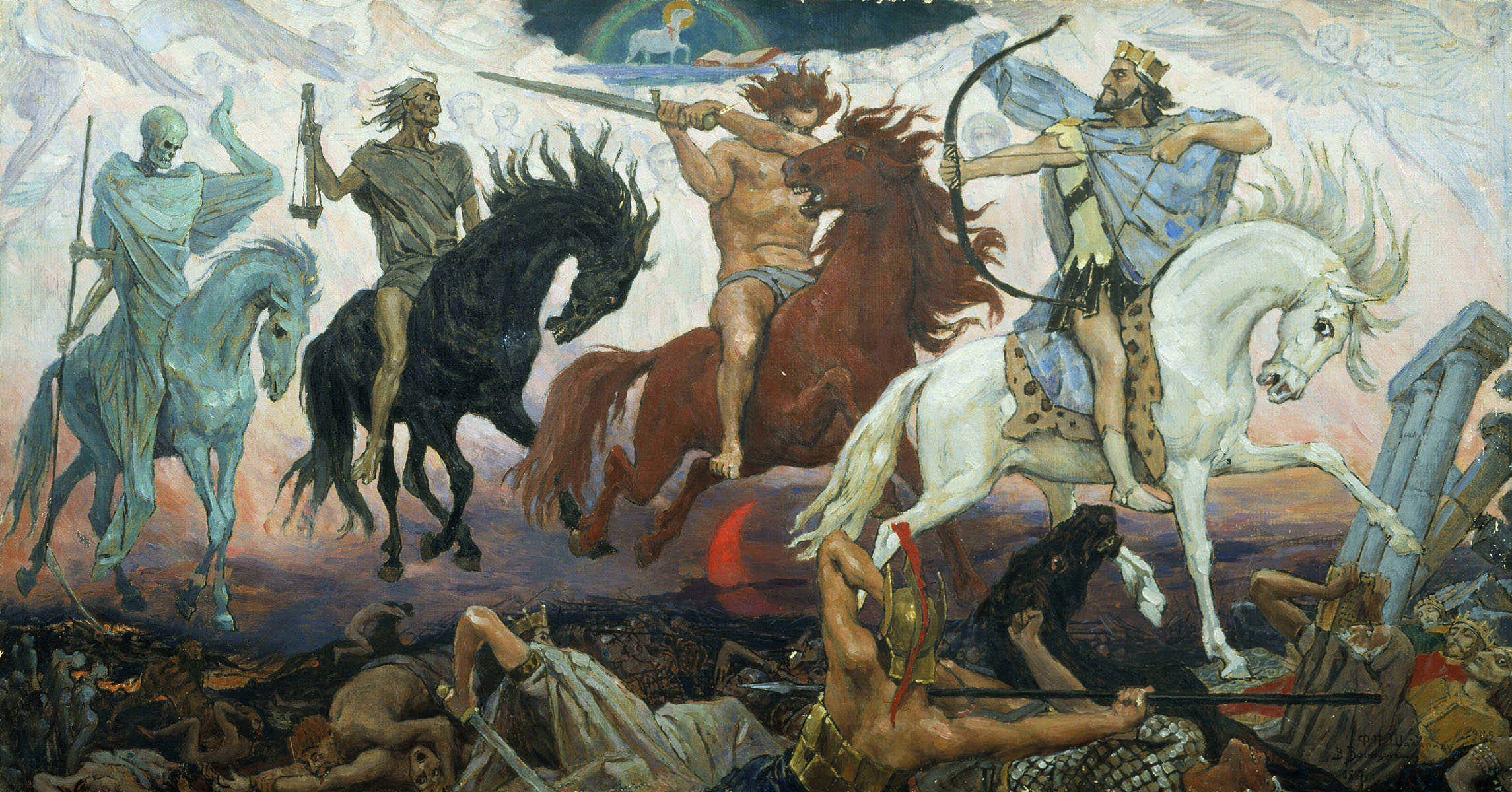
Conquest, war, famine, death
The four riders of the first four seals (Rev 6:1-8) became the most-painted image in the book — the Lamb, not Caesar, holds the scroll that sets history in motion.
Three sevens of judgment3
Seals, trumpets, bowls
Whether the three series run in sequence or recapitulate the same span is the hinge between the interpretive frameworks below — but the architecture of sevens is plain on the surface.
How the church has read it
Four frameworks, one text
◈Preterist · Historicist · Futurist · Idealistcontested · Contested — four honest readings
Preterist:the visions largely describe first-century realities — Roman persecution and the fall of Jerusalem (AD 70). It leans on the book’s own insistence that these things “must shortly come to pass” (1:1, 22:10).
Historicist: an unrolling map of church history from John to the end — the reading of Wycliffe and the Reformers, taking the seals, trumpets, and bowls as successive eras.
Futurist: from chapter 4 onward the visions are still future — a coming tribulation, beast, and return of Christ.
Idealist:the symbols portray the timeless conflict of God and evil rather than datable events, honoring the book’s recapitulating, poetic form.
On the millennium (Rev 20)premillennial, amillennial, and postmillennial readings divide over the thousand years.
Site posturepremillennial — Christ returns before the thousand years, the reading of Justin and Irenaeus (Against Heresies 5.32-36). Held as the site’s posture, not as the only view.
When it was seen
For that was seen no very long time since, but almost in our own day, towards the end of Domitian's reign.
Irenaeus· Against Heresies 5.30.3, c. 180Ante-Nicene · public domain
Follow the threads4
Where to go from here
Lens
The Old Testament beneath RevelationTrace the 500+ echoes of Daniel, Ezekiel, Isaiah, and the Psalms that build every vision.Quotations & allusionsLens
The architecture of sevensSeven churches, seals, trumpets, and bowls — how the book is built.StructuresReader
Read RevelationStart at the throne of the Son of man among the lampstands.Chapter 1Verse
The new heaven and new earthWhere every framework arrives: the city, the river, and the tree of life restored.Revelation 21-22Full commentary corpora are studied privately and never republished; every claim here is sourced in-text. See the typology lens for how the Lamb, the city, and the tree fulfill the whole canon.